Michael Chabon - Telegraph Avenue
Здесь есть возможность читать онлайн «Michael Chabon - Telegraph Avenue» — ознакомительный отрывок электронной книги совершенно бесплатно, а после прочтения отрывка купить полную версию. В некоторых случаях можно слушать аудио, скачать через торрент в формате fb2 и присутствует краткое содержание. Город: New York, Год выпуска: 2012, ISBN: 2012, Издательство: Harper, Жанр: Современная проза, на английском языке. Описание произведения, (предисловие) а так же отзывы посетителей доступны на портале библиотеки ЛибКат.
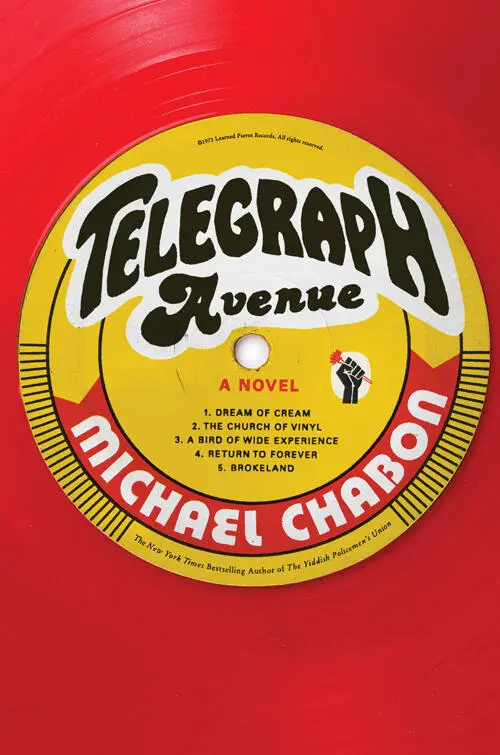
- Название:Telegraph Avenue
- Автор:
- Издательство:Harper
- Жанр:
- Год:2012
- Город:New York
- ISBN:978-0-06-149334-8
- Рейтинг книги:3.5 / 5. Голосов: 2
-
Избранное:Добавить в избранное
- Отзывы:
-
Ваша оценка:
Telegraph Avenue: краткое содержание, описание и аннотация
Предлагаем к чтению аннотацию, описание, краткое содержание или предисловие (зависит от того, что написал сам автор книги «Telegraph Avenue»). Если вы не нашли необходимую информацию о книге — напишите в комментариях, мы постараемся отыскать её.
When ex–NFL quarterback Gibson Goode, the fifth-richest black man in America, announces plans to build his latest Dogpile megastore on a nearby stretch of Telegraph Avenue, Nat and Archy fear it means certain doom for their vulnerable little enterprise. Meanwhile, Aviva and Gwen also find themselves caught up in a battle for their professional existence, one that tests the limits of their friendship. Adding another layer of complication to the couples’ already tangled lives is the surprise appearance of Titus Joyner, the teenage son Archy has never acknowledged and the love of fifteen-year-old Julius Jaffe’s life.
An intimate epic, a NorCal
set to the funky beat of classic vinyl soul-jazz and pulsing with a virtuosic, pyrotechnical style all its own,
is the great American novel we’ve been waiting for. Generous, imaginative, funny, moving, thrilling, humane, triumphant, it is Michael Chabon’s most dazzling book yet.
Telegraph Avenue — читать онлайн ознакомительный отрывок
Ниже представлен текст книги, разбитый по страницам. Система сохранения места последней прочитанной страницы, позволяет с удобством читать онлайн бесплатно книгу «Telegraph Avenue», без необходимости каждый раз заново искать на чём Вы остановились. Поставьте закладку, и сможете в любой момент перейти на страницу, на которой закончили чтение.
Интервал:
Закладка:
“Except Gibson Goode, right?”
“Whatever,” his father said. “Man has a right to sell what he wants, where he wants. Bring him on. Meanwhile, you. Cheer up. You got two more weeks of summer to get through.”
With a wan crackle, the Field of Silence fluttered back to life between them.
And he tried. But before he could tell us he died.
His father closed the door. Julie listened for the creak of his passage down the twisting stair.
The narrow, mirrored door of the old art deco chifforobe swung open, betraying the folded articulate span, half dressed in pressed blue jeans, of Titus Joyner.
“Yo yo yo,” Titus said. Bit by careful bit, he took himself out of the chifforobe and reassembled himself on the floor of Julie’s bedroom, a hit man snapping together the pieces of his rifle. He looked tired. He smelled like the locker room at the Y. “Five more minutes,” he said.
He unrolled himself along the floor of Julie’s room, on the coiled braids of a rag rug, and stretched out. He closed his eyes; his breathing turned solemn and slowed the rise and fall of his chest. He was a prodigy of furtive and impromptu sleep. The nightly bed that fate had furnished him was a zone of danger and dark insomnia. If you closed your eyes in that unsafe house, they would rifle your nightmares and violate your dreams.
“Titus,” Julie said. “Yo, T.”
Nothing; gone. Julie pulled the quilt from his bed and laid it over Titus. It was an antique of the ’80s, Michael Jackson in a tacky spacesuit with a motley crew of robots and aliens. Julie stared at the boy on his floor, a mystery boy fallen from the sky like the Wold Newton meteorite, apparently inert and yet invisibly seething with the mutagenic information of distant galaxies and exploding stars.
Julie was in love.
The title of the course, offered through the summer evening enrichment program of the city of Berkeley’s Southside Senior Center, was “Sampling as Revenge: Source and Allusion in Kill Bill .” It was scheduled to meet every Monday for ten weeks through August, amid the folding furniture of a beige multipurpose room where, in the past, Julie had taken classes in puppet making, clay sculpture, and ikebana. Always the youngest in the room by decades, half centuries, and happier there among the elderly than ever seemed possible in the company of his so-called peers.
That first Monday in June, a week after his graduation from Willard, Julie had taken his seat in the front row of five chairs at the exact center of the room, midway between the video projector and Peter Van Eder, whom Julie had always imagined, from his irritated tone in the Berkeley Daily Bugle , to be this one pudgy bald gentleman with aviator glasses and a square-tipped knit tie whom he would see from time to time at the California, glumly suffering the opening night of Planet of the Apes (perhaps the greatest disappointment in the movie life of Julie Jaffe, a mad Tim Burton fan) or Steamboy (another tragic dud). But Van Eder turned out to be a bony young guy not far past college age. Big Adam’s apple, big wrist bones, one shirttail untucked, his hair long and stringy and flecked with dandruff or ash from his cigarettes or both. On his chin, a hasty pencil sketch of a goatee.
Julie took a glue stick and a bright orange notebook, quadrille-ruled, out of a Pan Am flight bag. Neatly, he folded and glued to the inside front cover the syllabus of films that Peter Van Eder proposed to screen and discuss:
Lady Snowblood (1973) d Toshiya Fujita
The Doll Squad (1973) d Ted V. Mikels
The Good, the Bad and the Ugly (1966) d Sergio Leone
Female Convict Scorpion: Jailhouse 41 (1972) d Shunya Ito
Ghetto Hitman (1974) d Larry Cohen
The Tale of Zatoichi (1962) Kenji Misumi
The Band Wagon (1953) d Vincente Minnelli
A Clockwork Orange (1971) d Stanley Kubrick
36th Chamber of Shaolin (1978) d Gordon Liu
Coffy (1973) d Jack Hill
Julie studied the syllabus as Van Eder waited for the last two names on his roster, one of them, Julie was interested to learn, being Randall Jones. Mr. Jones had both given and attended classes at the Southside Senior Center, and it was through him, a few years ago, that Julie had learned of the puppet-making class. Mr. Jones, whose taste in film ran strongly to violent western and crime, was a regular attendee of Peter Van Eder’s film series at the Southside.
Julie found himself dizzied by his ignorance of Van Eder’s choices, only two of which, the Sergio Leone and The Band Wagon , he had seen. Unless, as seemed likely, there was another movie called The Band Wagon , because The Band Wagon that Julie had watched with his maternal grandparents one Christmas in Coconut Creek, Florida, was a delicious musical with Fred Astaire and Cyd Charisse, whose thighs stirred ancient and somewhat distressing longings in Grandpa Roth. A couple of the other titles and directors were familiar. Zatoichi. Kubrick, duh.
Somebody said, “Look at the bird !”
Cochise Jones, wearing a leisure suit with a faded houndstooth check, stepped into the multipurpose room with Fifty-Eight manning the poop deck of his left shoulder, trailing a kid, perhaps a grandson, about Julie’s age, light-skinned, light-eyed, broad at the shoulder, and slender at the hips. Though as far as Julie knew, Mr. Jones didn’t have any family apart from the bird. When he noticed Julie, he frowned, looking thoughtful, hesitating, as if trying to make up his mind about bringing over the kid to meet Julie.
“He a friend of Fifty-Eight,” Mr. Jones explained straight-faced, apparently deciding that no harm could come of the introduction. “Also a fan of Mr. Tarantino.” Only he pronounced the name as if it rhymed with “Tipitina.”
“Hey,” said Julie, twisting a finger in the tattered selvage of his denim cutoffs until the blood ceased to circulate in his fingertip. His index finger in its noose of cotton thread swelled and pulsed and throbbed and in general served as symbol or synecdoche for its owner and his fourteen-year-old heart, for that all-encompassing, all-expanding disturbance in his skinny little chest that was the love of Tarantino, the world, or all mankind. “I like him, too.”
Titus Joyner nodded, mildly amused (if that) by the spectacle of Julie in his cutoffs and sleeveless T, his portable eight-track on the floor by his feet in their clear white jellies, with his bright blue flight bag like one of the moon stewardesses in 2001 . He didn’t say anything. A slender, loose- and long-limbed kid, skin the color of a Peet’s soy latte. Hair worn in a neat, modest Afro with an air of studied retroism. Eyes wary, derisive, cold apart from that ghost of amusement, or maybe it was a flicker of recognition, as if he thought he knew how best to label Julie. Cleft chin. Clothes neat and spotless: dark jeans, short-sleeved, button-down oxford-cloth shirt. Nothing fancy, but somehow the crisp white shirt and the sharp creases ironed into the front of his trouser legs gave him an air of formality. On his feet he wore those imperial star-destroyer kicks.
“What’s up?” he said.
Julie took a card, newly printed, from his wallet, and passed it to the kid, one that read:
JULIUS L. JAFFE
Ronin ·HIRED BLADE
The look of mockery was still on the kid’s face as he studied the card, but he studied it. Slipped it into a pocket of his jeans. Then went to the back of the room to scatter his limbs across an upholstered armchair tucked into a corner.
“I’m sorry, sir.” It was one of the other students, a man in a wheelchair, speaking through a robo-box. Julie had seen the guy racing around Temescal, in the neighborhood of Brokeland, his body a toy in the paws of some brutal ailment. His voice came sparking through its Hawking box. “Sir? I’m sorry, but I have a bird allergy.”
Читать дальшеИнтервал:
Закладка:
Похожие книги на «Telegraph Avenue»
Представляем Вашему вниманию похожие книги на «Telegraph Avenue» списком для выбора. Мы отобрали схожую по названию и смыслу литературу в надежде предоставить читателям больше вариантов отыскать новые, интересные, ещё непрочитанные произведения.







Обсуждение, отзывы о книге «Telegraph Avenue» и просто собственные мнения читателей. Оставьте ваши комментарии, напишите, что Вы думаете о произведении, его смысле или главных героях. Укажите что конкретно понравилось, а что нет, и почему Вы так считаете.