Arthur Hailey - Wheels
Здесь есть возможность читать онлайн «Arthur Hailey - Wheels» весь текст электронной книги совершенно бесплатно (целиком полную версию без сокращений). В некоторых случаях можно слушать аудио, скачать через торрент в формате fb2 и присутствует краткое содержание. Жанр: Современная проза, на английском языке. Описание произведения, (предисловие) а так же отзывы посетителей доступны на портале библиотеки ЛибКат.
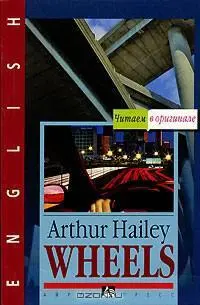
- Название:Wheels
- Автор:
- Жанр:
- Год:неизвестен
- ISBN:нет данных
- Рейтинг книги:5 / 5. Голосов: 1
-
Избранное:Добавить в избранное
- Отзывы:
-
Ваша оценка:
Wheels: краткое содержание, описание и аннотация
Предлагаем к чтению аннотацию, описание, краткое содержание или предисловие (зависит от того, что написал сам автор книги «Wheels»). Если вы не нашли необходимую информацию о книге — напишите в комментариях, мы постараемся отыскать её.
Wheels — читать онлайн бесплатно полную книгу (весь текст) целиком
Ниже представлен текст книги, разбитый по страницам. Система сохранения места последней прочитанной страницы, позволяет с удобством читать онлайн бесплатно книгу «Wheels», без необходимости каждый раз заново искать на чём Вы остановились. Поставьте закладку, и сможете в любой момент перейти на страницу, на которой закончили чтение.
Интервал:
Закладка:
Questions followed. Brett answered frankly. When possible, design students were fed these privileged tidbits, like heady bait, to keep their interest high. However, Brett was careful to fold and pocket his drawings afterward.
As students drifted back to classes, the courtyard session broke up. For the remainder of his time at the Art Center College of Design - through the same day and the next - Brett delivered a formal lecture, interviewed automotive design students individually, and critically appraised experimental car models which student teams had designed and built.
An instinct among this crop of students, Brett discovered, was toward severity of design, allied with function and utility. Curiously, it had been a similar combination of ideas agreed to by Brett, Adam Trenton, Elroy Braithwaite and the others, on the memorable night, two and a half months earlier, when the initial concept for Farstar had emerged. Through the time he had already spent on early Farstar designs, still being labored over in a closely guarded studio at Detroit, and now here, Brett was struck by the aptness of Adam's phrase: Ugly is Beautiful!
History showed that artistic trends - the latticework of all commercial designing - always began subtly and often when least expected. No one knew why artistic tastes changed, or how, or when the next development would come; it seemed simply that human virtuosity and perception were restless, ready to move on. Observing the students' work now - ignoring a degree of naivety and imperfection - and remembering his own designs of recent months, Brett felt an exhilaration at being part of an obviously fresh, emerging trend.
Some of his enthusiasm, it seemed, transmitted itself to students whom he interviewed during his second day at the school. Following the interviews, Brett decided to recommend two potential graduates to the company Personnel and Organization staff for eventual hiring. One was the short, swarthy student, Harvey, who had argued forcefully in the courtyard; his design portfolio showed an ability and imagination well above average.
Whichever auto company he worked for, Harvey was probably headed for trouble and collisions in Detroit. He was an original thinker, a maverick who would not be silenced, or dissuaded easily from strong opinions.
Fortunately, while not always heeding mavericks, the auto industry encouraged them, knowing their value as a hedge against complacent thinking.
Whatever happened, Brett suspected, Detroit and Harvey would find each other interesting.
The other candidate he chose was the gangling youth with untidy blond hair whose talent, too, was obviously large. Brett's suggestion of future employment, so the student said, was the second approach made to him. Another auto firm among the Big Three had already promised him a design job, if he wanted it, on graduation.
"But if there's any chance of working near you, Mr. DeLosanto," the young man said, "I'll go with your company for sure."
Brett was touched, and flattered, but uncertain how to answer.
His uncertainty was based on a decision reached, alone in his Los Angeles hotel room, the previous night. It was now mid-August, and Brett had decided: at year end, unless something happened drastically to change his mind, he would quit the auto industry for good.
On the way back East, by air, be made another decision: Barbara Zaleski would be the first to know.
Chapter 22
Also in August - while Brett DeLosanto was in California - the Detroit assembly plant, where Matt Zaleski was assistant plant manager, was in a state of chaos.
Two weeks earlier, production of cars had ceased. Specialist contractors had promptly moved in, their assignment to dismantle the old assembly line and create a new one on which the Orion would be built.
Four weeks had been allotted for the task. At the end of it, the first production Orion - job One - would roll off the line, then, in the three or four weeks following, a backlog of cars would be created, ready to meet expected demands after official Orion introduction day in September.
After that, if sales prognostications held, the tempo would increase, with Orions flowing from the plant in tens of thousands.
Of the time allowed for plant conversion, two weeks remained and, as always at model changeover time, Matt Zaleski wondered if he would survive them.
Most of the assembly plant's normal labor force was either laid off or enjoying paid vacations, so that only a skeleton staff of hourly paid employees reported in each day. But far from the shutdown making the life of Matt Zaleski and others of the plant management group easier, work loads increased, anxieties multiplied, until an ordinary production day seemed, by comparison, an unruffled sea.
The contractor's staff, like an occupying army, was demanding. So were company headquarters engineers who were advising, assisting, and sometimes hindering the contractors.
The plant manager, Val Reiskind, and Matt were caught in a crossfire of requests for information, hurried conferences, and orders, the latter usually requiring instant execution. Matt handled most matters which involved practical running of the plant, Reiskind being young and new.
He had replaced the previous plant manager, McKernon, only a few months earlier and while the new man's engineering and business diplomas were impressive, he lacked Matt's seasoned know-how acquired during twenty years on the job. Despite Matt's disappointment at failing to get McKernon's job, and having a younger man brought in over him, he liked Reiskind who was smart enough to be aware of his own deficiency and treated Matt decently.
Most headaches centered around new, sophisticated machine tools for assembly, which in theory worked well, but in practice often didn't.
Technically, it was the contractor who was responsible for making the whole system function, but Matt Zaleski knew that when contractor's men were gone, he would inherit any inadequate situation they might leave.
Therefore he stayed close to the action now.
The greatest enemy of all was time. There was never enough to make a changeover work so smoothly that by preassigned completion date it could be said: "All systems go!" It was like building a house which was never ready on the day set for moving in, except that a house move could be postponed, whereas a car or truck production schedule seldom was.
An unexpected development also added to Matt's burdens. An inventory audit, before production of the previous year's models ceased, had revealed stock shortages so huge as to touch off a major investigation.
Losses from theft at any auto plant were always heavy. With thousands of workers changing shifts at the same time, it was a simple matter for thieves - either employees or walk-in intruders - to carry stolen items out.
But this time a major theft ring was obviously at work. Among items missing were more than three hundred four-speed transmissions, hundreds of tires, as well as substantial quantities of radios, tape players, air conditioners, and other components.
As an aftermath, the plant swarmed with security staff and outside detectives. Matt, though not remotely implicated, had been obliged to spend hours answering detectives' questions about plant procedure. So far there appeared to be no break in the case, though the Chief of Security told Matt, "We have some ideas, and there are a few of your line workers we want to interrogate when they come back." Meanwhile the detectives remained underfoot, their presence one more irritant at an arduous time.
Despite everything, Matt had come through so far, except for a small incident concerning himself which fortunately went unnoticed by anyone important at the plant.
He had been in his office the previous Saturday afternoon, seven-day work weeks being normal during model changeover, and one of the older secretaries, Iris Einfeld, who was also working, had brought him coffee.
Читать дальшеИнтервал:
Закладка:
Похожие книги на «Wheels»
Представляем Вашему вниманию похожие книги на «Wheels» списком для выбора. Мы отобрали схожую по названию и смыслу литературу в надежде предоставить читателям больше вариантов отыскать новые, интересные, ещё непрочитанные произведения.




Обсуждение, отзывы о книге «Wheels» и просто собственные мнения читателей. Оставьте ваши комментарии, напишите, что Вы думаете о произведении, его смысле или главных героях. Укажите что конкретно понравилось, а что нет, и почему Вы так считаете.