Arthur Hailey - Strong Medicine
Здесь есть возможность читать онлайн «Arthur Hailey - Strong Medicine» весь текст электронной книги совершенно бесплатно (целиком полную версию без сокращений). В некоторых случаях можно слушать аудио, скачать через торрент в формате fb2 и присутствует краткое содержание. Жанр: Современная проза, на английском языке. Описание произведения, (предисловие) а так же отзывы посетителей доступны на портале библиотеки ЛибКат.
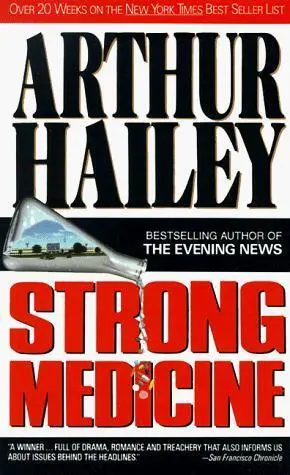
- Название:Strong Medicine
- Автор:
- Жанр:
- Год:неизвестен
- ISBN:нет данных
- Рейтинг книги:5 / 5. Голосов: 1
-
Избранное:Добавить в избранное
- Отзывы:
-
Ваша оценка:
Strong Medicine: краткое содержание, описание и аннотация
Предлагаем к чтению аннотацию, описание, краткое содержание или предисловие (зависит от того, что написал сам автор книги «Strong Medicine»). Если вы не нашли необходимую информацию о книге — напишите в комментариях, мы постараемся отыскать её.
Strong Medicine — читать онлайн бесплатно полную книгу (весь текст) целиком
Ниже представлен текст книги, разбитый по страницам. Система сохранения места последней прочитанной страницы, позволяет с удобством читать онлайн бесплатно книгу «Strong Medicine», без необходимости каждый раз заново искать на чём Вы остановились. Поставьте закладку, и сможете в любой момент перейти на страницу, на которой закончили чтение.
Интервал:
Закладка:
Dr. Stavely had already gone back to the paper she had been reading when Celia came in. She glanced up.”Good afternoon, Jordan.”
"Good afternoon," Celia said, and went out through the dismal offices to the equally dismal street outside.
Later in the afternoon, driving herself back from Manhattan to Morristown, Celia reflected on the nature of Dr. Stavely. Certainly Stavely was dedicated but also, to an extent, obsessed. It was equally clear that she was lacking in a sense of humor, unable to regard herself with less than total seriousness. Celia had met such people before; it was always hard to involve them in a thoughtful, objective conversation. They were so accustomed to thinking in black-and-white, antagonistic terms that they found it impossible to switch antagonism off and think in the shades of gray where much of life was lived. On the other hand, the CSM chairperson was clearly well informed, articulate, well organized, and had a keen, possibly brilliant mind. Her medical qualifications gave her stature and an automatic right to be heard on the subject of prescription drugs. Some of her views, too, were not all that far removed from Celia's, who remembered, fourteen years ago, describing "me-too" drugs and -molecular roulette" in much the same way as Stavely. It was Sam Hawthorne who, at that earlier time, had offered the arguments in response which Celia had used this afternoon. And despite using them, she was still not wholly convinced they were valid. But Stavely did become unbalanced when emphasizing the pharmaceutical industry's negative aspects while ignoring the many positive, humanitarian contributions to science and health the industry provided. Celia had once heard the United States drug industry described as "a national treasure," and believed the description was, on the whole, true. There was also Stavely's naive and absurd contention that drug research should be government controlled, and her gross misinformation and prejudice about Montayne. But all in all, Stavely and CSM were formidable opponents, neither to be ignored nor to be taken lightly. One thing Stavely had caught her out in, Celia thought ruefully, was the fact that Celia had not read the transcript of the Australian trial involving Montayne. Next week she intended to correct that omission, Still later that day, at dinner, Celia described her CSM experience and views to Andrew and he, as usual, had some wisdom to contribute. "You may not find those activist people-Maud Stavely, Sidney Wolfe, Ralph Nader and the others-easy to live with, and at times you may detest them," Andrew said.”But you need them, your industry needs them, just the way General Motors and the other auto companies needed Nader before he alighted on the scene. Nader helped make automobiles-for all of us-better and safer because of his needling and 1, for one, am grateful. Now, Stavely and Wolfe are keeping you and your people on your toes.”
"I admit it.”
Celia sighed.”But if only they were all more moderate and reasonable!" Andrew shook his head.”If they were that, they wouldn't be successful activists. Another thing-when they're ruthless and unethical, as they can be sometimes, you should ask yourself: where did they learn to be that way? The answer is: from companies like yours, my dear, because, when no one was watching them, ruthless and unethical is the way they were.”
Celia would have appreciated Andrew's last remark more if she had witnessed a scene at the Citizens for Safer Medicine offices a few minutes after she left on Friday afternoon. Summoning an assistant, Dr. Stavely asked, "Has that woman who was with me gone?" When the answer was yes, Stavely instructed the young man, "I want a press conference called for tomorrow morning-as early as you can arrange it. You will say that the subject is an urgent, life-and-death matter affecting hospitals and patients. Make sure you get the television networks and press wire services. There'll be a news release to be issued at the same time, which I'm going to write now. Someone will have to work tonight to...”
The brisk, efficient instructions continued, and at 10 A.M. next morning the press conference began. Facing reporters, and on camera, Dr. Stavely described the IN. fluid problem she had discussed with Celia the preceding day-the bacteria-contaminated bottles and the resultant septicemia, believed responsible for several deaths. What the CSM leader did not mention was either Celia or the information Celia had given her, namely that the FDA had already decided to forbid further use of all existing IN. fluid supplies from the company concerned, and that an announcement to that effect would be made on Monday. Instead, Stavely declared, "Citizens for Safer Medicine deplores the inaction both of the Food and Drug Administration and the manufacturer of this potentially deadly material. Further, we demand-yes, demand!-that all supplies of this IN. fluid be banned from use-and recalled . - .”
The effect was immediate. The major TV networks carried the story on their evening national news, while next day's Sunday newspapers gave it prominence, in many cases using an Associated Press photo of Stavely in action. Thus on Monday, when FDA delivered its announcement, most reporters-not bothering to check-began their stories, "Today, responding swiftly to a demand by Dr. Maud Stavely and her Citizens for Safer Medicine, the FDA announced a ban on further use by hospitals of...”
It was a triumphal coup d’état for CSM and, soon afterward, was used prominently in a mailed brochure appealing for donations. Celia, who followed the sequence of events with some embarrassment, kept the knowledge of her own involvement to herself. She had learned a lesson. She had, she realized, been foolishly indiscreet, and then had been made use of by a master tactician.
To Celia's surprise there was not, anywhere at Felding-Roth headquarters, a trial transcript of the Australian court case which had involved Montayne. Nor could the company's legal department locate one in the United States. There were plenty of reports that quoted it, but now Celia wanted to read the proceedings in their entirety. Although, obviously, Maud Stavely had a copy, Celia felt disinclined to ask Citizens for Safer Medicine to lend it; she therefore instructed the legal department to cable a correspondent law firm in Australia and have one sent by air. Meanwhile there were plenty of other things to do. The promotional program that would launch Montayne was now proceeding at a frantic tempo as the February deadline neared. Celia, aided by her deputy, Bill Ingram, was responsible for the several million dollars spent already; still more money was allocated for the months ahead. Elaborate advertising--expensive four-page multicolor inserts was appearing in a profusion of medical magazines, while an avalanche of direct mail was going out to the nation's physicians and pharmacists. Among promotional items being sent was a cassette tape--on one side, a recording of the beautiful Brahms "Wiegenlied" (Lullaby), on the other, a clinical description of Montayne. Backing up the advertising and direct mail, the company's detail men and women were delivering thousands of sample packages of Montayne to doctors, at the same time dropping on their desks golf tees and ball markers imprinted with "Montayne.”
At all levels of the company, as with any new drug launching. there was a mix of excitement, circus, nervousness and hope. Also creating hope, in an even wider dimension, was some news from the Felding-Roth Research Institute in Britain. There, it seemed, Martin Peat-Smith's scientific team had successfully broken through the technical barrier which had baffled them for so long. Complete details were lacking-Martin's report had been brief and in general terms only-but it appeared the now demolished barrier was the one of which Dr. Rao Sastri had said, when talking with Celia eighteen months earlier, "There are no techniques to take us further... possibly in ten years from now
Читать дальшеИнтервал:
Закладка:
Похожие книги на «Strong Medicine»
Представляем Вашему вниманию похожие книги на «Strong Medicine» списком для выбора. Мы отобрали схожую по названию и смыслу литературу в надежде предоставить читателям больше вариантов отыскать новые, интересные, ещё непрочитанные произведения.









Обсуждение, отзывы о книге «Strong Medicine» и просто собственные мнения читателей. Оставьте ваши комментарии, напишите, что Вы думаете о произведении, его смысле или главных героях. Укажите что конкретно понравилось, а что нет, и почему Вы так считаете.