Arthur Hailey - Evening News
Здесь есть возможность читать онлайн «Arthur Hailey - Evening News» весь текст электронной книги совершенно бесплатно (целиком полную версию без сокращений). В некоторых случаях можно слушать аудио, скачать через торрент в формате fb2 и присутствует краткое содержание. Жанр: Современная проза, на английском языке. Описание произведения, (предисловие) а так же отзывы посетителей доступны на портале библиотеки ЛибКат.
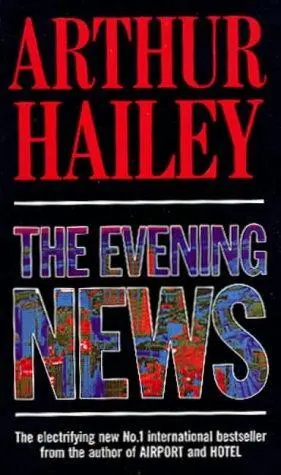
- Название:Evening News
- Автор:
- Жанр:
- Год:неизвестен
- ISBN:нет данных
- Рейтинг книги:3.5 / 5. Голосов: 2
-
Избранное:Добавить в избранное
- Отзывы:
-
Ваша оценка:
Evening News: краткое содержание, описание и аннотация
Предлагаем к чтению аннотацию, описание, краткое содержание или предисловие (зависит от того, что написал сам автор книги «Evening News»). Если вы не нашли необходимую информацию о книге — напишите в комментариях, мы постараемся отыскать её.
Evening News — читать онлайн бесплатно полную книгу (весь текст) целиком
Ниже представлен текст книги, разбитый по страницам. Система сохранения места последней прочитанной страницы, позволяет с удобством читать онлайн бесплатно книгу «Evening News», без необходимости каждый раз заново искать на чём Вы остановились. Поставьте закладку, и сможете в любой момент перейти на страницу, на которой закончили чтение.
Интервал:
Закладка:
Obviously, because physical evidence was involved at the Hackensack house, the FBI must be advised of the discovery certainly before broadcast time tonight.
”Sure we'll tell the FBI,” Kettering said.”But first I'd like to take a look at what's under that ground, if anything.”
"There are some shovels in the furnace room,” Mony said.
”Get them,” Kettering told him.”We're all healthy. Let's start digging.”
A short time later it became evident that what they were opening was not a grave. Instead it was a repository of discarded items left by the property's recent occupants and presumably intended to stay hidden. Some things were innocuous —food supplies, clothing, toilet objects, newspapers. Others were more significant—additional medical supplies, maps, some Spanish-language paperback books and automotive tools.
”We know they had a fleet of trucks and cars,” Jaeger said.”Maybe the FBI will find out what they did with them—if it matters at this point.”
"I don't think any of this matters right now,” Kettering ruled.”Let's quit.”
During the digging, videotaping had been started—initially a sound bite by Cokie Vale describing her search of classified advertising and how it led to the Hackensack house. On camera she was personable, expressed herself clearly and was economical with words. It would be her first appearance on television, she acknowledged afterward. Those watching had an instinct it would not be her last.
Jonathan Mony, it was felt, had earned some camera exposure too and repeated his showing of the upstairs room where the kidnapped trio had almost certainly been held. He also was effective.
”If this endeavor's done nothing else,” Jaeger commented to Don Kettering, "it's brought us some new talent.”
Mony, having returned from the house, was down in the excavated hole and had resumed digging when Kettering made the decision to quit. About to climb out, Mony felt his foot touch something solid and probed with his shovel. A moment later he had pulled out an object and called, "Hey, look at this!”
It was a cellular phone in a canvas outer cover.
Passing up the phone to Cooper, Mony said, "I think there's another underneath.”
Not only was there another, but four more after that. Soon the six were laid out, side by side.
”The people who used this place weren't short of money,” Cokie observed.
”Chances are it was drug money; anyway, they had plenty,” Don Kettering told her. He regarded the phones thoughtfully.”But maybe—just maybe we're getting somewhere.”
Jaeger asked, "Are records kept of all cellular phone calls?”
"Sure are.” Kettering, who as business correspondent had recently done a news feature on the booming cellular phone market, answered confidently.”There are also lots of other records including a regular phone user's name and billing address. For these the gang needed a local accomplice.” He turned to Cooper.”Teddy, on each phone there'll be an area code followed by a regular number, just as on a house or office line.”
"I'm tuned in,” Cooper said.”You'd like me to make a list?”
"Please!”
While Cooper worked, they continued videotaping the house and buildings. In a correspondent's standup, Kettering said:
“Some may believe discovery of the abandoned American base of the kidnappers is, at this point, too little too late. That may be true. But meanwhile the FBI and others will sift evidence found here while the world watches anxiously, continuing to hope.”
"Don Kettering, CBA News, Hackensack, New Jersey."
Before leaving, they called in the local police, asking them to inform the FBI.
* * *
Even before the National Evening News went on the air, Kettering had telephoned a friend high in NYNEX Corporation, operators of the New York and New Jersey telephone systems. Holding in his hand the list of numbers compiled by Teddy Cooper, Kettering explained what he needed—the name and address of the person or persons to whom the six telephones were registered, plus a list of all calls made to or from those numbers during the past two months.
”You realize, of course,” his friend—an executive vice president—informed him, "that not only would giving you that information be a violation of privacy, but I would be acting illegally and could lose my job. Now, if you were an investigative agency with a warrant—”
“I'm not and I can't be,” Kettering replied.”However, it's a safe bet the FBI will be asking for the same information tomorrow and they'll have one. All I want are those answers first.”
"Oh my god! How did I get mixed up with a character like you?”
"Since you ask, I remember your wanting a favor from CBA once or twice and I delivered. Come on! We've trusted each other since business school and never regretted it.”
At the other end, a sigh.”Give me the damn numbers.”
After Kettering had recited the list, his friend continued, "You said the FBI tomorrow. I suppose that means you need to know tonight.”
"Yes, but any time this side of midnight. You can call me at home. You have the number?”
"Unfortunately, yes.”
* * *
The call came at 10:45 P.m., just after Don Kettering arrived at his East Seventy-seventh Street apartment, having stayed late at CBA. His wife, Aimee, answered, then handed him the phone.
”I saw your news this evening,” his NYNEX friend said.”I presume those cellular numbers you gave me are those used by the kidnappers.”
"It looks that way,” Kettering acknowledged.
”In that case, I wish I had more for you. There isn't a lot. First, the phones are all registered to a Helga Efferen. I have an address.”
"I doubt if it's current. The lady's dead. Murdered. I hope she didn't owe you money.”
"Jesus! You news guys are cold-blooded.” After a pause, the NYNEX man went on, "About the money, it's actually the reverse. Right after numbers were issued for those phones, someone made a deposit of five hundred dollars for each account—three thousand dollars in all. We didn't ask for it, but it went on the books as a credit.”
Kettering said, "I imagine the people using the phones didn't want anyone sending bills or asking awkward questions until they were safely out of the country.”
"Well, for whatever reason, most of the money's still there. Less than a third was used and that's because, with one exception, all calls were solely between the six phones and not to other numbers. Local interphone calls get charged, but not all that heavily.”
“Everything points to the kidnappers' organization and discipline,” Kettering affirmed.”But you said there was an exception.”
"Yes—on September 13, an international direct-dial call to Peru.”
"That's the day before the kidnap. Do you have a number?”
"Of course. It was 011—that's the international access code—51, which is Peru, then 14-28-9427. My people tell me that '14' is Lima. Exactly where is something you'll have to find out.”
"I'm sure we will. And thanks!”
"I hope some of that helps. Good luck!”
Moments later, after consulting a notebook, Kettering tapped out a number for another call: 011-51-14-44-1212.
When a voice answered, " Buenas tardes , Cesar's Hotel,” Kettering requested, "Mr. Harry Partridge, por favor.”
8
It had been a discouraging day for Harry Partridge. He was tired and, in his hotel suite, had gone to bed shortly before ten o'clock. But his thoughts were still churning. He was brooding on Peru.
The whole country, he thought, was a paradox—a conflicting mixture of military despotism and free democracy. In much of the republic's remoter regions the military and so-called antiterrorist police ruled with steel fists and frequent disregard of law. They were apt to kill wantonly, afterward labeling their victims "rebels,” even when they were not—as independent inquiry often showed.
Читать дальшеИнтервал:
Закладка:
Похожие книги на «Evening News»
Представляем Вашему вниманию похожие книги на «Evening News» списком для выбора. Мы отобрали схожую по названию и смыслу литературу в надежде предоставить читателям больше вариантов отыскать новые, интересные, ещё непрочитанные произведения.










Обсуждение, отзывы о книге «Evening News» и просто собственные мнения читателей. Оставьте ваши комментарии, напишите, что Вы думаете о произведении, его смысле или главных героях. Укажите что конкретно понравилось, а что нет, и почему Вы так считаете.