John Hawkes - The Blood Oranges
Здесь есть возможность читать онлайн «John Hawkes - The Blood Oranges» весь текст электронной книги совершенно бесплатно (целиком полную версию без сокращений). В некоторых случаях можно слушать аудио, скачать через торрент в формате fb2 и присутствует краткое содержание. Жанр: Современная проза, на английском языке. Описание произведения, (предисловие) а так же отзывы посетителей доступны на портале библиотеки ЛибКат.
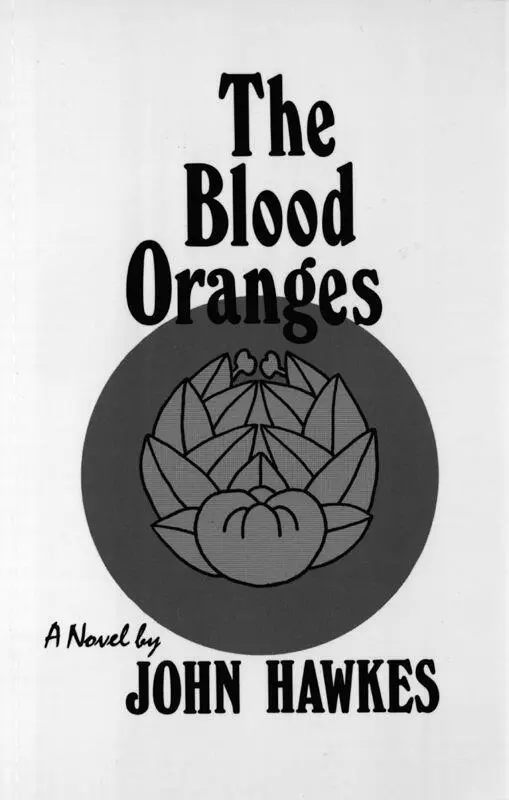
- Название:The Blood Oranges
- Автор:
- Жанр:
- Год:неизвестен
- ISBN:нет данных
- Рейтинг книги:5 / 5. Голосов: 1
-
Избранное:Добавить в избранное
- Отзывы:
-
Ваша оценка:
The Blood Oranges: краткое содержание, описание и аннотация
Предлагаем к чтению аннотацию, описание, краткое содержание или предисловие (зависит от того, что написал сам автор книги «The Blood Oranges»). Если вы не нашли необходимую информацию о книге — напишите в комментариях, мы постараемся отыскать её.
"Need I insist that the only enemy of the mature marriage is monogamy? That anything less than sexual multiplicity. . is naive? That our sexual selves are merely idylers in a vast wood?" Thus the central theme of John Hawkes's widely acclaimed novel
is boldly asserted by its narrator, Cyril, the archetypal multisexualist. Likening himself to a white bull on Love's tapestry, he pursues his romantic vision in a primitive Mediterranean landscape. There two couples — Cyril and Fiona, Hugh and Catherine — mingle their loves in an "lllyria" that brings to mind the equally timeless countryside of Shakespeare's
.
Yet no synopsis or comparison can convey the novel's lyric comedy or, indeed, its sinister power — sinister because of the strength of will Cyril exerts over his wife, his mistress, his wife's reluctant lover; lyric, since he is also a “sex-singer" in the land where music is the food of love.
The Blood Oranges — читать онлайн бесплатно полную книгу (весь текст) целиком
Ниже представлен текст книги, разбитый по страницам. Система сохранения места последней прочитанной страницы, позволяет с удобством читать онлайн бесплатно книгу «The Blood Oranges», без необходимости каждый раз заново искать на чём Вы остановились. Поставьте закладку, и сможете в любой момент перейти на страницу, на которой закончили чтение.
Интервал:
Закладка:
“That’s enough, now. Please.”
“What’s wrong?”
“Just stop being Cyril a minute, can’t you?”
“You’re the one who’s puzzled, Fiona, not me.”
“It’s just that he was doing something funny with that hand of his. I began to feel it. He was making me uncomfortable, and I didn’t know why. I was conscious of something a little different and I couldn’t get it out of my mind. I was beginning to lose what you call my crispness, baby, I was beginning to smile the way I do when I’m not sure what’s happening. He was making me think, he was making me fish around inside for a little clue about what he was doing and how I was supposed to respond. It was such a small thing, and yet suddenly I couldn’t think about him or me but just about what he was doing back there with that hand of his. Not him, but his hand. Not me, but my behind. It wasn’t exactly a tickling, but it wasn’t sweet. I was uncertain, baby, uncertain. I whispered something to him, but he didn’t care. I tried to move, but it didn’t matter. I wasn’t unhappy, just uncertain. Uncomfortable but interested. And then I got the idea, because he was pulling on me. Just pulling on me. He wasn’t rough, he wasn’t tender. Just holding half my little melon as hard as he could and pulling. He forgot me, baby. He forgot himself. And I did too. Because suddenly I got the idea that he must be working in collusion with some great big lovely satyr with hair all over his shanks and a lot of experience with little girls’ behinds. But he wasn’t. There was no satyr. Nothing.”
“Nothing?”
“No, baby. Nothing at all.”
“Poor Fiona.”
“Now I can’t think of anything else. Who’ll be my satyr — you?”
“Shaggy shoulders, horns, a lot of experience. OK?”
“You’re fun, baby, you really are.”
AFTER ALL, I TOLD MYSELF, IT HAD BEEN A LONG HOTdawn, and emerging now from the dragon’s mouth of the dark green cypresses, I found myself once more in this mild extremity of a familiar mood. There was no longer any point in being dressed for the night, everything about me revealed the pointlessness of a garb that had already served its purpose. The dressing gown untied and hanging open like a pair of splendid maroon-colored silken sails bereft of wind, the carefully tended hair uncombed and rumpled, the clear eyes cloudy, the fresh mouth numbed with fading taste, the cord of the pajama bottoms no longer tied in a perfect bow but sleepily knotted, the feet unaccountably bare, and brows furrowed, hands in pockets, no message on lips that were nonetheless working together in sensual emptiness, not even a cigarette to prolong the vaporous moment — all this told me that the negative account was full and that my usual and fastidious preparations of only a few hours past were now used up.
Catherine was no doubt sleeping. And Hugh? Fiona? The villa concealed on the other side of the wall of cypress trees behind me was dark, the villa lying directly ahead was also dark, concealing what contented faces or whispering mouths I could not predict. Would I hear them? Glimpse them? Join them? Or merely feel my way into a trysting place that would prove white and shadowy and empty after all? Was I, a lover, seeking the companionship of two more lovers or near lovers who might be thickly awake and just as interested as I was in a few moments of drowsy speech? I could not be sure.
I felt the dew on the soles of my feet, I saw myself sitting on the edge of Catherine’s bed and fumbling, as I had, with spectacles but not with tennis shoes. I smiled to think that the spectacles were crooked on the bridge of my nose, smiled to think that for once I had deviated from my usual habits and had walked among the pines and beside the dark sea, had returned without special purpose to Catherine’s villa. I had pushed my way through the cypress trees, had strolled in the lemon grove that fanned out soft and silent at the edge of our lives. Why, I asked myself. Why? And replied with another smile, a keener appreciation of the weight of the silk now dragging down my shoulders and brushing my calves.
Voices. One of the children demanding comfort from Catherine? But no, I told myself, walking squarely through the scented darkness that separated trees and villa, and feeling the irises growing large in eyes no longer as lackluster and heavy lidded as they had felt in the first portion of this wasted dawn — no, the voices were not high enough or querulous enough for the children’s. Thoughtfully I approached the rotten shutter locked open on the night and darkness within, avoiding stealth I approached so close to the irregular oblong of Catherine’s window that I might have peered inside, had I so desired. I stopped. I listened. I was close enough to see the morning-glories twining in the broken slats of the shutter, and yet even now the voices inside the familiar room were muffled, unclear, loud with intimacy but indistinct. I recognized the burden of the dialogue if not the words, and suddenly recognized the voices themselves because one was tired, insistent, reluctant, and belonged to Catherine, while the other was ingratiating, importuning, and obviously issued from a dry throat that could only be Hugh’s.
But Hugh? Bare-chested? Fresh from his own trampled garden and wide-awake? Was that really Hugh in there, in this late hour sprawled across a sagging bed more mine than his? Hugh propped up on his one good eager arm and filled with clumsy confidence, talking to Catherine as he had never talked to Fiona, Hugh now singing his happy but constricted version of my sweet song? No doubt of it, I told myself, our paths were crossing, and I moved closer.
I listened. I asked myself what was unusual about this pattern of sounds. I followed the rhythms of Catherine’s voice, the rhythms of Hugh’s, and then I understood. Even before I heard any actual words I understood that Catherine was employing a variety of defensive responses, whereas Hugh was saying the same words again and again as if the ease with which he had apparently shifted from Fiona’s stimulation to Catherine’s struggle justified his use of repetition. But why had Fiona let him go? Why must Catherine struggle?
I could not make out any of Catherine’s negative phrases, and decided that she was hiding her face, speaking into the pillow. But no matter, I told myself, since Catherine’s declamations came readily to mind (those words and phrases of conventional denial), and since what most concerned me now, as a matter of fact, was the precise content of what Hugh was saying, the exact nature of those particular words which had borne the freight of his sexual needs for all the years of his marriage.
For a mere instant he raised his voice. For an instant I heard him as clearly as if Hugh had popped his head out of the window and spoken not for Catherine’s benefit but mine.
“Don’t be afraid of Daddy Bear,” he was saying, “don’t be afraid of Daddy Bear …"
So this was what we had bargained for, Fiona and Catherine and I — this sad and presumptuous appeal from a man who had spent all the nights of his marriage fishing for the love of his wife with the hook of a nursery persona. The dew was a cold bath on the soles of my feet. My shoulders were heavy, my hands were more than ever resigned to the large pockets of the indifferent silk dressing gown. Instantly Hugh’s voice sank, subsided, once more rumbled along its subterranean road. The translation went hand in hand with the sounds of his voice, simple text and desperate message were one in my ear, and it took no great effort to identify the source of his words. Of course, I told myself, the honeymoon. What else if not a few words stolen in desperation from the vocabulary of the cheapest myth of childhood and spoken aloud unwittingly but successfully into Catherine’s ear in the first surge of crisis? Yes, I told myself, those words had worked, had carried Hugh with surprise and relief across that first rough spot of Catherine’s ignorance and thereafter had become the only lyrics to his monogamous song.
Читать дальшеИнтервал:
Закладка:
Похожие книги на «The Blood Oranges»
Представляем Вашему вниманию похожие книги на «The Blood Oranges» списком для выбора. Мы отобрали схожую по названию и смыслу литературу в надежде предоставить читателям больше вариантов отыскать новые, интересные, ещё непрочитанные произведения.


Обсуждение, отзывы о книге «The Blood Oranges» и просто собственные мнения читателей. Оставьте ваши комментарии, напишите, что Вы думаете о произведении, его смысле или главных героях. Укажите что конкретно понравилось, а что нет, и почему Вы так считаете.