John Hawkes - The Blood Oranges
Здесь есть возможность читать онлайн «John Hawkes - The Blood Oranges» весь текст электронной книги совершенно бесплатно (целиком полную версию без сокращений). В некоторых случаях можно слушать аудио, скачать через торрент в формате fb2 и присутствует краткое содержание. Жанр: Современная проза, на английском языке. Описание произведения, (предисловие) а так же отзывы посетителей доступны на портале библиотеки ЛибКат.
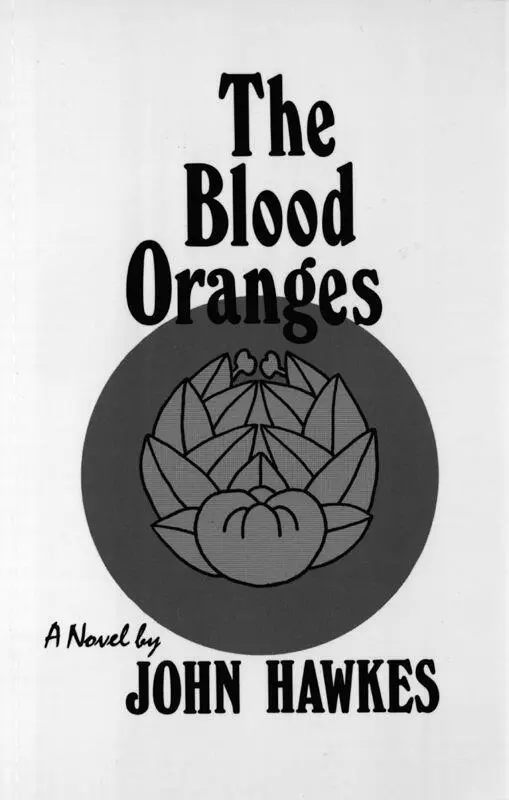
- Название:The Blood Oranges
- Автор:
- Жанр:
- Год:неизвестен
- ISBN:нет данных
- Рейтинг книги:5 / 5. Голосов: 1
-
Избранное:Добавить в избранное
- Отзывы:
-
Ваша оценка:
The Blood Oranges: краткое содержание, описание и аннотация
Предлагаем к чтению аннотацию, описание, краткое содержание или предисловие (зависит от того, что написал сам автор книги «The Blood Oranges»). Если вы не нашли необходимую информацию о книге — напишите в комментариях, мы постараемся отыскать её.
"Need I insist that the only enemy of the mature marriage is monogamy? That anything less than sexual multiplicity. . is naive? That our sexual selves are merely idylers in a vast wood?" Thus the central theme of John Hawkes's widely acclaimed novel
is boldly asserted by its narrator, Cyril, the archetypal multisexualist. Likening himself to a white bull on Love's tapestry, he pursues his romantic vision in a primitive Mediterranean landscape. There two couples — Cyril and Fiona, Hugh and Catherine — mingle their loves in an "lllyria" that brings to mind the equally timeless countryside of Shakespeare's
.
Yet no synopsis or comparison can convey the novel's lyric comedy or, indeed, its sinister power — sinister because of the strength of will Cyril exerts over his wife, his mistress, his wife's reluctant lover; lyric, since he is also a “sex-singer" in the land where music is the food of love.
The Blood Oranges — читать онлайн бесплатно полную книгу (весь текст) целиком
Ниже представлен текст книги, разбитый по страницам. Система сохранения места последней прочитанной страницы, позволяет с удобством читать онлайн бесплатно книгу «The Blood Oranges», без необходимости каждый раз заново искать на чём Вы остановились. Поставьте закладку, и сможете в любой момент перейти на страницу, на которой закончили чтение.
Интервал:
Закладка:
“Having trouble?”
“No.”
“Some of those stems are a little short for weaving. But that looks pretty nice, Meredith. Good choice of colors.”
“It’s falling apart.”
The occasion was mine, and I was determined that each child should have her luxurious and perfectly executed crown. It was up to me, and so I wove all three of them, though not before I created a great thick yellow wreath of Laurus nobilis and Genista cinerea that was heavy, majestic, sweetly scented and much too large for the head of a child.
“Like it?”
“God, you’re selfish.”
“I simply knew it would take longer, Meredith, so I made it first. Now we’ll fix up yours and your little sisters’.”
“I thought we were making them just for us.”
“Who’s being selfish now?”
“You don’t need one. Why do you have to have one too? They’re only for children.”
“If you want me to make you a flower crown as nice as mine, how about a little politeness? Shall we finish the game or stop right here?”
“It has to be as good as yours. Promise?”
“Promise.”
Yes, all three children wanted wreaths like mine, and so I wove them — tossing aside my splendid yellow concoction, adjusting the spectacles, smiling into those three little expectant faces. Meredith put an arm around Eveline’s shoulder, through their eyes I saw the familiar and freshly turned-out man become the flower god at play. Why not? Sentimentality was hardly a problem, my estimation of the circumference of each of those three small heads was more accurate, say, than Hugh’s. And if despite this good judgment of mine I erred somewhat in the size of Meredith’s little queenly crown so that it sat low on her slender brow and obscured her eyes? And if the other two were hastily made and were identically composed of nothing more than leftovers from the bed of Odontospermum maritimum? Could such trivialities detract from the eagerness of those cross-legged children or from my own composure? Not at all. The satisfaction of adjusting each delicate crown on each little bowed waiting head was mine. The satisfaction of seeing their self-consciousness was mine. The transference was actual, the flowers of the glen leapt from their hair, drooped over their ears, with a few good natural strokes I paid my debt to Iris and to all the other imaginary nudes of a more distant time.
“On your feet,” I murmured, “they’re coming.”
The three girls in a silent row, I leaning back against the bare trunk of the tallest fig tree — thus they found us, Fiona and Hugh and Catherine, when I called out, directing them to the passage through the pines. They veered our way, laughing, Hugh pursuing his dark unrhythmical shadow, our two wives carrying between them the wicker-bound demijohn of white wine, and found the passage and entered our fig tree bower.
“Hugh, look what he’s done!”
“Catherine, what do you think of what Cyril’s done to our little girls?”
“They’re sweet, baby. They really are. But what about yourself? I want to see you wearing a great big floppy crown of flowers.”
“I’ve got one.”
“Well, put it on, baby. Let’s see.”
I shrugged, reached down and slowly retrieved the wreath at my feet. The children watched, Hugh laughed. Cathernie’s eyes met mine. With both hands I settled that outspoken yellow mass into the heavy texture of my blond hair. I felt the tree at my back and slowly glanced up through the speckled light toward the clear sky that accompanied all our days of idyling.
“God, boy, what a sight.”
“Don’t ever take it off, baby. Ever.”
IHAVE MADE IT PLAIN TO CATHERINE THAT IT IS A GOOD idea for the two of us to poke around, as I put it, in the remains of my tapestry. She agrees. She now understands my reasoning. My moody psychic organization is becoming hers, together we have been touring this landscape of old deaths and fresh possibilities. The lovers have become companions. We are equally inclined, at last, to share the pleasure of turning up the occasional familiar relic or of visiting one of the crevices or hollow enclosures once known to our foursome or perhaps threesome, or even to Catherine alone or to me alone. What else is my tapestry if not the map of Love? I know well its contours, its monuments, its abandoned gardens, its narrow streets, and Catherine is beginning to know them too. In an atmosphere of peaceful investigation we are traveling together from sign to sign, from empty stage to empty stage. We turn a blind corner, we hear a distant bell, we discuss a handprint on a fragment of stone wall, suddenly we recognize the featureless head of a small child sculpted in white stone. What we both know, we share. What Catherine does not know, I tell her. The monuments, the places to visit, are inexhaustible.
For instance, not far from the squat church (within sight of its little mordant cemetery, as a matter of fact) stands a small aboveground granite cistern built by the barbarians in the same era as the construction of the squat church itself. Its mouth is open, a few crude steps lead down to pestilent green water, the vaulted ceiling reflects the greasy surface of the irregular clay tiles, the small and crumbling protrusions carved on the columns suggest a spiraling array of curling leaves, as the original artisan must have intended. Yet more important, a pear tree grows in this unlikely place, has taken root in the mud that lies beneath the polluted water and has flourished, has burst the masonry of the vaulted ceiling so that now it flowers high above the large ragged hole its green head once forced through the blanket of hard tile. It is a curious spectacle, this fusion of pear tree and ancient cistern. And sitting side by side on one of the low steps, hips touching and shoulders touching, elbows on knees and chins on clasped hands, smelling the stench and staring into the darkness of the cistern and the light let down by the heroic tree — what better spot, I told her, for concealing the wooden arm which had been stolen by Fiona and Hugh and retrieved just in time, I thought, by me. After all, the arm could not have been returned to the church, and our villa was not the place for displaying a religious theft. And so it was into this very water that late one night I flung the heavy arm, risking Fiona’s petulance but satisfying the dictates of my own good sense. At the time of our visit, Catherine and I speculated on the possibility that it must still be there, sunk in the deep fetid water toward the rear of the cistern, and waterlogged, still gaudy, still unattached to human form. Perhaps it is, though no hand rose to the surface when, that day, I tossed a few smooth stones into the echoing darkness and, in a sentence or two, evoked the past. But at least the tree stands, the cistern stands, while the shadows of love, as I told Catherine, are still flickering.
Or, to take another example, not far from the church and the cistern and cemetery stands a perfectly simple and unadorned statue of a small nude figure which, at first glance, appears to be that of a young girl. The stone is disintegrating, the lower legs and feet have long since been destroyed, the slender arms are cracked, the head is gone. The figure is little more than a small torso standing somewhat higher than my waist and covered with a leprous pink skin of dust that is the residue of its own deteriorating stone. Unprepossessing? The very antithesis of voluptuous intention? A mere weed beside the fiery bloom of the conventional greater-than-life-size female nudes sculpted out of muscular marble or cast in bronze? Yes, at first glance the breasts are small and soft, nothing more than suggestions of latent womanhood, the hips are undistinguished, the belly seems to have been molded by the hand of a sexless creator. And at first passing glance the eye resists and then dismisses the one blemish, a disproportionately large and perfectly round black hole drilled upward between those small helpless thighs.
Читать дальшеИнтервал:
Закладка:
Похожие книги на «The Blood Oranges»
Представляем Вашему вниманию похожие книги на «The Blood Oranges» списком для выбора. Мы отобрали схожую по названию и смыслу литературу в надежде предоставить читателям больше вариантов отыскать новые, интересные, ещё непрочитанные произведения.

Обсуждение, отзывы о книге «The Blood Oranges» и просто собственные мнения читателей. Оставьте ваши комментарии, напишите, что Вы думаете о произведении, его смысле или главных героях. Укажите что конкретно понравилось, а что нет, и почему Вы так считаете.