John Hawkes - The Blood Oranges
Здесь есть возможность читать онлайн «John Hawkes - The Blood Oranges» весь текст электронной книги совершенно бесплатно (целиком полную версию без сокращений). В некоторых случаях можно слушать аудио, скачать через торрент в формате fb2 и присутствует краткое содержание. Жанр: Современная проза, на английском языке. Описание произведения, (предисловие) а так же отзывы посетителей доступны на портале библиотеки ЛибКат.
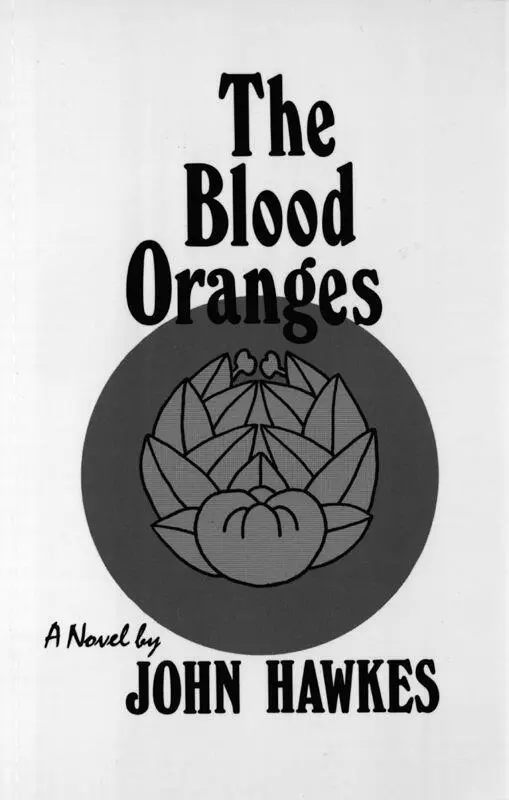
- Название:The Blood Oranges
- Автор:
- Жанр:
- Год:неизвестен
- ISBN:нет данных
- Рейтинг книги:5 / 5. Голосов: 1
-
Избранное:Добавить в избранное
- Отзывы:
-
Ваша оценка:
The Blood Oranges: краткое содержание, описание и аннотация
Предлагаем к чтению аннотацию, описание, краткое содержание или предисловие (зависит от того, что написал сам автор книги «The Blood Oranges»). Если вы не нашли необходимую информацию о книге — напишите в комментариях, мы постараемся отыскать её.
"Need I insist that the only enemy of the mature marriage is monogamy? That anything less than sexual multiplicity. . is naive? That our sexual selves are merely idylers in a vast wood?" Thus the central theme of John Hawkes's widely acclaimed novel
is boldly asserted by its narrator, Cyril, the archetypal multisexualist. Likening himself to a white bull on Love's tapestry, he pursues his romantic vision in a primitive Mediterranean landscape. There two couples — Cyril and Fiona, Hugh and Catherine — mingle their loves in an "lllyria" that brings to mind the equally timeless countryside of Shakespeare's
.
Yet no synopsis or comparison can convey the novel's lyric comedy or, indeed, its sinister power — sinister because of the strength of will Cyril exerts over his wife, his mistress, his wife's reluctant lover; lyric, since he is also a “sex-singer" in the land where music is the food of love.
The Blood Oranges — читать онлайн бесплатно полную книгу (весь текст) целиком
Ниже представлен текст книги, разбитый по страницам. Система сохранения места последней прочитанной страницы, позволяет с удобством читать онлайн бесплатно книгу «The Blood Oranges», без необходимости каждый раз заново искать на чём Вы остановились. Поставьте закладку, и сможете в любой момент перейти на страницу, на которой закончили чтение.
Интервал:
Закладка:
“It’s hard to tell your little sisters apart, Meredith. Very hard.”
“It’s easy.”
“At least your mother could dress them differently. Blue polka dots for one, say, and red for the other.”
“She likes them the same.”
“I see.”
“Eveline has bigger teeth.”
“I don’t think they understand our game. Let’s teach them.”
No answer. No effort to show me anything except her back. Was she engaged at last? Lost in the scent of the flowers and distracted in the dream I had offered her? Or was she eluding kindness, going through motions, feigning preoccupation, reminding herself that she disliked the sound of my voice and disdained my game? Was I dealing with Meredith the spy, who was filled with duplicity and fear of what she took to be my own duplicity, or was I now in charge of Meredith the harmless child, as I had first assumed? Engaged, I decided, and only the harmless child, because now her small white haunches were frozen where she had just been crawling in the still grass, her head was turned, one hand was raised, in poignant shyness and feminine delicacy she was holding up to her small pointed nose a single bud of Tolpis barbata and sniffing in pleasure unmistakably her own. The thin hand quivered. I was sure that her eyes were closed.
“Well,” I murmured, “if you won’t help your sisters, I guess I’ll have to.”
“Go ahead.”
“I’d prefer that we work together, Meredith.”
And pausing, thinking, and then deciding to relent: “Dolores,” she said, “Eveline, pick the flowers.”
I rubbed the patina of soft dust from one green pendant fig, I watched as Meredith broke a few more stems and abruptly propelled herself toward a clump of Cistus ladaniferus worthy, I thought, of any young girl’s breathlessness. But obviously Meredith was more attentive to the situation than to the flowers, was listening for some remark from me or some sound from the twins. She waited, she shrugged, until conscience and impatience overcame the lure to beauty and elicited a brief example of the pre-emptory maternal tone she always adopted when addressing the twins. “Come on, come on,” she muttered, “just pick them. Pick a lot of them.”
“That’s fine, Meredith. But Dolores and Eveline don’t understand. Let’s help them.”
“They won’t be able to make crowns anyway.”
“Of course they will. But if we’re going to surprise Fiona and Hugh and Catherine, we’ll have to hurry. There isn’t much time.”
“Who cares?”
“Listen, Meredith. Let’s make yours out of those pink and lavender flowers and the white ones. They’re best for your eyes.”
“I’m not a child.”
“Maybe I’ll wear one too, who knows.”
“What are you doing now?”
“Just sitting down, Meredith. Do you mind?”
Cyril descending among the children. Cyril reclining on the floor of the fig tree bower. Fiona’s husband reposing within arm’s length of Catherine’s two smaller girls who appeared to have been dropped like heavy seeds into our dark-eyed glen. Amuse them, I told myself, control them, don’t frighten them, don’t awe them with effusion or excessive magnificence. And how easy it was to avoid boredom, repugnance, or exceptional condescension. Of course Meredith was watching me, ready to pounce on my first slip, and of course the twins were watching me, waiting for what chance to erupt into private persecution or unpredictable rebellion I could not be sure. If they fled, if they pummeled each other, if they began to shriek — what then? Above all I expected serenity from all three of them, was determined to see for myself that even these three were capable of charm and of conforming to my own concepts of playful sport that would entertain not only them but me. And yet it turned out that I had only to incline my back, extend one leg, seize the upraised knee of the other and smile, first at Dolores and then at Eveline, to cause both children to blink, to roll apart, to come to me.
“Look what you’re doing. You’re kicking my pile of blues to pieces.”
“Sorry. Just gather them up again.”
Supine, I was lying partially supine and wondering whether it was Dolores or Eveline who had flopped belly down on my heavy thigh, Eveline or Dolores who was attempting to perch herself on my upraised knee. But of course one name was as good as the other, I told myself, and for a moment longer tolerated the inertness of the little stomach flat on my thigh and the slow persistent movements of the short legs against my massive calf. But at least there was no tugging on Cyril’s hair, no poking at spectacles, no bouncing. Only the polka dots, the two fat bodies, the two sets of large brown eyes brooding impossibly on mine. The little stomach was sighing, the fat legs were searching for a grip. All this I tolerated for the sake of the apparent depth of feeling with which they were clambering upon the bemused figure of the man who kissed their mother and knew the way to the glen.
“Now we’re going to help Meredith pick the flowers. I’ll show you how.”
They understood, they disengaged legs and stomach from my knee and thigh, they stepped aside and waited (plump, somber, square-faced, bright of eye), and without hesitation they followed my example as I descended to all fours and moved through the speckled sunlight and between the dusty trunks of the fig trees appraising, selecting, admiring, but picking (endlessly picking) the flowers that most caught my attention or most appealed to little Eveline or little Eveline’s twin.
“You like this one. Take it to Meredith.”
“Don’t bother. We’ve got plenty of those.”
“Never mind, Meredith. Eveline likes this kind.”
“God …”
Like my small white purely artificial sheep with its stifled cry and faint accusing expression on the small face that was neither human nor animal but something of each, they drifted about in the fig tree bower together, all three of them, clumsy industrious children engrossed in gathering armfuls of goatsbeard, ghostly asphodel, and the heavy lidded Anemone coronaria . I led the way. My industry, though of a different sort, matched theirs. Eveline, I noted, remained at my side while her twin preferred more independence and was given to nibbling certain prime specimens of the Cistus salviaefolius .
“She’s eating them. Make her stop.”
“Dolores is enjoying herself, Meredith. Let’s leave her alone.”
“She’s ruining everything. You want her to.”
“Not at all, Meredith. Not at all. But look, it’s easy to make the crowns. You simply take a few flowers from each pile and a few green leaves and bind them together with these slender stems until you get a chain long enough to fit around your head. Then you fasten the ends, of course, into a beautiful circlet of all kinds of flowers. These little milky stems are like string. Think you can do it?”
“God, what a question.”
“You and I will have to help your sisters. But I’m sure that you can make a beautiful crown without any help from Cyril.”
“Why don’t you just stop talking?”
“I don’t suppose your mother ever told you that Theophrastus was the father of botany. Well, Meredith, he was.”
She scowled. I cajoled the two smaller girls until they were finally seated in a row with Meredith facing what I thought of immediately as the feast of the flowers. Bent heads, sounds of dismay, hands tangling, tears of innocence stuck between chubby fingers or falling onto their little immobile legs. Their silence made mine the more melodious as I watched all of them struggling with tissued gems, their peaceful though unsuccessful employment heightened the serenity of my own involvement in what was, for me, an easy and, as it were, poetic task. I worked swiftly and my progress kept pace with their frustrations. Meredith was not as clever or dexterous as I had at first assumed, her sisters could do no more than mangle my prized flowers in helpless palms. Yes, I thought, their ineptitude was certainly my skill, their strain my relaxation, their dubious fun my pleasure.
Читать дальшеИнтервал:
Закладка:
Похожие книги на «The Blood Oranges»
Представляем Вашему вниманию похожие книги на «The Blood Oranges» списком для выбора. Мы отобрали схожую по названию и смыслу литературу в надежде предоставить читателям больше вариантов отыскать новые, интересные, ещё непрочитанные произведения.



Обсуждение, отзывы о книге «The Blood Oranges» и просто собственные мнения читателей. Оставьте ваши комментарии, напишите, что Вы думаете о произведении, его смысле или главных героях. Укажите что конкретно понравилось, а что нет, и почему Вы так считаете.