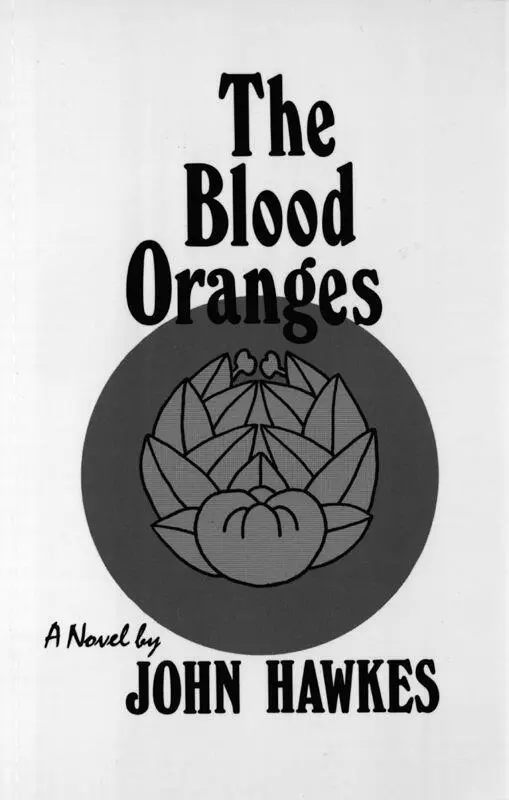
John Hawkes - The Blood Oranges
Здесь есть возможность читать онлайн «John Hawkes - The Blood Oranges» весь текст электронной книги совершенно бесплатно (целиком полную версию без сокращений). В некоторых случаях можно слушать аудио, скачать через торрент в формате fb2 и присутствует краткое содержание. Жанр: Современная проза, на английском языке. Описание произведения, (предисловие) а так же отзывы посетителей доступны на портале библиотеки ЛибКат.
- Название:The Blood Oranges
- Автор:
- Жанр:
- Год:неизвестен
- ISBN:нет данных
- Рейтинг книги:5 / 5. Голосов: 1
-
Избранное:Добавить в избранное
- Отзывы:
-
Ваша оценка:
The Blood Oranges: краткое содержание, описание и аннотация
Предлагаем к чтению аннотацию, описание, краткое содержание или предисловие (зависит от того, что написал сам автор книги «The Blood Oranges»). Если вы не нашли необходимую информацию о книге — напишите в комментариях, мы постараемся отыскать её.
"Need I insist that the only enemy of the mature marriage is monogamy? That anything less than sexual multiplicity. . is naive? That our sexual selves are merely idylers in a vast wood?" Thus the central theme of John Hawkes's widely acclaimed novel
is boldly asserted by its narrator, Cyril, the archetypal multisexualist. Likening himself to a white bull on Love's tapestry, he pursues his romantic vision in a primitive Mediterranean landscape. There two couples — Cyril and Fiona, Hugh and Catherine — mingle their loves in an "lllyria" that brings to mind the equally timeless countryside of Shakespeare's
.
Yet no synopsis or comparison can convey the novel's lyric comedy or, indeed, its sinister power — sinister because of the strength of will Cyril exerts over his wife, his mistress, his wife's reluctant lover; lyric, since he is also a “sex-singer" in the land where music is the food of love.
The Blood Oranges — читать онлайн бесплатно полную книгу (весь текст) целиком
Ниже представлен текст книги, разбитый по страницам. Система сохранения места последней прочитанной страницы, позволяет с удобством читать онлайн бесплатно книгу «The Blood Oranges», без необходимости каждый раз заново искать на чём Вы остановились. Поставьте закладку, и сможете в любой момент перейти на страницу, на которой закончили чтение.
Интервал:
Закладка:
But was the bird descending, drawing closer to us, a deliberate herald of the rich desolation that lay before us, fierce bird of prey somehow attracted to large lovers and the cherries in Fiona’s bag? Was he singling us out as further confirmation of Fiona’s essential soberness and lack of fear, or even as a reminder of the terror that once engulfed the barbarians and from which Hugh, for instance, was still not free? At any rate the bird was descending and the hills, like distant burial mounds, were dark. Slowly I put pressure with my upper arms first on Catherine’s shoulder and then on Fiona’s.
All eyes on the approaching eagle. Fiona began to shiver, Catherine returned the pressure of my affection. But Hugh, I thought, was growing impatient, was much too preoccupied with his own doubts and desires to realize that sometimes the faceless eagle heralds not only the breath of dead kings but the sunrise.
Yes, the sunrise. And now, quite suddenly, the sunrise was so immense, so hot and brilliant that Fiona found it necessary to respond in kind and leaped to her feet, all at once was standing upright between Hugh and me and taking swift athletic breaths of the golden air, apparently unconscious of my own hand steadying her right calf and Hugh’s her left. The black and silver sky turned orange and foamed for miles behind the stationary air-borne eagle, and the purple hills dissolved, reappeared, revealed on thick green slopes a clear pattern of thistle, clay, warped trees, a few abandoned stone huts. Mist filled the valley at our feet and then lifted. The cold air grew warm, the eagle suddenly glided downward to the east and was gone, simply gone. The day was ours.
“What’s that, baby? Listen.”
I listened, we all listened, Catherine’s ring hand was on my thigh. Across from us the large round sun had already outlived its bright circumference, its glorious round orange shape had already given up its enormous singular shape to time, had become only the light of our day, the undefined brilliance of our morning song. But that clear random tinkling sound from the valley? That metallic musical sound too unstructured for music and yet harmonizing, so to speak, with the sweet smell of our still unexplored valley?
“Sheep bells,” Catherine murmured. “That’s what it is.”
“By God, boy, do you see what I see?”
“Couldn’t be better,” I said, and drew Fiona’s upright leg more tightly to my rib cage and with my other hand signaled Catherine through the brown cloth on her hip.
Because cold dawn had given way to hot morning, the sun had yielded to light, the eagle had flown off only to return to us as a flock of long-haired semidomesticated animals.
“Goats,” I said pleasantly, “not sheep.”
“But the girl, baby. Look at the girl.”
It was the new day’s gift to Fiona, nature’s final gift to my wife. Yes, the random tinkling sound we had heard was produced by bells fastened around the necks of goats, small rusty pear-shaped iron bells hand-forged by peasants oblivious to the sad melodies that unknown cultivated strangers might hear in their noise. And goats, an entire flock of them, wearing long brown shaggy robes the color of Catherine’s slacks but more shiny, and bearing bone-colored curling horns on the tops of their nodding heads, now suddenly filled our valley with motion, color and the sound of their bells. From where Hugh and Catherine and I sat and Fiona stood, we could see that these stately animals were attended by a young girl wearing a large white hat and running, slowly running, through the tall grass.
“I want to talk with her. Right now.”
“How can you talk with her?”
“I’ll find a way.”
“Don’t you worry about Fiona. She’ll do what she wants.”
“Of course she will,” I said and laughed. “But there’s the problem of language. And the hill’s too steep for Fiona, Hugh. Believe me.”
“Cyril,” Fiona said, and the calf of her leg was hard and trembling, the skin was cold, “she’s just a child.”
“A young woman,” I heard myself saying. “About seventeen. But sit down, Fiona. You’ll fall.”
“I’m holding her, boy. Don’t worry.”
The moment passed. I made a low humming sound of affirmation in my nose and throat and said nothing. And who was to say which was the more remarkable, I asked myself, the girl or the goats? The goats were overly large, their coats long, here and there were the obvious bell-carriers, the jangling sunlit leaders, and it was quite apparent that the entire flock had come in slow hungry pursuit of the tough little black leaves of the olive trees, was following some purely aesthetic instinct to feed at dawn on the resilient branches laden with dawn’s oldest and most meager fruit. We could hear the hooves, the bells, the grass, the rubbing of long hair which was either dry and regal or still damp from the recent discharging of white milk. And the girl? This girl who carried no crook and appeared to feel no responsibility for lost kids or straggling elders? How could her slight vaulting presence down there be anything if not more remarkable than the indifference of her ancient goats?
“Baby. She sees us!”
The girl was waving. Standing still and waving. And in this instant, the very moment of correspondence between the girl’s world and ours, Catherine returned her wave, Fiona suddenly tightened her fingers in my hair. Hugh laughed because the largest goat had discovered the largest olive tree and like some tall but malformed adventurer was standing on his hind legs and nibbling in tenuous balance at the dusty leaves. It was like Hugh, I thought, to care more about the rising, unnaturally distended old goat than about the girl.
The goat chewed while the girl ran to us. Full of trust and candor she skirted a creamy boulder, she sped through the grass. On bare feet she raced toward the rocky, precipitous slope that separated the hilltop where we watched from the secluded green valley where her unsuspecting goats were feeding. But where had she gotten her clothes, the castoff garden hat and tattered dress so clearly unintended for rusticity? How could she be so unaware of girlhood, so unaware of the fact that the goatherd, in this lonely world, was usually a sullen boy or unshaven, unfriendly man?
“Here she comes,” Fiona cried. “Help her.”
How many times had we sat on this same fragment of rocky wall composed of stones that certainly were the teeth of time, sat together on this hill of ours and watched the transformation of hills and air, hemlocks and clouds, roots and rocks into a clear and sunlit but always lifeless panorama that we never ceased to admire? And now eagle, goats, unlikely girl. Perhaps Fiona had appealed to the sylvan sources in a voice more winsome and undeniable than ever before. At any rate I could not begrudge Fiona the exhilaration that was now removing her, distracting her, from Hugh and me.
“Don’t frighten her, Cyril. Please.”
I stood. We all stood. My very posture acknowledged the voices behind my back and welcomed the girl. Like one of her charges she scrambled up to us, raising dust, clutching at loose stones and tufts of grass, discovering crevices with her bare toes, laughing at the ease with which she emulated the climbing ability of her silken goats. Her face was round, her eyes were dark, the enormous flimsy hat remained somehow on the back of her head, there was a faded pink bow fastened to the bodice of the threadbare gown that fell below the knees and yet swirled and mingled with the bright air and dust she raised. She clung to the hillside, laughed again, glanced up and took her bearings and then lowered her eyes and without hesitation scrambled the last few feet into our waiting arms.
“Made it,” I said aloud, and placed the flat of my open hand on the small of her back, helped her over the wall, stepped aside for Hugh. We crowded around her shamelessly, Catherine took hold of a bare elbow, Hugh vied with Fiona for a closer look.
Читать дальшеИнтервал:
Закладка:
Похожие книги на «The Blood Oranges»
Представляем Вашему вниманию похожие книги на «The Blood Oranges» списком для выбора. Мы отобрали схожую по названию и смыслу литературу в надежде предоставить читателям больше вариантов отыскать новые, интересные, ещё непрочитанные произведения.


Обсуждение, отзывы о книге «The Blood Oranges» и просто собственные мнения читателей. Оставьте ваши комментарии, напишите, что Вы думаете о произведении, его смысле или главных героях. Укажите что конкретно понравилось, а что нет, и почему Вы так считаете.