John Hawkes - The Blood Oranges
Здесь есть возможность читать онлайн «John Hawkes - The Blood Oranges» весь текст электронной книги совершенно бесплатно (целиком полную версию без сокращений). В некоторых случаях можно слушать аудио, скачать через торрент в формате fb2 и присутствует краткое содержание. Жанр: Современная проза, на английском языке. Описание произведения, (предисловие) а так же отзывы посетителей доступны на портале библиотеки ЛибКат.
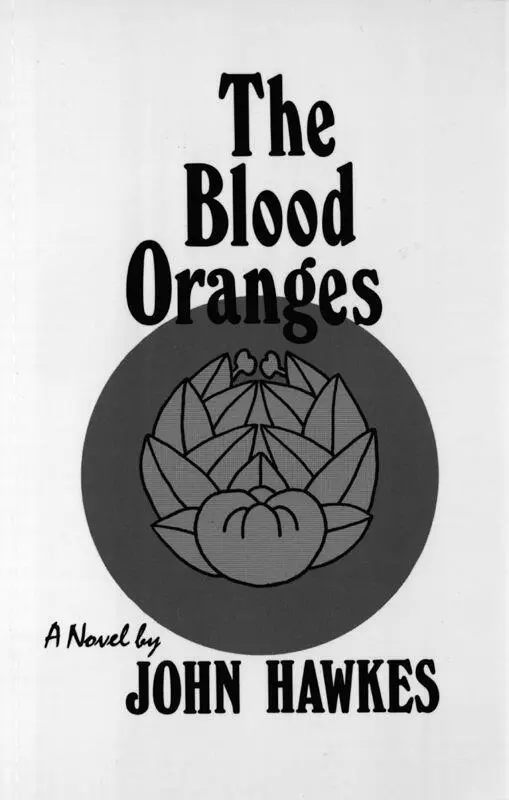
- Название:The Blood Oranges
- Автор:
- Жанр:
- Год:неизвестен
- ISBN:нет данных
- Рейтинг книги:5 / 5. Голосов: 1
-
Избранное:Добавить в избранное
- Отзывы:
-
Ваша оценка:
The Blood Oranges: краткое содержание, описание и аннотация
Предлагаем к чтению аннотацию, описание, краткое содержание или предисловие (зависит от того, что написал сам автор книги «The Blood Oranges»). Если вы не нашли необходимую информацию о книге — напишите в комментариях, мы постараемся отыскать её.
"Need I insist that the only enemy of the mature marriage is monogamy? That anything less than sexual multiplicity. . is naive? That our sexual selves are merely idylers in a vast wood?" Thus the central theme of John Hawkes's widely acclaimed novel
is boldly asserted by its narrator, Cyril, the archetypal multisexualist. Likening himself to a white bull on Love's tapestry, he pursues his romantic vision in a primitive Mediterranean landscape. There two couples — Cyril and Fiona, Hugh and Catherine — mingle their loves in an "lllyria" that brings to mind the equally timeless countryside of Shakespeare's
.
Yet no synopsis or comparison can convey the novel's lyric comedy or, indeed, its sinister power — sinister because of the strength of will Cyril exerts over his wife, his mistress, his wife's reluctant lover; lyric, since he is also a “sex-singer" in the land where music is the food of love.
The Blood Oranges — читать онлайн бесплатно полную книгу (весь текст) целиком
Ниже представлен текст книги, разбитый по страницам. Система сохранения места последней прочитанной страницы, позволяет с удобством читать онлайн бесплатно книгу «The Blood Oranges», без необходимости каждый раз заново искать на чём Вы остановились. Поставьте закладку, и сможете в любой момент перейти на страницу, на которой закончили чтение.
Интервал:
Закладка:
So our feet were deep in the sand, I lit a cigarette, the boat was balancing between the loosely divided halves of the launching party. Beneath the plane tree, a young man was seated alone beside a bare wooden table, and it was he who played the archaic heart-shaped stringed instrument. I took it all in — the assembled villagers, the enormous white crescent of the waiting boat, and the dogs, the children, the black shawls, the impoverished young man whose metallic Eastern music was now reaching out toward the rolling sea. And here we were, Catherine and I together at last in the festive air. The sun was overhead but close to us, close and orange. Once more the invisible nets were spread.
“It’s all right,” I murmured, “take the glass. The old fellow just wants you to toast his boat.”
At that moment the old goat-faced man himself was suddenly before us and smiling, holding out to Catherine a little battered tin tray bearing not one of their black bottles but a small dirty glass half filled with a colorless drink more powerful, I knew, than the dusty wine. He extended the tray, raised one shoulder, looked into Catherine’s eyes and into mine. Little more than a commonplace event, an instant in time, only a small disreputable old man with a gray shirt ripped open to the waist and partially unbuttoned trousers loose at the large hips. But thanks to his agility and bright blue eyes and stubby fingers, I realized immediately that he was a friendly guide who at a glance had read Catherine’s past and mine in the very shape of our middle-aged bodies that were so much larger than his.
“Take a sip,” I said. “I’ll drink the rest.”
Catherine held the glass to her lips, I nodded my approval of the clear fierce taste that suggested both the salt of the sea and the juice of the heavy lemon. I left him a few drops which he licked with his fingers, laughing and tilting the little dirty glass above his burnished head. For another moment the glass hung high in the air while the old man patted Catherine’s arm, shook my hand, pointed with expansive admiration toward the boat still propped upright and waiting for the first touch of the uncontrollable sea.
The glass fell to the beach, the grip of the vanished hand lingered in my empty hand, Catherine smiled exactly as if the old man had not yet disappeared. But he was already gone and even now was rousing the villagers to the final effort of pushing the majestic slow boat across the sand to the sea.
“Well,”I heard myself saying, “recovered yet?”
I glanced at Catherine, the heart-shaped instrument leapt between two or three high notes and one smashing chord, Catherine held her bared elbow still tingling, no doubt, from the touch of that unfamiliar hand.
“I don’t know why I feel this way.”
“Excited?”
“It’s lucky he found us.”
“Look,”I murmured, “here come the oars.”
Two youthful figures ran down the beach with a pair of long virginal oars suspended between them. The distant fortress was cupped in the shriveled palm of desolation. The orange sun descended, the open sea undulated in slow fleshy waves. The old man and the angry priest were arguing about a few half-submerged brown rocks which apparently lay directly in the path of the boat. Catherine smiled. Heavy-headed Cyril smiled. The boat was in motion.
Yes, in motion, and Catherine had already removed her sandals, already I anticipated the sight of Catherine’s green slacks wet to the knees and the sensation of my own black trousers weighted at least to my bulky calves with dark sea water.
The upheld oars protruded above the sweat-dampened heads of those men straining at the stern of the boat, to one side and at the edge of the beach the priest stood with his skirts awash and the large and radiant silver cross held aloft in both extended fists. Again the two small boys were filled with self-importance and were hard at work. The forward motion of the boat was slow, painful, continuous, unmistakable, and bore no relation to priest, struggling men, old women. No, I thought, that white boat was moving only for the sake of Catherine, me, and for one agile and ageless village elder obviously deformed at birth. Quietly I smiled at the symmetry of orange sky, chunks of bloodied wood, oars that projected into nothing more than air, boat that still lay several yards from the vast tide that would float it into life and yet would one day reduce it to nothing more than a few cracked wooden ribs half buried in sand.
“Remind you of anything?”
My smile was embedded in those slow words, and as soon as I spoke I knew that my voice was exactly as audible to Catherine as it was to me, as if all those other sounds (water, music, laborious breathing, grinding of wood on wood) were only a silence for me to fill or existed only that Catherine and I might listen more attentively to what each of us had to say. Catherine glanced over her shoulder and her eyes were larger than I remembered.
“I’m not sure. Tell me.”
“How about the day we met?”
Had I gone too far? Summoned too abruptly our missing shadows? Merely ripped open old graves, old secret bowers? Exposed myself to more conventional grief and unjustified accusation? Was she less perfectly healed than I had begun to assume? But no, her hands were on her womanly green hips, her head was turned in my direction, the immediacy of her amber-colored eyes was still undimmed. Yes, I thought, she was looking directly at my golden spectacles and into my warm eyes and the white boat was exerting more than ever its pull on the fringes of Catherine’s consciousness.
She spoke without insistence, without emphasis, clearly: “I never expected to talk to you again.”
“I know,” I murmured, lending her strength.
“But I’ve changed my mind.”
“Catherine. Doesn’t it remind you of a wedding?”
“Not ours.”
“Positive?”
As if my voice and the very depths of my broad chest were not enough, suddenly our heads were together. We stooped, splashing ankle-deep in the first slow reddish swell, stooped just in time to see the rounded bottom of the bow slide within inches of the red tile and the first clear drops of spray already trickling in a bright pattern of transparent bubbles down the steep curve of that thickly enameled white wood. Was Catherine gasping? Was I gasping too? But even as Catherine and I perceived the clear bubbles splattered like an ever-changing necklace on the lower portion of the gleaming and steeply pitched white bow, the bow itself moved forward and sank, obliterating the first signs of spray and foam at the very moment they leapt up and settled expressly, I thought, for Catherine’s pleasure and mine.
“Careful,” I said, “not too close.”
The men fell back. The boat was free. Catherine laughed. We were wading in soft water up to our thighs, and all around us the men were floundering, the villagers were wading in behind us, the golden fish on the bow of the boat was flashing. A figure leapt high (hair wet, face contorted in both grief and joy) and snatched away the white flowers and flung them off to float bereft and abandoned on the surface of the deep sea tinted with blood.
“Look, Catherine. There he is.”
“I see him.”
Yes, he was there. Yes, we saw him. Impish, angular, energetic, indomitable, immersed to his armpits but ready to spring, ready to take possession of what was his, dark head and narrow shoulders distinctly visible as the white stern twisted and rose above him and the orange sun came down, coagulated, turned time itself into a diffusion of thick erotic color.
“Help him,” Catherine said.
“Don’t have to.”
We waited. Our shoulders touched. The water that was saturating Catherine’s pea-green slacks was filling my pockets. Somebody shouted, the oars clattered, the white stern came down. And then the old man jumped and seized some fragment of glossy wood and in full view of ancient women, small boys, shouting friends, two strangers whose spiritual relationship he somehow shared, propelled himself upward so that in the next instant, as the now orange-white stern towered above us all once more, the old man also towered above us, balancing up there on his spread knees that were wiry, insensitive to pain, and naked. Yes, naked, because he had had the forethought to rip off his ragged trousers before committing himself to frenzy and determination, had kicked them off at the edge of the beach before the white boat had rolled, pitched, begun to float. The stern was at the top of its arc, Catherine and I were staring up into the orange brilliance of the old man’s aged nakedness, and his shanks were dripping, his buttocks were dripping, his obviously unspent passion was hanging down and rotating loosely like a tongue of flame.
Читать дальшеИнтервал:
Закладка:
Похожие книги на «The Blood Oranges»
Представляем Вашему вниманию похожие книги на «The Blood Oranges» списком для выбора. Мы отобрали схожую по названию и смыслу литературу в надежде предоставить читателям больше вариантов отыскать новые, интересные, ещё непрочитанные произведения.








Обсуждение, отзывы о книге «The Blood Oranges» и просто собственные мнения читателей. Оставьте ваши комментарии, напишите, что Вы думаете о произведении, его смысле или главных героях. Укажите что конкретно понравилось, а что нет, и почему Вы так считаете.