John Hawkes - The Blood Oranges
Здесь есть возможность читать онлайн «John Hawkes - The Blood Oranges» весь текст электронной книги совершенно бесплатно (целиком полную версию без сокращений). В некоторых случаях можно слушать аудио, скачать через торрент в формате fb2 и присутствует краткое содержание. Жанр: Современная проза, на английском языке. Описание произведения, (предисловие) а так же отзывы посетителей доступны на портале библиотеки ЛибКат.
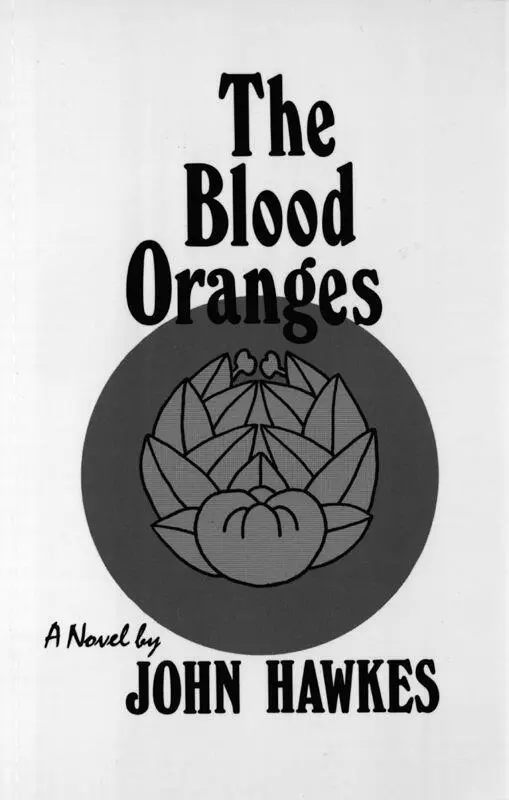
- Название:The Blood Oranges
- Автор:
- Жанр:
- Год:неизвестен
- ISBN:нет данных
- Рейтинг книги:5 / 5. Голосов: 1
-
Избранное:Добавить в избранное
- Отзывы:
-
Ваша оценка:
The Blood Oranges: краткое содержание, описание и аннотация
Предлагаем к чтению аннотацию, описание, краткое содержание или предисловие (зависит от того, что написал сам автор книги «The Blood Oranges»). Если вы не нашли необходимую информацию о книге — напишите в комментариях, мы постараемся отыскать её.
"Need I insist that the only enemy of the mature marriage is monogamy? That anything less than sexual multiplicity. . is naive? That our sexual selves are merely idylers in a vast wood?" Thus the central theme of John Hawkes's widely acclaimed novel
is boldly asserted by its narrator, Cyril, the archetypal multisexualist. Likening himself to a white bull on Love's tapestry, he pursues his romantic vision in a primitive Mediterranean landscape. There two couples — Cyril and Fiona, Hugh and Catherine — mingle their loves in an "lllyria" that brings to mind the equally timeless countryside of Shakespeare's
.
Yet no synopsis or comparison can convey the novel's lyric comedy or, indeed, its sinister power — sinister because of the strength of will Cyril exerts over his wife, his mistress, his wife's reluctant lover; lyric, since he is also a “sex-singer" in the land where music is the food of love.
The Blood Oranges — читать онлайн бесплатно полную книгу (весь текст) целиком
Ниже представлен текст книги, разбитый по страницам. Система сохранения места последней прочитанной страницы, позволяет с удобством читать онлайн бесплатно книгу «The Blood Oranges», без необходимости каждый раз заново искать на чём Вы остановились. Поставьте закладку, и сможете в любой момент перейти на страницу, на которой закончили чтение.
Интервал:
Закладка:
Later, and into my ear and softer, much softer than before: “I guess I wanted you all the time,” she whispered. “But I never thought we’d be in bed together.”
“Glad you were wrong?”
“Yes. I'm glad.”
The sunrise, as later I happened to see for myself, was brilliant.
STEADY WIND, HARD CLEAR LIGHT, THE FOUR OF US HOLDing hands on the rocks that faced the squat ominous remains of the fortress across the narrow crescent of dark water now harboring only four or five half-sunken wooden boats with high prows, broken oars, red chains. Moody, we were bound together by wind and light and hands. All eyes were on the ruined penitential structure just across the water that was apparently unchanged, unnourished by the sea crashing on three sides of us. All eyes were on the gutted shape of history, as if the clearly visible iron base and broken stones and streaks of lichen were portentous, related in some way to our own presently idyllic lives. But I for one was conscious of bodies, hands, squinting eyes, positions in line, was well aware that Fiona stood on my left and Catherine on my right and that Hugh was doomed forever to the extreme left and could never share my privilege of standing, so to speak, between two opposite and yet equally desirable women. Even on our promontory of sharp wet rocks it amused me to think that, thanks to Hugh, our sacred circle would remain forever metaphysical. Nothing more.
But what was he saying?
“That fort, boy … soon …”
“Good idea,” I shouted and, nodding my head up and down, again I was struck with the perception that he was black while I was gold. But a ruined fortress was not a safe place for a man like Hugh, and though I did not yet understand the basis for so much oblivious intensity, still I admired his courage and was beginning to share his eagerness to undertake the expedition to that unwholesome place of bone, charred wood, seaweed.
Suddenly I felt the pre-emptory childish tugging on my left hand and the cold lips against my ear. Fiona’s words seemed to lodge immediately and permanently in the still room of my brain.
“Do you know where we are, baby? Tell me quick.” Surprised at her sudden and atypical desperation, but laughing and aiming my mouth toward the hint of white cartilage buried like an arrow in the now violent cream- and sable-colored hair: “Sure,” I shouted, “we’re in Illyria. Like it?”
“I like you, baby. You.”
WAKING, WRINKLING MY NOSE, ROLLING OVER, I HEARD my hand slap accidently against my own thick mottled thigh and realized that despite our early agreement intended to safeguard children and husband alike, I had dozed off, so that now we were only a few hours from dawn. I was faced with precisely the situation we had thought it best to avoid. Slowly I climbed out of the bed and found the polka-dotted pajama bottoms and put them on, lit the lantern, yawned, made my way toward the cry that I had recognized as coming from the little tight-lipped mouth of Meredith. And then there was the battle of whispers, one side tormented, bitter, the other dismayed, calm as usual.
“What’s the matter?”
“Nothing.”
“Your nose is bleeding.”
“It’s not.”
“Stop being a child.”
“I’m going to tell my father.”
“Let’s do something about this nosebleed.”
“He’ll probably kill you for coming here.”
“Hold still.”
Despite the eyes of the injured eaglet and her obvious efforts to escape the touch of my hand (cowering, hunching the thin white naked shoulders), she could no longer defend herself from my kindness because the blood was running into her mouth and down her little pointed chin. Her nostrils became dilated, the head drew back. But with the tip of Fiona’s pink sheet, which was already bloody between my fingers, slowly and carefully I wiped her face and pinched her nose until finally the gushing stopped and coagulation started. I cradled her damp head against my chest, waited, then by the light of the lantern satisfied myself that only a few dried streaks and stains now betrayed the lonely extravagance of Meredith’s nightmare bleeding.
“You can wash it all off in the morning,”I whispered. “Now go to sleep.”
In the immediate afterglow of the extinguished flame her face hung below me a moment like the small white mask of some sacrificial animal. But though the eyes were still fearful and unforgiving, the mouth, after all, was growing soft.
WE TURNED, STARTING UP THE HILL TOGETHER, CLIMBINGone of the high narrow twisting streets of the village without purpose, without destination, drawn upward together by the air, the light, the dusty steep grade of the little street, by the abrupt seasonal invasion of the wild flowers that had taken root, matured, bloomed all in a single night. The flowers lay in bright masses of wet color on walls, tiles, flat stones, or packed like some kind of floral mortar in cracks and fissures around slanting doorways and beneath crude window ledges. So the two of us were climbing together and admiring the flowers when suddenly the village street looped again and there above us, amidst priest and children and a crowd of barefoot men, stood the white boat.
Yesterday? Only yesterday.
I was taking slow uphill strides and smelling the flowers, asking myself why I had had such unhappy luck with Catherine, wondering how I was ever to win her to all the sensual possibilities of the intimacy I had in mind, persuade her to give me her complete attention, to look at me, to live on with Cyril.
Yes, I thought, there in all this suffusion of flowers is the familiar Physanthyllis tetraphylla . The ripe and fruity vinelike plant with its wet green leaves, yellow buds and faint traces of silver hair, lay spread across the entire surface of the dusty village street, and I could hardly fail to note its tendrils drifting off into silence, its nodules cup-shaped, as usual, in pulpy succulence. And wasn’t that the Pisum elatius? Yes, I thought, Fiona’s favorite.
But Catherine, I asked myself, why doesn’t Catherine know by now that I am enough, that she is enough, that we are all interchangeable, so to speak, and that our present relationship is already as unlimited and undeniable as our past affair? After all, there is something glorious about standing together in time as two large white graceful beasts might stand permanently together in an empty field. And yet how could I convey the truth of all this to Catherine?
At least she was wearing her pea-green slacks (glancing over my shoulder, waiting for her to close the gap between us, frowning at her obvious reluctance to catch up with me), exactly as if her children had yet to smear their little hands in the folds of my dissolving tapestry and we, the four of us, had yet to follow the angular black-haired shepherd into the still grove and then beyond to sun, sea, joyous ruins, long nights, distant piping. At least the pea-green slacks, a white sweater, an old pair of heavy dried-out leather sandals on bare feet. At least there was the clear sound of her matter-of-fact exertion — the sounds of her breath, the grating comfortable sound of the sandals. But nothing more. No corresponding glance at my own black suit and white shirt open at the collar and golden hair beginning to curl at last into tight sprightly barbs over the ears and down the back of my neck. No smile. No music in the way she moved. Nothing for Cyril.
And then? Then it burst upon us, so to speak, the spectacle, the processional, the very message of our actuality. Suddenly the narrow street was looping again, rising more steeply than ever, and in one single instant priest and children and barefoot men and white boat were poised above us. Suddenly Catherine and I were thrust against high stone walls on opposite sides of the narrow street. The two of us stood upright and facing each other with our flesh and even our bones flush to the rock, precisely as the village priest tried to wave us back down the street and out of the way of the white boat whose lunging destructive descent was prevented only by the crowd of men.
Читать дальшеИнтервал:
Закладка:
Похожие книги на «The Blood Oranges»
Представляем Вашему вниманию похожие книги на «The Blood Oranges» списком для выбора. Мы отобрали схожую по названию и смыслу литературу в надежде предоставить читателям больше вариантов отыскать новые, интересные, ещё непрочитанные произведения.



Обсуждение, отзывы о книге «The Blood Oranges» и просто собственные мнения читателей. Оставьте ваши комментарии, напишите, что Вы думаете о произведении, его смысле или главных героях. Укажите что конкретно понравилось, а что нет, и почему Вы так считаете.