John Hawkes - The Blood Oranges
Здесь есть возможность читать онлайн «John Hawkes - The Blood Oranges» весь текст электронной книги совершенно бесплатно (целиком полную версию без сокращений). В некоторых случаях можно слушать аудио, скачать через торрент в формате fb2 и присутствует краткое содержание. Жанр: Современная проза, на английском языке. Описание произведения, (предисловие) а так же отзывы посетителей доступны на портале библиотеки ЛибКат.
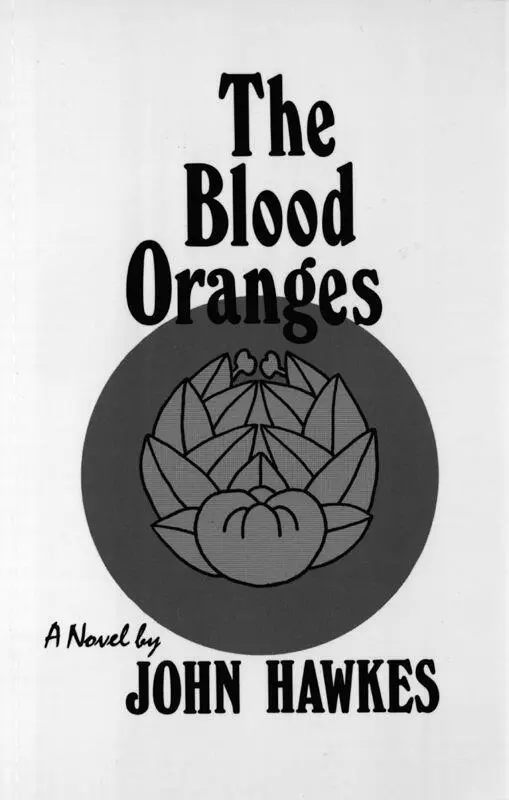
- Название:The Blood Oranges
- Автор:
- Жанр:
- Год:неизвестен
- ISBN:нет данных
- Рейтинг книги:5 / 5. Голосов: 1
-
Избранное:Добавить в избранное
- Отзывы:
-
Ваша оценка:
The Blood Oranges: краткое содержание, описание и аннотация
Предлагаем к чтению аннотацию, описание, краткое содержание или предисловие (зависит от того, что написал сам автор книги «The Blood Oranges»). Если вы не нашли необходимую информацию о книге — напишите в комментариях, мы постараемся отыскать её.
"Need I insist that the only enemy of the mature marriage is monogamy? That anything less than sexual multiplicity. . is naive? That our sexual selves are merely idylers in a vast wood?" Thus the central theme of John Hawkes's widely acclaimed novel
is boldly asserted by its narrator, Cyril, the archetypal multisexualist. Likening himself to a white bull on Love's tapestry, he pursues his romantic vision in a primitive Mediterranean landscape. There two couples — Cyril and Fiona, Hugh and Catherine — mingle their loves in an "lllyria" that brings to mind the equally timeless countryside of Shakespeare's
.
Yet no synopsis or comparison can convey the novel's lyric comedy or, indeed, its sinister power — sinister because of the strength of will Cyril exerts over his wife, his mistress, his wife's reluctant lover; lyric, since he is also a “sex-singer" in the land where music is the food of love.
The Blood Oranges — читать онлайн бесплатно полную книгу (весь текст) целиком
Ниже представлен текст книги, разбитый по страницам. Система сохранения места последней прочитанной страницы, позволяет с удобством читать онлайн бесплатно книгу «The Blood Oranges», без необходимости каждый раз заново искать на чём Вы остановились. Поставьте закладку, и сможете в любой момент перейти на страницу, на которой закончили чтение.
Интервал:
Закладка:
“All right.”
Did she take a breath? Was she turning her head in my direction? Had I heard the first welcome shades of laughter in her voice? I shifted knees, waited. And then she spoke softly, matter-of-factly: “Your wife really meant you’re the perfect man. I didn’t have to ask what she meant. I knew.” “Another heart-stopper,” I said as softly as I could, and heard the sweetness thickening. “Thanks for the heart-stopper. But how did you know?”
“I knew.”
A fresh surprise, more pauses, the low sound of her accent poised between invitation and resignation, a suggestion of despondency balancing the brief hint of pleasure. Could she have meant what she had said? Seen what she had claimed to see? At the very moment of wading from the absurd and dangerous canal had some vague recognition of the headless god lolling in the guise of my composure overcome her mortification and fear for her children? I could not be sure. But at least we were turning the pages at a swifter pace. And was I about to subject us to the test of the children? Perhaps. Perhaps not. Carefully I reached through our small wall of darkness and filled her glass.
“So you think you see me as Fiona sees me,” I said, and laughed. “The perfect man.”
“Yes. But it doesn’t have much to do with me.”
“Not even now?”
“Not yet.”
“There you go again. More disappointment.”
“Why should I be disappointed?”
“Of course Fiona exaggerates. I’m a lot more ordinary than she’d like you to believe.”
“You asked for a secret. I told you.”
“Good. Let’s have another.”
“No. It’s your turn. What’s in your pocket? What did she give you a moment ago?”
Wrong, I thought, I had been admirably wrong, and I allowed myself to shape one gigantic, tremorless ring of smoke and then set it free and watched it swell, widen, disintegrate heavily in our night of the untasted grapes. Apparently she had witnessed something of Fiona’s playful exchange after all, had been aroused by being in the presence of Fiona’s swift act of partially denuding herself. But did I wish to hazard a discussion of Fiona’s simple and private gesture, or resort to it? Might I not better keep at least this relatively insignificant example of Fiona’s sex-language to myself? Was the risk too great, the ploy too easy? I made my choice.
“Just Fiona’s panties,” I said under my breath. “They’re not important.”
“Why did she take them off?”
“Who knows? Do you really care?”
“I’m not sure.”
“Trust me.”
“You remind me of my father.”
“Listen,” I said then, as if our heads were inches apart, “listen a moment.” I waited, holding out my hand for silence and knowing that it was in fact time to act, and then carefully I uncrossed my legs and stood up so that the hard cool globules of the lowest grapes spilled onto the top of my head and brushed my ears. I was relaxed. I was crowned with fruit. And then under my breath: “Listen. I knew they’d wake the children. Let’s go.”
“I don’t hear anything.”
“We’d better look.”
She moved, she too must have felt the passing weight of the grapes. I led the way, she followed. I heard the sound of her breathing, strolled on. At the far side of the funeral cypresses I glanced at the dying eye of my cigarette and waited while the trailing woman slowly extricated herself from the thorns and brittle twigs that lined the opening through the tall black cypresses. Beneath the clothesline that I had rigged at dusk we paused among the silhouetted trousers, dress, miniature dresses, stockings, all greater than life size and still dripping with the waters of the black canal. As we approached the villa that Fiona had opened up for them, I noted the high silver grass, the broken tiles, the listing shutters stuffed with rags and impacted with the earthen ceramics of transient wasps, the small gothic niche near the doorway where birds had raised their young and no candle burned, no icon glowed. And entering the cold corridor, I in the lead and she following, I smiled at the sound of the snoring dog and at the feeling of wet stone beneath my hand and the smell of the old kerosene lantern that was smoking in one of the cell-like rooms ahead of us. Once again I knew that a ruined villa was even more appropriate to passion than was a silent grape arbor filled with stars.
“Come on,” I whispered, “let’s look at them.”
And then I was holding high the lantern by its rusty wire loop and we were standing shoulder to shoulder and peering down at the two large and almost identical heads lying side by side in the smoky orange light at our feet. The faces were square, the curls were tight and dark, the lips were thick. Could these be the faces of small girls? I could understand their size (the mother was large, the father now silently romping with my wife was large) but it was difficult to account for their expressions of sexless power.
“That’s Dolores,” I heard my companion whispering, “that’s Eveline.”
Dolores, Eveline. Together we studied the sleepers, Catherine and I, and even these children were beginning to make a difference, were already strengthening nameless bonds between us, as I had thought they might.
“And somewhere over there,” she whispered, so that I lifted the lantern and swung it loosely in the direction she appeared to be pointing toward with her restrained and contented voice, “is Meredith.”
Together we felt our way among the piles of clothing, piles of blankets provided by Fiona, suddenly bulky articles of luggage (opened and ransacked or still locked, bound tight with archaic leather straps, but each piece smelling of the polluted water), until our slow elbow-knocking search at last revealed the girl called Meredith curled in naked sleep on a hasty pallet of Fiona’s pink sheets spread on the cold stones on the floor.
“She doesn’t like me,” I whispered, and leaning closer saw that one of her thin fingers was in her mouth.
“Of course she does.”
“Fiona always wins the confidence of children. No such luck for me.”
And slowly, again attempting to point through the darkness with her whispering voice: “We’re going to sleep in there. Hugh and I.”
We waited, she made no further comment. It looked to me as if Meredith wanted to cry out in frail anger, but thanks to the sleep of children was unable to move, to make even the smallest sound. The hair across her brow was wet, one little sharply pointed ear was white.
“They’re all safe,” I said. “No nightmares.”
“No. They won’t wake up.”
“Fiona and that noisy husband of yours may do their best,” I whispered as if I myself were rolling over casually on a soft bed in the darkness. “But I’m glad we looked.”
“So am I.”
Already I was groping behind me with my free hand while probing forward with the hot lantern toward the room they had chosen for themselves. Already we were moving forward together into the darkness empty and silent except for the dismal snoring of their old dog. Even by then I knew that the poor wretched animal was deaf, and both of us knew that otherwise the room was empty and that there was no longer any danger of stepping on an unsuspecting child. And yet our breathing was becoming shallow, in unspoken accord we were wary, both of us, of stumbling against an alpine pack or one of their swollen leather bags.
“The lantern’s smoking,” I whispered. “Can you see?”
“You know I can.”
Once more I swung my arm solemnly and it all leapt to view — the dog, the scattered shoes, a tall medieval chest that smelled of iron spikes, the broad and sagging wooden bed whose tight percale sheets and a little hasty bouquet of hyacinths again revealed my wife’s impulsiveness. At the foot of the bed and on his scrap of dark blue carpet, the dog was sleeping on his back with his paws in the air. Carefully I lowered the lantern, the smoke rose between us, side by side we were standing in the midst of their transient lives.
Читать дальшеИнтервал:
Закладка:
Похожие книги на «The Blood Oranges»
Представляем Вашему вниманию похожие книги на «The Blood Oranges» списком для выбора. Мы отобрали схожую по названию и смыслу литературу в надежде предоставить читателям больше вариантов отыскать новые, интересные, ещё непрочитанные произведения.


Обсуждение, отзывы о книге «The Blood Oranges» и просто собственные мнения читателей. Оставьте ваши комментарии, напишите, что Вы думаете о произведении, его смысле или главных героях. Укажите что конкретно понравилось, а что нет, и почему Вы так считаете.