John Hawkes - The Blood Oranges
Здесь есть возможность читать онлайн «John Hawkes - The Blood Oranges» весь текст электронной книги совершенно бесплатно (целиком полную версию без сокращений). В некоторых случаях можно слушать аудио, скачать через торрент в формате fb2 и присутствует краткое содержание. Жанр: Современная проза, на английском языке. Описание произведения, (предисловие) а так же отзывы посетителей доступны на портале библиотеки ЛибКат.
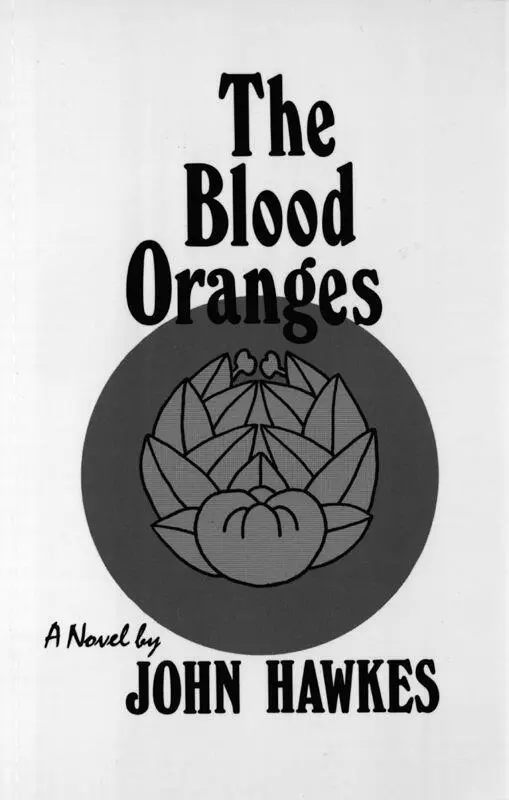
- Название:The Blood Oranges
- Автор:
- Жанр:
- Год:неизвестен
- ISBN:нет данных
- Рейтинг книги:5 / 5. Голосов: 1
-
Избранное:Добавить в избранное
- Отзывы:
-
Ваша оценка:
The Blood Oranges: краткое содержание, описание и аннотация
Предлагаем к чтению аннотацию, описание, краткое содержание или предисловие (зависит от того, что написал сам автор книги «The Blood Oranges»). Если вы не нашли необходимую информацию о книге — напишите в комментариях, мы постараемся отыскать её.
"Need I insist that the only enemy of the mature marriage is monogamy? That anything less than sexual multiplicity. . is naive? That our sexual selves are merely idylers in a vast wood?" Thus the central theme of John Hawkes's widely acclaimed novel
is boldly asserted by its narrator, Cyril, the archetypal multisexualist. Likening himself to a white bull on Love's tapestry, he pursues his romantic vision in a primitive Mediterranean landscape. There two couples — Cyril and Fiona, Hugh and Catherine — mingle their loves in an "lllyria" that brings to mind the equally timeless countryside of Shakespeare's
.
Yet no synopsis or comparison can convey the novel's lyric comedy or, indeed, its sinister power — sinister because of the strength of will Cyril exerts over his wife, his mistress, his wife's reluctant lover; lyric, since he is also a “sex-singer" in the land where music is the food of love.
The Blood Oranges — читать онлайн бесплатно полную книгу (весь текст) целиком
Ниже представлен текст книги, разбитый по страницам. Система сохранения места последней прочитанной страницы, позволяет с удобством читать онлайн бесплатно книгу «The Blood Oranges», без необходимости каждый раз заново искать на чём Вы остановились. Поставьте закладку, и сможете в любой момент перейти на страницу, на которой закончили чтение.
Интервал:
Закладка:
We looked, we waved, Catherine’s eyes met mine.
“Starting over,”I murmured and laughed, straightened my spectacles, wiped the spray from my face. Catherine smiled. At last, I thought, we had come under the aegis of the little crouching goat-faced man half naked at the end of the day. What more could we ask?
WE BROKE, WE RAN, WE SCATTERED UPWARD ON THE FACE of our favorite hill like birds or like children, and because I was last in line, lowest figure in that bright pattern, and was holding back as usual (tail of the kite, conscience and consciousness of our little group), I found myself generalizing the visceral experience of the moment itself, found myself thinking that our days were idyls, our nights dreams, our mornings slow-starting songs of love. On my extreme right Fiona was already halfway up the hill (hands waving, large woolen bag slung over her shoulder army-style and bouncing on a lean hip), Hugh was angling in sly pursuit, off to my left Catherine was stumbling loosely and happily toward the bare crest of that familiar hill, while behind them all and on a clear tangent between Hugh and Catherine I brought up the rear heavily, gracefully, varying my speed, saving my breath, and wondering what effect this kind of dawn exertion might have on the ruthless fist lodged in the blackness of Hugh’s chest. The early morning trip to the hill was Fiona’s idea, of course, and I suspected that even had she known of Hugh’s secret ailment, which apparently she did not, there would have been no change in Fiona’s plans, no slacking of Fiona’s pace.
“Come on, boy,” Hugh shouted over his shoulder, “quit lagging.”
I waved him on. In the chilly air and on the tawny slope between two darkly nesting growths of small olive trees, the four of us constituted the four major points of the compass oddly compressed, distorted, oddly disarrayed, and Fiona sprinted girlishly toward the top where the silence had no direction and the sun in another moment or two would be rising.
Like birds, I thought, like children. In a glance I recorded Catherine’s dark brown slacks, Hugh’s black bell-bottoms, Fiona’s white shorts cut low on the waist and high on the thighs (tight elasticized garment winking above me in the dawn light), my own soft cord trousers hastily donned in semidarkness and stuffed into the tops of large and only partially laced chamois boots now slow and rhythmical on the stubbled surface that smelled of dead grass, sharp spice, sweet dust. My faded denim shirt still unbuttoned and flowing away from massive breast with its bronze luster and sleep-matted hair, Hugh’s black turtleneck, Catherine’s plain mustard-colored blouse, Fiona’s pink shirt unbuttoned and merely tied at the waist — even these simple details of careless dress reminded me of Fiona’s whimsical leadership and unaccountable energy. Thanks to a nudge from Fiona’s elbow and the sound of her voice, we were all four of us only minutes away from the twin villas and still sleeping children. A few details of clothing revealed at least to me our haste, our dawn dishevelment, our desire to please each other, our sense of well-being against that panorama of steepening hillside and wiry dark green trees.
“Don’t say anything, Cyril. Don’t spoil it.”
The top. The silence filled with the smell of thyme. And I who might well have been first came last, climbed over the crest and smiled at Fiona’s eager words and squeezed into my place on the fragment of stone wall between Catherine, who was out of breath, and Fiona, who was always breathless yet never out of breath. I drew up my heavy knees and wiped my mouth on the back of my arm and sighed. Hugh’s heart was pounding, Catherine’s dark hair was loose. From Fiona’s bare stomach came a faint brief purling sound of some internal agitation, Hugh cleared his throat, Catherine shifted audibly on the cold stones. And clasping my knees and leaning to the rear so that I was able to glance at Hugh behind Fiona’s firm curving back, for a moment I caught Hugh’s eye and smiled. Was he attempting to convey some kind of masculine detachment in the grip of Fiona’s enforced silence and rather theatrical poetic expectancy? I could not be sure. At least I could afford to nod and smile at the narrow sweat-drenched stony face and did so.
“What’s all this about the sunrise, boy?”
But before I could answer: “Shut up, Hugh. For God’s sake.”
I respected Fiona’s need for silence, always respected the stillness that contained her sudden electrical sense of purpose, and so refrained from remarking that dawn was Fiona’s hour and that everything about my wife suggested the flights of dawn and excitement of the first light, despite her admitted shivers of theatricality and the interference of Hugh’s crude temperament. Behind Fiona’s tight back I shrugged, glanced away from Hugh, and allowed this first clear chilly breath of morning to fill my chest. Fiona said nothing more, Catherine leaned forward and crossed her legs. Like Fiona, I tilted my head back into the rising light and contented myself with the paradox that while Fiona was concentrating on the sunrise Catherine was no doubt thinking of nothing more than the possibility of turning and placing a gentle hand on my bare chest. Again Hugh cleared his throat.
So we sat together, waited together, on a fragment of stone wall in this sacred spot. At our feet lay the abrupt and nearly vertical and rock-strewn descent, and down there the windy darkness of the miniature valley contained one field of waist-high grass (remembered now from previous occasions rather than seen) as well as a single line of small pungent olive trees marching, so to speak, across the soft floor of that sheltered contour of darkness, gloom, silence. But beyond it all, beyond perfect valley and rock wall and Fiona, Hugh, Catherine and me (four witnesses seated flank to flank in the uninterrupted tension of Fiona’s rare feminine interest in natural phenomena), three low purple hills and a sweep of bare silvery horizon belied witnesses, lyricism, grape-bespattered joys of love, sleeping children, sleeping invisible village, belied the sunrise itself. Once more it occurred to me that the splendor of ominous distance reflected a side of Fiona and even an aspect of my own personality which Hugh, for instance, would never appreciate. After all, Fiona enjoyed the sight of moody colors and somber landscape — why not? Only Hugh’s compulsive interest in Fiona’s more obviously active life blinded him, I decided then, to the understandable necessity of Fiona’s silences. Fiona was sexual but hardly simple.
“Look, baby,” she whispered clearly, “an eagle.”
“Big one,” I murmured, “a real beauty.”
“Where, boy? I don’t see any eagle.”
“Take another look,” I said after a moment. “He’s there.” It was a small matter, of course, and yet the sky, it seemed to me, was empty except for rolling darkness and cold bands of silver. I looked, I squinted (seeing dark hills, inhuman sky, nothing more) and assumed that this was merely another instance of Fiona’s occasional inaccuracy for the sake of a deeper vividness, for the sake of an important mood. Between Fiona’s voice and Hugh’s sometimes brusque insistence on reality there was, for me, no choice.
“I see him,” Catherine said, and pointed. “Up there.”
“She’s right, boy. He’s unmistakable.”
Nodding, suddenly identifying the crooked speck at the end of Catherine’s finger: “A sign,” I murmured deeply, agreeably, “it’s a doubly significant sign, Hugh, don’t you think?”
“Keep quiet, baby. Please.”
Correct and incorrect, I thought, right and wrong. And yet at bottom my sense of the situation was essentially true, and I felt only pleasure at the sight of this new justification of Fiona’s vision and my own supportive role. Unmistakably, as Hugh had said, the eagle was now hooked almost directly above us on bent but stationary wings in the black and silver medium of the empty sky. Stark, unruffled, quite alone, a featureless image of ancient strength and unappeased appetite, certainly the distant bird was both incongruous and appropriate, at once alive and hence distracting but also sinister, a kind of totemic particle dislodged from the uninhabited hills and toneless light. Here, I thought, was a bird of prey that would utter no cry, make no kill. And for some reason his presence brought to mind the handfuls of dark cherries which Fiona was carrying in the off-white woolen bag still slung from her firm shoulder.
Читать дальшеИнтервал:
Закладка:
Похожие книги на «The Blood Oranges»
Представляем Вашему вниманию похожие книги на «The Blood Oranges» списком для выбора. Мы отобрали схожую по названию и смыслу литературу в надежде предоставить читателям больше вариантов отыскать новые, интересные, ещё непрочитанные произведения.
Обсуждение, отзывы о книге «The Blood Oranges» и просто собственные мнения читателей. Оставьте ваши комментарии, напишите, что Вы думаете о произведении, его смысле или главных героях. Укажите что конкретно понравилось, а что нет, и почему Вы так считаете.