Mircea Cărtărescu - Blinding - Volume 1
Здесь есть возможность читать онлайн «Mircea Cărtărescu - Blinding - Volume 1» весь текст электронной книги совершенно бесплатно (целиком полную версию без сокращений). В некоторых случаях можно слушать аудио, скачать через торрент в формате fb2 и присутствует краткое содержание. Год выпуска: 1996, ISBN: 1996, Издательство: Archipelago, Жанр: Современная проза, на английском языке. Описание произведения, (предисловие) а так же отзывы посетителей доступны на портале библиотеки ЛибКат.
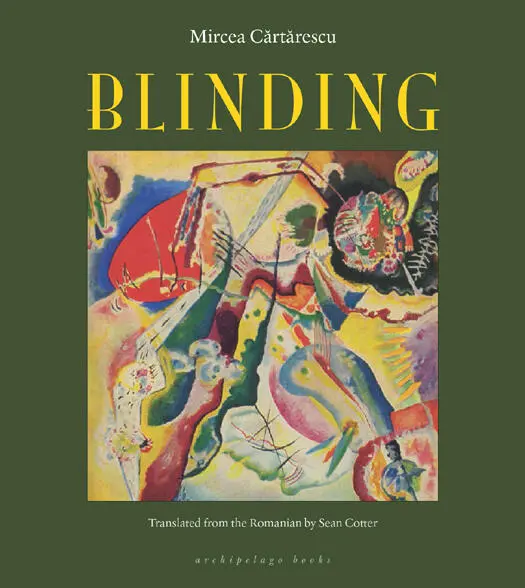
- Название:Blinding: Volume 1
- Автор:
- Издательство:Archipelago
- Жанр:
- Год:1996
- ISBN:9781935744856
- Рейтинг книги:3 / 5. Голосов: 1
-
Избранное:Добавить в избранное
- Отзывы:
-
Ваша оценка:
Blinding: Volume 1: краткое содержание, описание и аннотация
Предлагаем к чтению аннотацию, описание, краткое содержание или предисловие (зависит от того, что написал сам автор книги «Blinding: Volume 1»). Если вы не нашли необходимую информацию о книге — напишите в комментариях, мы постараемся отыскать её.
was one of the most widely heralded literary sensations in contemporary Romania, and a bestseller from the day of its release. Riddled with hidden passageways, mesmerizing tapestries, and whispering butterflies,
takes us on a mystical trip into the protagonist’s childhood, his memories of hospitalization as a teenager, the prehistory of his family, a traveling circus, secret police, zombie armies, American fighter pilots, the underground jazz scene of New Orleans, and the installation of the communist regime. This kaleidoscopic world is both eerily familiar and profoundly new. Readers of
will emerge from this strange pilgrimage shaken, and entirely transformed.
Blinding: Volume 1 — читать онлайн бесплатно полную книгу (весь текст) целиком
Ниже представлен текст книги, разбитый по страницам. Система сохранения места последней прочитанной страницы, позволяет с удобством читать онлайн бесплатно книгу «Blinding: Volume 1», без необходимости каждый раз заново искать на чём Вы остановились. Поставьте закладку, и сможете в любой момент перейти на страницу, на которой закончили чтение.
Интервал:
Закладка:
Distractedly regarding the reflection of his face in the Comrade’s portrait on his desk, Ion Stănilă admitted, in his heart, that he would not be capable of something like that. Secret agents were heroes whom he raised to superhuman heights. But as for himself … it was enough he had gotten this far. The rest of his family was still in the country. His brother had had such a hard time in ’58, when collectivization left him hobbled with a bad hip and a twisted hand, that he would have been begging at the church door if Ion hadn’t found him a job in the garage. So now Luca washes under the car with the hose, brings the mechanics cigarettes and bread buns, what can you do … Since his family had turned in the horses and been left with the cart in the barn (they had been to Măgureni last summer and been sad to see the way the beautiful landscapes of blue serenas and red flowers were flayed off of the rubber-tire cart), it looked like the whole family had gone senile. Ion always had to intervene at the mayor’s, the People’s Guidance, to ask that the authorities not take the vinery away … And here he was, an officer in the Securitate, with a big salary, success on every side, living in a house with calcio-vecchio and an interior stairway, and more importantly, with a woman who made everyone’s mouth water when they went out to a restaurant. “You know when my frickin yid walks in, with freckles down to her ass, in that red deux-pièces and red high heels, even the waiters have their mouths hanging open. What they wouldn’t do to her, there she walked, all tits and ass, her purse in her hand, down the carpet in the Athenée, the Hall of Mirrors …” Yes, he had been much luckier than other people. Many had been stuck on one level or another without knowing why, and it was more than certain that he would have gotten stuck, too, if the propaganda secretary at the university (“Aaah, I’m going to flee the country … oh, give it to me! harder!.. I’m giving a speech in Europe … uuuh! do me, lover … do my ass … aoleu! oh! down with Communismmmmmm …!”), his dear little wife, hadn’t watched over him, with her frightening dedication to principle. Take Dunăreanu: he went down on something stupid. He said something offhand at a party … something about Dubcek … or who the hell knows, just a joke, but his well-meaning colleagues ratted him out. Now he’s teaching Party history at who knows what communal school. With Maria’s man Costică it was something else: the comrades took them both at once, one from scrubbing statues, and the other from the metal shop in the ITB on Grozovici. “Comrade, would you like to go to officer training in the Securitate?” There wasn’t a stain on their files — they were children of poor peasants, not political. They had no family anywhere except Ficătari and Râmnicu Sărat. They were sharp kids who’d done junior high and an apprenticeship. That was in ’59. They took him and sent him right to Băneasa. Costică — blubba blubba blubba blubba (the officer had been flicking his lower lip and gotten lost for a moment). During the physical they found a cyst on one of his kidneys. No good for the Securitate, so they sent him to Ştefan Gheorghiu to become a newspaper man. But his kid, that snotty Mircea — who was like maybe … three at the time … (so they were still on Silistra) — when that smart Maria asked: “Dear, do you want your daddy to be a newspaper man?” he began to cry: for him, newspaper man meant the hunchbacked drunk who sold newspapers. Back then (you can see one even now) they wandered the streets, with a stack of newspapers in a pink cardboard box around their necks: “Informatia! Informatia!” Newspaper men and street cleaners were pretty much the same, in the minds of regular people. But two years ago, on Moşi, where Stănilă was dressed like a guy selling cardboard hats, trotting along on his mission to catch the spider-woman’s superiors, he had seen one of these lowlifes right next to the camper: he was staring, dead drunk, at the monkey-trainer’s tits on a billboard, while his newspapers fell from his box into the mud, one by one …
When they started to get rid of some of the yids (’cause the boss was a real anti-Semite), Estera became Emilia. Only close friends still used the old name. Comrade Stănilă Emilia — who once every year assembled the law school department secretaries and the student leaders (handsome young people, their hair cut like the Chinese or Koreans, the girls with skirts well below their knees) to tell them that love of country and Party was much more important than “the beloved person” — had been great during the winter of ’56, when a few mangy students had done some silly things. She had taken measures immediately, first assembling a complete list of all the hoodlums and putting it into the right hands. The officer smiled at the memory: what a nut! During those nights when frost grew high on the windows, Estera was fainting with excitement as she was taken vigorously from behind. She was in the college bathroom, kneeling beside the urinals, and those revolting students did her every way you could imagine, one after another and several at a time … Then she rose to the top of the University Party hierarchy, and now she would rise even more. They had called her to the Capital. He had seen her speaking at meetings several times, and she had an amazing way with words, chapter and verse. She had adapted perfectly to the changing of the Palace guards, from Russophile to nationalist. Ceauşescu’s name replaced Dej’s in the economy of her nocturnal orgasms, which, once Stalin was forgotten and the terrors ended (or because of her advancing age?) diminished slightly in drama, while becoming longer and more carefully staged.
Lieutenant-Major Ion Stănilă wasn’t really known for his intelligence in the Department of State Security. Instead, a mean hillbilly cunning had kept him away from traps, from his colleagues’ ill will, from deals that were too dirty or from deals where you would end up knowing too much. His work had been routine: he recruited informants in a few businesses, so that his desk always had a pile of inarticulate and boring reports, which, no matter how hard you tried, you couldn’t squeeze anything out of — this one did this, that one said that … “Yesterday, 26 V ’967 was paiday and Maistru Boţan Ilie had a beer, telled the one about the Chief in Hell in a shit tub. He also say that Communists is a society for lazy peoples, that the Germans don’t goof off like we do. He say that over there, the engiuneers keeps their asses in the chairs and their eyes on their works, and we do it all backwards, we keeps our eyes on the chairs and asses in our works …” Most infractions were for political jokes. How the hell were you supposed to arrest a person for that, especially since you knew that the jokes were put out, along with all the rumors, by a special team in Buzeşti, by your own colleagues adapting them from French collections … And they got passed to the Czechs, Bulgarians, Russians, and Poles, so it was no shock that the whole camp laughed at the same jokes, just changing Kadar into Brezhnev or Walter Ulbricht into Ceauşescu. Better to have them laugh than march in the streets. Or how were you supposed to arrest someone for listening to Radio Free Europe? First of all, there weren’t a lot of people doing it, and then, even those who were said it was all lies and provocations. The youth have their music. They need something to suck on, or else they’ll do something even sillier.
Two years ago, he had been surprised to be taken from the routine of meeting stool pigeons in safe houses (actually the squalid dwelling of some worker who left a key for him to use the place while he was at the factory: many of his colleagues used these houses, in fact, more as “fuck rooms” for their women), and to receive his first more unusual mission. Information existed that throughout Eastern Europe, wandering troupes of free-professionals had appeared, nomadic circus performers who entertained at fairs and vacant lots at the edge of town, troupes that resisted legitimate attempts to centralize the artistic phenomena of the circus world and place it under state control, following the model of the celebrated Moscow State Circus. Of course, there had always been rope dancers, fire swallowers and sword swallowers, strong men, dwarves, and paranormals, but what was happening now was completely different. The itineraries of some twenty of these kinds of troupes, from Gdansk to Groznâi, had followed pointless routes, apparently unconnected to immediate sources of profit. They often arrived at market sites and regular festivals, but not during the traditional fair season. Some drove covered carts or GAZ trucks with clanging sheet metal and drove in circles, while others, after a long straight path, sometimes going through rapeseed and sunflower fields, suddenly curled wide toward the left. As though on command, all of the troupes performed their shows simultaneously, on the same day and at the same time. This made the KGB officers, who were the first to be briefed (coincidence?) on the circus people’s strange maneuvers, suppose that there was either an existing plan, known and followed like a train schedule by all of the troupes, or that there was constant communication between the convoys. The second hypothesis fell right away. There was no physical contact in evidence, not by radio, homing pigeons, or human messengers. The idea of a pre-existing conspiracy, probably against state orders (there was some evidence in this respect), became the working hypothesis of the socialist secret services, even though the possibility of a political, military, or even industrial espionage network was not ruled out (some of the circus people did own and use cameras, old ones, true, actually daguerreotypes, which projected inverted images directly onto opaque glass plates). Moscow sent a coordinated plan of counterattack to the satellite countries. Then, in 1966, and not two years later, the first rebellion against the Russians had happened nearby, those first beatings of national pride; the Securitate leadership checked with the “Big Chief” to cover its ass and then rejected the Soviet plan, with many tactful caveats, demonstrating that, given our particular conditions, measures should be taken on the local level. The national plan was code-named “Operation Sycamore,” not for some occult reason, but simply because the officer in charge was Major Sycamore Bădescu. Being a bit of a physiognomist — the Major had written his doctorate in criminology on the works of Gall and Lombroso, in connection with recent work on “the crime chromosome” —, the officer chose the most “folksy-faced” people for the operation, so that they would integrate perfectly into the atmosphere on Moşilor Street. Idiots, fatties, rosacea drunks, crosseyed hillbillies, one-toothed brachycephalics, women with beehives and powdered faces, teenagers with wet lips and the crooked gaze of onanists — this was the profile of ideal agents for the present mission, in the Fellini-like vision of Major Bădescu. The fact that all of these features presupposed a subsidiary oligophrenia produced a paradox: like any artist, the major would have to accept that his ideal was impossible in the world of the senses. Wasn’t it Leonardo da Vinci himself who said that the hand cannot follow the mind? “La polizia e una cosa mentale,” said Sycamore Bădescu to himself, smiling bitterly, and he used what he had at hand.
Читать дальшеИнтервал:
Закладка:
Похожие книги на «Blinding: Volume 1»
Представляем Вашему вниманию похожие книги на «Blinding: Volume 1» списком для выбора. Мы отобрали схожую по названию и смыслу литературу в надежде предоставить читателям больше вариантов отыскать новые, интересные, ещё непрочитанные произведения.












Обсуждение, отзывы о книге «Blinding: Volume 1» и просто собственные мнения читателей. Оставьте ваши комментарии, напишите, что Вы думаете о произведении, его смысле или главных героях. Укажите что конкретно понравилось, а что нет, и почему Вы так считаете.