Mircea Cărtărescu - Blinding - Volume 1
Здесь есть возможность читать онлайн «Mircea Cărtărescu - Blinding - Volume 1» весь текст электронной книги совершенно бесплатно (целиком полную версию без сокращений). В некоторых случаях можно слушать аудио, скачать через торрент в формате fb2 и присутствует краткое содержание. Год выпуска: 1996, ISBN: 1996, Издательство: Archipelago, Жанр: Современная проза, на английском языке. Описание произведения, (предисловие) а так же отзывы посетителей доступны на портале библиотеки ЛибКат.
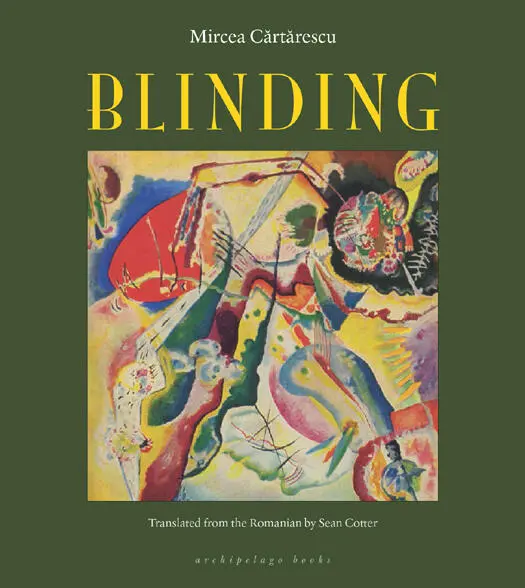
- Название:Blinding: Volume 1
- Автор:
- Издательство:Archipelago
- Жанр:
- Год:1996
- ISBN:9781935744856
- Рейтинг книги:3 / 5. Голосов: 1
-
Избранное:Добавить в избранное
- Отзывы:
-
Ваша оценка:
Blinding: Volume 1: краткое содержание, описание и аннотация
Предлагаем к чтению аннотацию, описание, краткое содержание или предисловие (зависит от того, что написал сам автор книги «Blinding: Volume 1»). Если вы не нашли необходимую информацию о книге — напишите в комментариях, мы постараемся отыскать её.
was one of the most widely heralded literary sensations in contemporary Romania, and a bestseller from the day of its release. Riddled with hidden passageways, mesmerizing tapestries, and whispering butterflies,
takes us on a mystical trip into the protagonist’s childhood, his memories of hospitalization as a teenager, the prehistory of his family, a traveling circus, secret police, zombie armies, American fighter pilots, the underground jazz scene of New Orleans, and the installation of the communist regime. This kaleidoscopic world is both eerily familiar and profoundly new. Readers of
will emerge from this strange pilgrimage shaken, and entirely transformed.
Blinding: Volume 1 — читать онлайн бесплатно полную книгу (весь текст) целиком
Ниже представлен текст книги, разбитый по страницам. Система сохранения места последней прочитанной страницы, позволяет с удобством читать онлайн бесплатно книгу «Blinding: Volume 1», без необходимости каждый раз заново искать на чём Вы остановились. Поставьте закладку, и сможете в любой момент перейти на страницу, на которой закончили чтение.
Интервал:
Закладка:
“Stop! Stop! Turn on the lights!” yelped Stănilă suddenly, leaping to his feet. “Securitate!” The spotlight went out and there was a terrible scramble. People poured out on every side, running into and trampling each other. “Turn the lights on for fuck’s sake!” shouted the officer again, trying to get to the stage, buffeted by bodies in fur coats. Now he knew: the contact had been made! The butterfly was the message! “You thieves!” he shouted like he was out of his mind when he finally reached the dirty stage wings, a booth in fact, full of moth-eaten costumes. He grabbed the collar of the barker who, in the gray light of day that came through the window, was a poor little man with the face of a civil servant. The spider-woman was nothing other than a slutty girl with a chin full of zits, who had just taken the black and hairy legs made of thread-filled rags off her hips. The snake swallower was in a housedress and was combing the chimpanzee’s head for fleas, holding it in her lap like a child. A woman burst in, frightened, holding a piece of old newspaper — the baba in lamé, who left the booth door open in her surprise. “Aha! The evidence! You’re doing yourselves in!” Stănilă grabbed the newspaper that the woman was bringing back from the privy, unfolded it and …
Two years later, the officer still could see before his eyes an enormous, illegible, hazy newspaper article with a headline two fingers tall that he tried in vain to read, an article printed around a map of Eastern Europe, the socialist camp, over which, in a large arc, beginning with Eastern Germany, going down through Czechoslovakia, Hungary, and Romania, and climbing again toward the middle of the Russian steppes, a word was written, in enormous type:
BLINDING
The lieutenant knew that he was holding a document of historic importance. The letters showed nothing other than the path of the travelling caravans, which cut through fields, crossed watercourses, went brazenly up mountains and sank into sulfurous swamps to draw (for whose eyes?) with invisible traces a word across the curvature of the planet. He alone, Securitate officer Stănilă Ion, through his exceptional abilities, had unmasked a (fascist? American? or, like he had read in Science and Technology magazine, extraterrestrial?) conspiracy against the state powers of the Warsaw Pact. Naturally, what he had found was only one tile of the politico-diplomatic chain of dominos, but it was essential. His superiors barely realized how important it was. As for him, he could not have imagined a greater triumph than to go home one fine day and embrace his little Jew and whisper in her ear: “Wife, take a look at your major!” “I’m very curious to know how a major makes love,” she would whisper, and the two of them would end up on the rug in their house’s sumptuous hallway …
Unfortunately, none (or almost none) of this happened. Stănilă did not receive anything more, two years later, than one star to go with the other two on his epaulet. A banal promotion, for years of service, not merit. After a moment of panic, the circus people had asked for his identification, and he discovered that he had no papers on him at all. They had been stolen in the crowd, even the badge from his coat pocket. Then the circus people began to yell and hit him with whatever they could find, shouting, “Crazy jerk! Get out, get the hell out of here!” Even the monkey jumped on his back and yanked his hair. Scratched and beaten by gypsies, smeared with greasepaint by saltimbanques, and blinded by clouds of face powder, he was sent off with a formidable kick from the spider-woman directly into the putrid pond behind the wheeled booth, where he lay unconscious until evening. When he woke up, across the sky there was nothing but a blood-colored stripe. The caravan had disappeared, and nothing more remained but the wooden sideshow booth in the middle of the deserted piaţa. Behind him, the motionless chain carousel stood against the sky like a sad mushroom. A dull bulb on a lightpost, far away, increased the air of desolation. The suitcase of fair trinkets, of course, had also disappeared. The officer came home huffing and hawing, after he had argued with the tram inspector because he didn’t even have five bani for a ticket. The last surprise of the unhappy day awaited him in his little nest of folly, where he found his wife discovering with delight how a major makes love … his own supervisor, Sycamore Bădescu, whose ruddy butt, decorated with two large balls, was pumping vigorously between the white gams, in satin stockings, of his Esther. It was given to the unhappy lieutenant to listen one more time, covered in mud and propped against the bedroom doorway, to her passionate abuse of the leaders of humanity …
Having reached this desolate point in his remembrance, the lieutenant-major, sitting in his office in an anonymous Bucharest building, held his head in his hands and pressed his eyeballs with the tips of his stiff fingers. He pushed until the green-blue dots drew a misshapen carpet over his field of vision that reminded him of the ink blots of a Rorschach test, where, at the time, he had only seen, only … but the officer refused to remember what came next, and he pushed away, with desperate gestures, the flashing images, loaded with hate and horror, with which his consciousness assaulted him: the starched fabric of the straightjacket, the bearded doctor, the tranquilizers, the fights with the other patients, the escape attempt at night, in his pajamas, in the deserted quiet of the tram. He’d been captured again and held in the high-security wing for six months, and for two of those weeks he’d been strapped down … And then the morning when he woke up with a clear mind and feeling light, completely in control of himself, when he asked to be contacted by his superiors regarding a question of maximum importance … The Securitate acknowledged him only after another week, during which he was subjected to countless tests, each more disconcerting than the one before, jumping between questions and images, until Stănilă came to believe he was simply a lab rat, the object of some research, with his mind exposed to reveal its obscenity and turpitude to inscrutable superhumans. They applied the Minnesota Multiphase Personality Inventory, which through its 550 questions crucified him on four validity scales (? L, F, and K) and nine clinical scales (hypochondriasis, depression, hysteria, psychopathic deviate, masculinity/femininity, paranoia, psychasthenia, schizophrenia, hypomania). Then came Galton’s word-association test in the Jungian variation, the thematic apperception, the Rosenzweig study, with 24 pictures of frustration, and the Szondi test, with 48 photographs of mental patients … In the end, terrible, terrible butterflies drawn in charcoal, pencil, and blood on the Rorschach cards ( Herman Rorschach — isn’t that strange?), where he couldn’t see anything but … From messer Sandro di Mariana a. k. a. Botticelli, Leonardo da Vinci learned to stimulate the imagination through chance marks left on a wall by a paint sponge. You could see landscapes and battles, and yellow human torsos turned in strange positions, but more importantly you saw yourself, since ogni pintore depinge se … Koch’s Baum test and the Machover Draw a Person test concluded the graphico-linguistic avalanche that a normal, dignified mind would have responded to in only one way: aphasia, and it may in fact be that this is always the response.
The pajama-clad lieutenant was in a daze of tests and para-tests when he was visited by an unusually massive man, with a head like an ox and brown eyes, who stood beside his bed, hands in his pockets, looking toward him without much interest. “I’m just a pig-farmer’s kid,” said Stănilă to himself, over and over, and not only in this regard. “That’s what we country people are, damn pig-farmer’s kids, ready to pull our hats on our hearts whenever the boyar comes.” And in fact, everyone in the hospital room had stood up in a kind of silly ten-hut even before the stranger showed his papers. And the truth is that he didn’t make a great effort. The doctor who followed him was so scared-looking that he didn’t need any other identification. At a wave, the doctor disappeared, and a short and frustrating discussion followed. The stranger did not believe one iota of the phantasmagoria with the spider-woman. It’s also true that he didn’t think the jejune lieutenant was lying. He believed that there, in the side-show booth, something else had happened: that the officer had found out about something so terrible that his mind had sealed the revelation off, had vomited it out like poison, like an object it could not digest, and it had woven in its place the flimsy scenario that Stănilă remembered. The traces of the truth might persist in his subconscious, so that the superior officer (Romanian Securitate? KGB? Both at once?) recommended — it was, in fact, an order — that Stănilă be interrogated while in a state of disinhibition. Resigned, Stănilă accepted. He knew what the man was talking about: Jagodka disinhibition, something they had also used. How the hell, he always asked himself, were the high-class spies trained to withstand an Amytal Interview? In any case, this method had proven more efficient than torture, and it had revolutionized the interrogation process. Only South American cretins (Stănilă still thought, then) would still use the electric clamps. Bloodthirsty animals.
Читать дальшеИнтервал:
Закладка:
Похожие книги на «Blinding: Volume 1»
Представляем Вашему вниманию похожие книги на «Blinding: Volume 1» списком для выбора. Мы отобрали схожую по названию и смыслу литературу в надежде предоставить читателям больше вариантов отыскать новые, интересные, ещё непрочитанные произведения.










Обсуждение, отзывы о книге «Blinding: Volume 1» и просто собственные мнения читателей. Оставьте ваши комментарии, напишите, что Вы думаете о произведении, его смысле или главных героях. Укажите что конкретно понравилось, а что нет, и почему Вы так считаете.