Mircea Cărtărescu - Blinding - Volume 1
Здесь есть возможность читать онлайн «Mircea Cărtărescu - Blinding - Volume 1» весь текст электронной книги совершенно бесплатно (целиком полную версию без сокращений). В некоторых случаях можно слушать аудио, скачать через торрент в формате fb2 и присутствует краткое содержание. Год выпуска: 1996, ISBN: 1996, Издательство: Archipelago, Жанр: Современная проза, на английском языке. Описание произведения, (предисловие) а так же отзывы посетителей доступны на портале библиотеки ЛибКат.
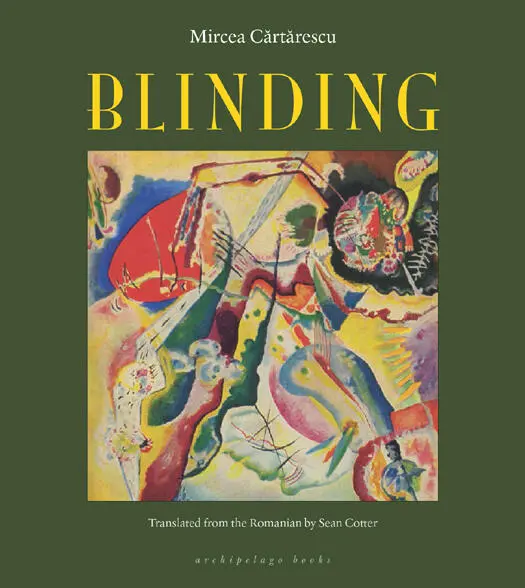
- Название:Blinding: Volume 1
- Автор:
- Издательство:Archipelago
- Жанр:
- Год:1996
- ISBN:9781935744856
- Рейтинг книги:3 / 5. Голосов: 1
-
Избранное:Добавить в избранное
- Отзывы:
-
Ваша оценка:
Blinding: Volume 1: краткое содержание, описание и аннотация
Предлагаем к чтению аннотацию, описание, краткое содержание или предисловие (зависит от того, что написал сам автор книги «Blinding: Volume 1»). Если вы не нашли необходимую информацию о книге — напишите в комментариях, мы постараемся отыскать её.
was one of the most widely heralded literary sensations in contemporary Romania, and a bestseller from the day of its release. Riddled with hidden passageways, mesmerizing tapestries, and whispering butterflies,
takes us on a mystical trip into the protagonist’s childhood, his memories of hospitalization as a teenager, the prehistory of his family, a traveling circus, secret police, zombie armies, American fighter pilots, the underground jazz scene of New Orleans, and the installation of the communist regime. This kaleidoscopic world is both eerily familiar and profoundly new. Readers of
will emerge from this strange pilgrimage shaken, and entirely transformed.
Blinding: Volume 1 — читать онлайн бесплатно полную книгу (весь текст) целиком
Ниже представлен текст книги, разбитый по страницам. Система сохранения места последней прочитанной страницы, позволяет с удобством читать онлайн бесплатно книгу «Blinding: Volume 1», без необходимости каждый раз заново искать на чём Вы остановились. Поставьте закладку, и сможете в любой момент перейти на страницу, на которой закончили чтение.
Интервал:
Закладка:
At eleven, as usual for that day of the week, I went off again through the hospital corridors to the office where I did “the rays.” This time it seemed like I made it there extremely easily, in a second. The vast labyrinth of green corridors was reduced (at least in my memory) to a single corridor, with a door at the end that seemed to me, maybe from the semi-shadow, scarlet and mysterious. When I went in, though, I found the banal and pitiful electrotherapy office, with mounds of devices dating from the time of Volta, exhibits from a technological museum. In the seventh grade I had tried to build a voltameter from cardboard, wire, and an empty marmalade jar: all of the instruments here seemed made by students in a workshop, from the same materials. Miraculously, they still worked, although the only proof was the movement of the stamped metal needles in the graded windows of thick, green glass. There was no sign of the doctor except a copy of Sport , forgotten on the chair, with pages turned down. But why did I need a doctor? I sat where I always did facing the galvanized metal monster, and I greased my temples with a little Vaseline from a yogurt jar. Then I put the electrodes on my temples, glued them with leucoplast, and stuck the prong at the end of the wire into its ebony plug. I turned the potentiometer gently toward the right, watching the needle come to life and move slowly over the screen. At the same time, I started to hear the somehow reassuring little sparks of heated Vaseline. Then I sat still, with my eyes closed, swimming again in my imagination, in the fabulous trajectory of rays through the empire of my mind. There were ghost towns there, villas with crystal columns, and torture chambers with instruments of gold. There were crematoria with violet smoke coming from their chimneys. There were Flemish houses lining canals where cephalorachidian fluid flowed lazily. There were chameleons with iridium jaws. While I watched the mysterious cavernous flux, I was blinded now and again by the multicolored shine of cave flowers. I was moved emotionally by a naked girl wrapped in cobwebs, by a pregnant woman whose stomach curved as much as possible and broke like a pomegranate and scattered into the holy night of light and blood, and by an old woman in a shell of sugar. In my mind, the words of the “saint” suddenly rang out, clearer than any real sounds that her vocal chords and cartilage could have made, echoing like in a frozen hall: “Go all the way! All the way!” Then, another voice, indescribably terrifying, annihilating, so intense and closed within itself that it could not have been composed of sounds, but phonemes, whispered quietly and powerfully in my brain: “Mircea.” For a moment, the enormous universe had this name. “Here I am, Lord,” I whispered, opening my eyes. I already knew what was being asked of me. And it was as though everything had already happened long ago. As I stood shaking in front of the tangle of wires and screens, with Vaseline licking my cheek and throat, for a long time I didn’t move at all. Finally, I put out my hand and took the potentiometer knob between my fingers. I can still feel its hard ebony ridges. I was not inside my body. Everything seemed like a sculpture from a block of yellow matter, a forgotten legend, an incomprehensible allegory. “All the way!” ordered the quiet, impenetrable nurse, who had no glottis, hyoid bone, tongue, tonsils, or palate. In the emotional sculpture one detail began to move. My fingers turned an ebony knob toward the right. A metal needle also glided to the right in a graded window, watched by two brown, inexpressive eyes. Hermetically sealed, like a syllable, in the glass vial of my body, I watched helplessly as I made the most insane gesture of my life, the one that unleashed, perhaps, everything. After I had turned the knob very slowly, after my lunatic internal structures began to shake, and chimeras and stone gargoyles fell off and smashed to bits on the pavement, and the quartz architraves of my temples cracked in zigzags, and a population of giant myriapods and termites swarmed in the dusk, I quickly turned the button all the way !
Back from the bathroom, the doctor found me on the floor, convulsing with clonic spasms, with red foam on my lips (I had broken a molar and bitten the inside of my cheek) and my pajama bottoms drenched. My temples smelled like something burnt. They took me to the basement, to intensive care, where I stayed in a coma for more than a week. They fed me glucose intravenously, and then through a tube down my nose. My epileptic seizures continued daily. When I opened my eyes again, it was evening, and a dry sadness floated over the intensive care ward full of people in agony, thousands of kilometers under the earth, with all history and all shapes and all ages. The patients lay on their tables wrapped in plaster sheets. A nurse in white, with a waxy face, stood still beside a podium. Nickel cases with boxes of syringes vibrated gently in the light-brown air. I stayed another week in that cargo hold. I saw outlines without being there myself. I made out sounds — moans, footsteps, a clink — without ears or hearing. Someone defecated, at times. Someone urinated. I was a duplicate, a copy, a picture, a mannequin. I saw, I felt, what a movie character sees, feels, and thinks, a character who moves and talks but is, in the end, only a spot of emulsion on a filmstrip. What despair and horror hides beneath the arrogant attitude and turned-up mustache of a grandfather, long dead, of whom only a picture is left? I was also long dead. They kept just my simulacrum. Glazed surfaces, eternal evening, plaster statues on sarcophagi … Falling back into sleep, wrapped to the neck in my liver and bile and nerves and guts … Curled up in my own stomach, feeding like a parasitic worm on the striated muscles of my homunculus … Blowing a living mist on my own mirror …
On one of the evenings, when the intensive care ward looked at itself for a few minutes, I suddenly felt that I was looking. I sat up, fresh and nonchalant, without any crack in my consciousness, perfectly aware of what had happened and where I was. I removed the transparent tube from my nose by myself, slowly, like an exotic parasite, and then I touched my face. Trying to smile, I noted — as I had already guessed — the elasticity and docility of my muscles that raised the corners of my mouth. I had made great progress. I could blink my left eye — true, more slowly than the right, and not all the way — and I could raise my eyebrows. For a few months, my smile would stay crooked, and my face would always have a gentle asymmetry. The world of my left eye, withered from so much privation and humidity, would be crepuscular and dark, with strange olive tones, but, combined with the radiant colors from the right, it would not bother me too much. On the contrary, this way my world has a special topography, which I didn’t notice before the illness, and which looks like the world in a dream, when every shape is porously illuminated by emotion.
Doctor Zlătescu, who was in charge of our ward, seemed to have expected I would come back to life. I hadn’t been myself more than an hour yet when she came toward my bed like a Fury, red with indignation, with her teeth clenched. She called me everything, stupid suicide, senseless, idiot kid. She asked me rhetorically (since she was too angry to listen to anyone) what had been in my sick head when I did that. Didn’t I realize I could have died, for Christ’s sake? Didn’t I think about my parents? And how bad would she look, she who was responsible for me as long as I was in the hospital? I listened, scared, embarrassed by the indecent sounds she made in the eternal twilight of the basement. I wouldn’t have known how to respond, anyway. After a little while she calmed down, spent, and sat on the edge of my bed, and after a long silence, she looked at me and smiled. Like a newborn who sees a smiling mask, I raised, reflexively, the corners of my mouth. “You’re going the right way, băbuţo,” she told me, mussed my hair a bit and left. I would see Doctor Zlătescu again after seven or eight years, one sunny day, downtown on Magheru Boulevard. I was with a friend from college and we were gossiping about the Folklore assistant when I saw her: even in the middle of summer when the asphalt melted under our feet, she was wearing a grotesque wool hat, with vines of her dandruffy hair coming out in all directions. On the breast of her spandex, fluorescent-green dress, she wore scout badges and medals. Yellow unit commander ribbons emerged from a purse of ripped white rubber-cotton that she’d found in some trash pile. Her face was a terrible mask of insanity. She talked incessantly, pointing at a parking sign … I was shaken for the rest of the day. That evening, I sat at the window for hours, in the twilight yellow like a sodium flame, repeating the motto of my life: “God, what is happening? What the hell is happening?” to which the city responded with murmurs and specters.
Читать дальшеИнтервал:
Закладка:
Похожие книги на «Blinding: Volume 1»
Представляем Вашему вниманию похожие книги на «Blinding: Volume 1» списком для выбора. Мы отобрали схожую по названию и смыслу литературу в надежде предоставить читателям больше вариантов отыскать новые, интересные, ещё непрочитанные произведения.











Обсуждение, отзывы о книге «Blinding: Volume 1» и просто собственные мнения читателей. Оставьте ваши комментарии, напишите, что Вы думаете о произведении, его смысле или главных героях. Укажите что конкретно понравилось, а что нет, и почему Вы так считаете.