Mircea Cărtărescu - Blinding - Volume 1
Здесь есть возможность читать онлайн «Mircea Cărtărescu - Blinding - Volume 1» весь текст электронной книги совершенно бесплатно (целиком полную версию без сокращений). В некоторых случаях можно слушать аудио, скачать через торрент в формате fb2 и присутствует краткое содержание. Год выпуска: 1996, ISBN: 1996, Издательство: Archipelago, Жанр: Современная проза, на английском языке. Описание произведения, (предисловие) а так же отзывы посетителей доступны на портале библиотеки ЛибКат.
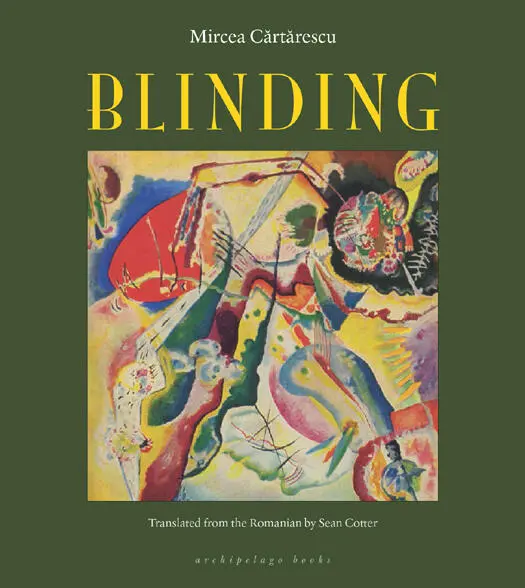
- Название:Blinding: Volume 1
- Автор:
- Издательство:Archipelago
- Жанр:
- Год:1996
- ISBN:9781935744856
- Рейтинг книги:3 / 5. Голосов: 1
-
Избранное:Добавить в избранное
- Отзывы:
-
Ваша оценка:
Blinding: Volume 1: краткое содержание, описание и аннотация
Предлагаем к чтению аннотацию, описание, краткое содержание или предисловие (зависит от того, что написал сам автор книги «Blinding: Volume 1»). Если вы не нашли необходимую информацию о книге — напишите в комментариях, мы постараемся отыскать её.
was one of the most widely heralded literary sensations in contemporary Romania, and a bestseller from the day of its release. Riddled with hidden passageways, mesmerizing tapestries, and whispering butterflies,
takes us on a mystical trip into the protagonist’s childhood, his memories of hospitalization as a teenager, the prehistory of his family, a traveling circus, secret police, zombie armies, American fighter pilots, the underground jazz scene of New Orleans, and the installation of the communist regime. This kaleidoscopic world is both eerily familiar and profoundly new. Readers of
will emerge from this strange pilgrimage shaken, and entirely transformed.
Blinding: Volume 1 — читать онлайн бесплатно полную книгу (весь текст) целиком
Ниже представлен текст книги, разбитый по страницам. Система сохранения места последней прочитанной страницы, позволяет с удобством читать онлайн бесплатно книгу «Blinding: Volume 1», без необходимости каждый раз заново искать на чём Вы остановились. Поставьте закладку, и сможете в любой момент перейти на страницу, на которой закончили чтение.
Интервал:
Закладка:
Mamma came every day to sob at my bed, to brush back my sweat from my brow and to straighten the bag of glucose on the stand. She also could not understand what had made me run hundreds of volts through my fragile skull, peeling off layers and layers of old calcium. When they moved me again to the neurology ward, she came back to life, especially when I could smile without effort. She kept trying to hide her hands, stiff and blackened like an auto mechanic’s, which I had seen right away, but I hadn’t wanted to say anything about their terrible state. She said she had cleaned the sink or undone the trap underneath, she wasn’t sure … Only when I went home again, after about ten days (during which time they did several EEGs without finding anything), I found out what had happened: my mother had argued horribly with my dad, and she was trying desperately to find a job and make a little money, so that he didn’t have to take care of her, a fact that he constantly threw in her face. Some newspaper ad had unleashed this mess. One day she came home with a spool of steel wire and a kind of bizarre drill, with a vise attached — it turned out to be a spring-turning machine. “Ma’am, this work isn’t for you,” the metal worker had said humbly at the shop that placed the ad, but my mother insisted, and now she was trying to work at home, in the kitchen, tripping over spirals of blackened wire, moaning and whining about her hands, while the springs came out crooked and twisted, or they sprang back, recalcitrant, smacking her fingers and scraping the backs of her hands. When she started it up, the drill screamed loud enough to make the whole block jump to its feet. In a kind of martyrdom mixed with pain and hate, and the desire to victimize the entire world, my mother kept at this dumb idea for a few months, and she never made even one spring right. Her hair smelled like hot iron, and her hands were one big wound, but she went back to her torture, night after night, with a crazed blindness, refusing to listen to anyone, her eyes fixed and red, and when I held her hands and tried to talk to her rationally, she writhed and shouted like she was out of her mind: “Leave me alone! Stay out of it, snotface! Leave me alone!” This was her plan to punish my father.
It had been a hard winter. The mounds of brown snow lining Ştefan cel Mare were taller than a person. The plows, lined up one after another, were still parked along the sidewalk, and their drivers, in coveralls and fur hats, stood in a circle for a little ţuica. In the morning, my windows were frozen everywhere. In the bottom part, the frost was completely dull and twisted in rhythms of Art Nouveau, while a hand’s width from the top, the ice became translucent, wet, and wavy, and through it, standing on the bedstead, I liked to look at the snowy city. The air was so milky then, and the fog was so compact, that the rapidly falling flakes were barely visible. Bucharest looked like a child’s drawing, all roofs buried in snow and smoking chimneys. The roads, in spite of the plows and salt, were covered again immediately with new immaculate layers, which then dirtied into puddles of milky coffee by twilight. And twilight came quickly, at four in the afternoon, when the streetlights came on, and the snow-filled sky darkened into rose and remained red all night. I spent countless nights at that window, watching how it snowed furiously in the neon lights, and counting cars and trams … Once, in a winter that I cannot place (in childhood? in a dream? in another life?), something disturbing and charming happened. Only a splinter of it remains in my mind, flashing now and then without hope of elucidation: the painful violet of the imagination … a snow-covered hill … a green window … Nothing more, but in this nothing was a tangle of beings and inexpressible states, a kind of a prophecy, an aura, a happiness with a tight heart …
In spring, late in April, at night, I had the first “dream” with that terrible, terrible sound, amplified into a flame. In the golden, transparent air of my waking mind, or my ultra-waking mind, open like a triumphant crown in my sleeping body, a spiral appeared in my head. A long and fine arc, made up of smaller spirals, each twisting in turn, rotated spiral after spiral, making another one, hundreds of times larger, which rotated in turn around another axis, making close, flexible circles. From the new tube another formed, and from this one another, endlessly upwards and downwards, so that you could climb up and down from spiral to spiral, from one existential level to another, without limits, you could encompass the entire spiral simultaneously in each of its spirals, you could simultaneously become the master of the universe and the nothing of nothingness … The grandeur of the embossed tubes that began at the third and fourth level up could barely be imagined, and the others grew exponentially, so much that they broke the crystal safe of any mind, escaping into obliteration and insanity. And still I followed them, while the sound of gold and the void grew with each new level, until the spirals and the sound were one, and my face shattered like a handful of dust in the breath of God. Then I screamed, carbonized by beatitude and torture, in phrases I no longer knew, although I could touch them like the hard blades of knives. After a time without succession, my being acquired an asymmetry, the volume of a non-spatial void and the absence of light. Just as abyssal caves swab the dark and cold with their bioelectric train, I felt a Being approach — a Being made of cosmoses. Every cosmos had inhabited worlds, and every one of those worlds had a multitude of inhabitants. Their material was fire, and their thoughts sparked like supernovas. I shouted toward that Being, and it responded.
The center of the dream, the gate, the vulva, can no longer be described. I woke up in another dream, in a foggy levitation, wandering through the well-known rooms of our apartment. At five in the morning, when the sun was a scarlet ball over the Dâmboviţa Mill and my sweaty parents were sleeping under disordered sheets, I felt a wave of love for my mother, for the closeness of her shape completely wrapped in a sheet, like a mummy. Then I went back to my own bed in the room above the street, a mechanical movement, without thought … I woke up disoriented. I remember the trip to the bathroom, my small pointless actions, and shaking all over, like a cornered animal … It would all repeat dozens of times, almost identically, up to today (yes, almost up to today ), for fourteen years. And each time after that, sometimes for a week, I dropped everything, sinking completely into my piercing sense of predestination. I was called toward something, there were signs, coincidences multiplied, and in my mind there were imperious and strange images, but I was to be held a bit longer in the antechamber of understanding. I would have preferred eternal torture, if torture was predestined. My past was the key, the disturbing signs seemed to be legible , I had to begin the great reading, but no shining star offered me any epiphany of understanding. I didn’t know whether the lines of my life (voices and caresses, clouds and cities, laughter and the earth full of worms) should be read vertically or horizontally, from the left or the right, of if I should go back and forth in the boustrophedon of my childhood. I didn’t know if the writing was pictographic, phonetic or if it was a writing at all. Illustrations and illuminations, vignettes and friezes with labyrinths of reeds decorated the old book of hours, its pages made of skin. In the filigree of every page, I could see a braid of blue and red veins, beating with a single pulse, irrigating the paragraphs. Arborescent nerves made every letter as sensitive as a tooth. Mistakes were attacked with antibodies of lymph. The parchment was alive, like skin just flayed from a martyr, and it smelled of ink and blood. What precisely was written on my skin, or what was tattooed there, between my nipples, was completely obscure to me. Thinking and fretting didn’t help, just as good eyesight doesn’t help an illiterate. After weeks of helpless reverie, I abandoned the search and returned to my sorry everyday life.
Читать дальшеИнтервал:
Закладка:
Похожие книги на «Blinding: Volume 1»
Представляем Вашему вниманию похожие книги на «Blinding: Volume 1» списком для выбора. Мы отобрали схожую по названию и смыслу литературу в надежде предоставить читателям больше вариантов отыскать новые, интересные, ещё непрочитанные произведения.












Обсуждение, отзывы о книге «Blinding: Volume 1» и просто собственные мнения читателей. Оставьте ваши комментарии, напишите, что Вы думаете о произведении, его смысле или главных героях. Укажите что конкретно понравилось, а что нет, и почему Вы так считаете.