Mircea Cărtărescu - Blinding - Volume 1
Здесь есть возможность читать онлайн «Mircea Cărtărescu - Blinding - Volume 1» весь текст электронной книги совершенно бесплатно (целиком полную версию без сокращений). В некоторых случаях можно слушать аудио, скачать через торрент в формате fb2 и присутствует краткое содержание. Год выпуска: 1996, ISBN: 1996, Издательство: Archipelago, Жанр: Современная проза, на английском языке. Описание произведения, (предисловие) а так же отзывы посетителей доступны на портале библиотеки ЛибКат.
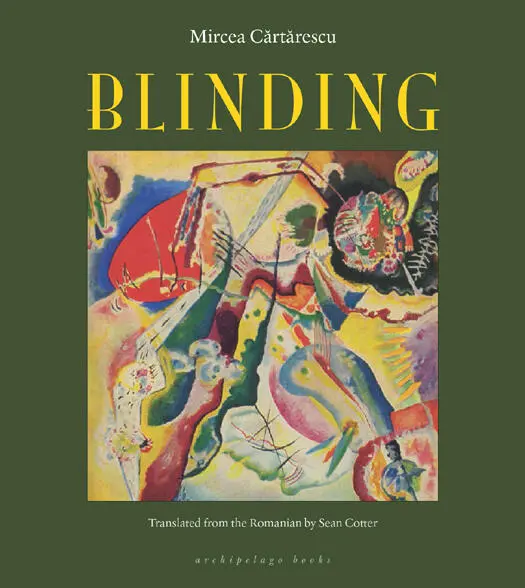
- Название:Blinding: Volume 1
- Автор:
- Издательство:Archipelago
- Жанр:
- Год:1996
- ISBN:9781935744856
- Рейтинг книги:3 / 5. Голосов: 1
-
Избранное:Добавить в избранное
- Отзывы:
-
Ваша оценка:
Blinding: Volume 1: краткое содержание, описание и аннотация
Предлагаем к чтению аннотацию, описание, краткое содержание или предисловие (зависит от того, что написал сам автор книги «Blinding: Volume 1»). Если вы не нашли необходимую информацию о книге — напишите в комментариях, мы постараемся отыскать её.
was one of the most widely heralded literary sensations in contemporary Romania, and a bestseller from the day of its release. Riddled with hidden passageways, mesmerizing tapestries, and whispering butterflies,
takes us on a mystical trip into the protagonist’s childhood, his memories of hospitalization as a teenager, the prehistory of his family, a traveling circus, secret police, zombie armies, American fighter pilots, the underground jazz scene of New Orleans, and the installation of the communist regime. This kaleidoscopic world is both eerily familiar and profoundly new. Readers of
will emerge from this strange pilgrimage shaken, and entirely transformed.
Blinding: Volume 1 — читать онлайн бесплатно полную книгу (весь текст) целиком
Ниже представлен текст книги, разбитый по страницам. Система сохранения места последней прочитанной страницы, позволяет с удобством читать онлайн бесплатно книгу «Blinding: Volume 1», без необходимости каждый раз заново искать на чём Вы остановились. Поставьте закладку, и сможете в любой момент перейти на страницу, на которой закончили чтение.
Интервал:
Закладка:
Soon, the small procession could barely squeeze itself between so many walls, barrels, cables, people of different countries and epochs, fair monsters, stinking lagoons (which they crossed in gondolas), statues at every step — Hitler and Kafka and Lombroso and Pushkin —, branching seas with trawlers and whales … They were not surprised when they passed along the shore of Beheading with three beings crucified on pitch-covered crosses, whom they recognized as Gaspar, Melchior, and Balthazar, in their rich oriental costumes, nor when Marconi, in front of his ridiculous device, received the first message over the air-waves: from quiqui quinet to a michemiche chellet and from a jambebatist to a brulo brulo … Crossing countries and seas, eras and spheres, finally they reached the middle of the middle, the enigma of the enigma, the navel. They were on the sharp edge, beyond which the void began. The black hole in the center of the disk must have been hundreds of meters in diameter. The river of vertical fire, which you couldn’t think of or look at, fell directly through this orifice, forming a great and holy mandala forming together a — yin and yang, matter and spirit, horizontal and vertical, woman and man, vulva and penis, in eternal copulation, palpable, the fire without beginning or end … The roar of this liquid column, like melting pearls, sounded like enormous rushing waters. They stopped there, half illuminated, half burned by the light of that light. Humanity, all humanity, flowed behind them and surrounded them, like an amphitheater of bodies stretching for dozens of miles. And strangely, however far away a face might be, an old man’s face, a child’s face, the face of a beggar or an emperor or a cardinal, even if it blended into thousands of other faces in a stripe of ochre at the edge of sight, it was perfectly drawn, and recognizable even before you actually saw it. Everyone saw each other as though they were in the foreground, half a meter away. Cedric, for example, recognized his neighbors from the The Crest, every last one here in the catacombs of the swamp. Everyone talked to each other, and their voices wove together like bindweed at the root of a giant tree — the great voice of a golden waterfall and wind. Concentrating on one face alone, you heard its voice at that moment, however far away the prostitute or pastor speaking might be, as though that voice had been born right in your ear, or in the auditory zone of your mind, like the wheedling voices of madness.
“Fra Armando waited for all movement to settle. The voices fell silent. The oak of flame raged and shook in its monotone flow, but soon its howl became the definition of quiet, and if this howl, which no one understood, suddenly ceased, the true silence would have made the blood run from everyone’s tympana. When the archon stepped slowly toward the razor’s edge of the disk, they could hear the delicate tap, like the touch of Chopin, of his heels over the gentle surface. The priest of all religions stopped just at the edge of nothing, with his face toward the purple flow. He raised his hands. The long sleeves of his vestments made thick folds around his shoulders, unveiling his unexpectedly thin arms. In that moment the irradiant column, dozens of meters wide, stopped burning, so that now a pearly liquid could jet from the apex of the vault, at once obscene and prophetic, because it looked like either procreative sperm or a melted brain, but most of all like the old and sickly gemstones that decorated the haloes of Byzantine Gods. Then the air under the fantastical vault withered into a warm, semitransparent brown, and the kaolin yellow walls began to pulse like skin, and to blush with an uncertain mosaic of red and blue capillaries, against a hyaline background of diaphanous flesh. Looking around themselves, some believed they were in the stomach of a giant being, distinguishing, with the stubbornness of amateur astrologists, beyond the skin of the walls, the richly irrigated wrinkles of a large intestine, and the circular muscles around a urinary sack. Others believed they were in the vestibule of a brain, and they swore that the folds, taken by the first group for intestines, were nothing other than cerebral circumvolutions, and the so-called bladder was the pineal gland, smelling of neural hormones. And, as the great disk of the floor regained its mirror-like qualities in this low light, we floated inside a sphere where up and down swapped places a billion times a second, becoming utterly identical, mixing layers of reality and possibility until being became homogenous, and no person could say who he truly was: the one that stood in front of the mirror, or the one that grew from his feet, higher and higher toward the Nadir. He was in fact both. What every person had intuited at some point in their lives somehow, suddenly, became clear: that reality is just a particular case of unreality, that we all are, however concrete we may feel, only the fiction of some other world, a world that creates and encompasses us …
“A great mystery, a penetrating melancholy spread now through the billions of surrounding eyes, which in the peanut-colored penumbra shone like balls of glass hanging from thin peduncles, as though all of humanity, melted under the organic sky of the grotto into a single being, was nothing more than a carnivorous plant, a sundew cup open in the bog, flashing its sticky diamonds under the sun at dawn. Everyone waited for signs and wonders, for admixtures of angelic protein into their poor terrestrial feed. How those eyes would have adhered to a lost angel, blown by the wind over sulfurous fens, how they would have touched, delicately, thoughtfully, and ravenously, the rings of gold falling over his shoulders, his ribs sculpted in morphyl, his sandals of iridium wire … How they would have immobilized him in a terrifying embrace, he who came to bring the Gospel to the garbage of the world. How they would have digested him, organ after luminous organ, voice after voice, drinking him through their eyes, then turning their faces to the remains of feathers and bones scattered in the wind, sterile insemination in sycamore eyes of water, full of larvae and mosquitoes … How they would have waited then, for centuries and millennia, those eyes becoming clear and innocent again (a sign of hunger), for another messenger, another revelation of Good News …
“Fra Armando turned toward the immense auditorium and began to speak, profiled against the quaking column, his face so dark that his features were visible only as a sketch of fine lines, like the impenetrable mask of an insect. As he talked, his strange miter spread one or more mechanical petals open, so that by the end of his speech, the rosy brain of the hierarch was unveiled and defenseless, in the middle of a flower of steel. The pipe as thin as a syringe needle irrigated Wernike’s area in the left hemisphere, with a yellow milk, vesicant or nutritive, or both perhaps …
“ ‘There are gods,’ he said, ‘there is Divinity. The countless grotesque, tragic, false, and crude religions are only sensory organs, ways our world touches what transcends and creates us. They are the insect’s antennae, the grub’s palps, the open eyes of soothsayers, through which we touch? attract? drive off? murder? love? the divinity that approaches. The eternal schizophrenia of religions, tangled in rites and interdictions, stained with visions and blood, inverted against conscience and happiness, and preaching another conscience, another happiness, is like a parricide who wants his father to be king, and kills him to become one himself. Religions are madness, and yet they are the only way, since they are the only way out of our world that the mind (our organ to detect gates and exits) can imagine, the only great purpose for which the universe lives. Because an enormous conspiracy in the world is being plotted against our being: everything, the pencil we touch and feel as hard , the pain that darts through our molars, identical days, the fact that every morning we open our eyes in the same room with the same things in their places, the sun that never suddenly turns green — everything wants to convince us, against all evidence, that existence actually exists , that the world is real, that we are truly living in a true world. That we should be calm, that we should be born, that we should live, that we should die comfortably. But how can the wall exist in front of me? In a single second when the voices in your ears stop, in one pure moment of meditation, all of the demented propaganda collapses, and we begin to shake the bones of our minds awake, trampling down madness with madness. Because everything and everyone, however monstrous or distorted, whether motionless in catatonic dances, rounding their circular retina, clanking rat skulls at the waist, crowned with human teeth, or spit on with gold and myrrh — these images themselves are phantoms produced by neurons, along with acetylcholinesterase. Gods and demons, with cannibalistic mouths or with no mouths at all, say the same thing, always the same thing: You are not from here. Here is not your kingdom. You must leave, you must find your world, the world where you have been and where, without your knowing, you long to be. You have to search for the exit, this is the purpose of your life, for the rules of the game at the level where you are. Everything conspires to convince you that there is no exit, and truly an exit does not exist until you search for it. And in a way, the searching is the exit, as though the space you move through with hope and faith were to harden behind you, and construct your exit tunnel, your own, open only to you, like a pore that spreads suddenly in the flower-petal skin of Divinity. No sect, no church can take you there directly. Prayers and postures cannot help. Churches are like dreams: the vein of ore runs thin through many strata of useless sediment. The art of belief is the art of sorting. But everything in a rite is a sign, an indicator, flickering under centuries of perversion: a wonder, a hallucination, a catastrophe, a bearded face in a triangle of rays — here, there is nothing to find, but from here, you can begin to search. Wonders exploding like a carpet of bombs over Judea. The billion faces of Krishna, permitted for a moment to a few human eyeballs. Turquoise giants, god-goddesses, from the brain of he who listens to Bardo Thodol. Koans and mandalas and the Great Vehicle and the Lesser Vehicle and the light of Tabor and interior prayer. All of the techniques of ecstasy, all of the alkaloids of sacred plants and those distilled (coca and angel dust and speed and acid and grass and Jacob’s ladder and smack), all dreams, all mantras — all of it leads here, to this hall, and you have all arrived here by searching along one of the endlessly multiple paths. Perhaps all of you see, in the cistern of living fire from the depths of your being, a Salvation. And it is true, here, we stand in the center of any one of us, because, sinking ourselves into ourselves as though we descended inside a tower and we extended the decent into the earth all towers are built on, we would all meet in this great common hall, this hall that is everyone’s and no one’s. But the revelation has only now begun.
Читать дальшеИнтервал:
Закладка:
Похожие книги на «Blinding: Volume 1»
Представляем Вашему вниманию похожие книги на «Blinding: Volume 1» списком для выбора. Мы отобрали схожую по названию и смыслу литературу в надежде предоставить читателям больше вариантов отыскать новые, интересные, ещё непрочитанные произведения.












Обсуждение, отзывы о книге «Blinding: Volume 1» и просто собственные мнения читателей. Оставьте ваши комментарии, напишите, что Вы думаете о произведении, его смысле или главных героях. Укажите что конкретно понравилось, а что нет, и почему Вы так считаете.