Mircea Cărtărescu - Blinding - Volume 1
Здесь есть возможность читать онлайн «Mircea Cărtărescu - Blinding - Volume 1» весь текст электронной книги совершенно бесплатно (целиком полную версию без сокращений). В некоторых случаях можно слушать аудио, скачать через торрент в формате fb2 и присутствует краткое содержание. Год выпуска: 1996, ISBN: 1996, Издательство: Archipelago, Жанр: Современная проза, на английском языке. Описание произведения, (предисловие) а так же отзывы посетителей доступны на портале библиотеки ЛибКат.
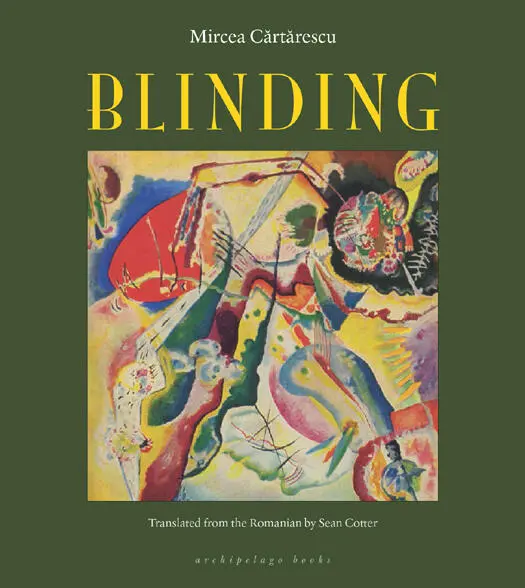
- Название:Blinding: Volume 1
- Автор:
- Издательство:Archipelago
- Жанр:
- Год:1996
- ISBN:9781935744856
- Рейтинг книги:3 / 5. Голосов: 1
-
Избранное:Добавить в избранное
- Отзывы:
-
Ваша оценка:
Blinding: Volume 1: краткое содержание, описание и аннотация
Предлагаем к чтению аннотацию, описание, краткое содержание или предисловие (зависит от того, что написал сам автор книги «Blinding: Volume 1»). Если вы не нашли необходимую информацию о книге — напишите в комментариях, мы постараемся отыскать её.
was one of the most widely heralded literary sensations in contemporary Romania, and a bestseller from the day of its release. Riddled with hidden passageways, mesmerizing tapestries, and whispering butterflies,
takes us on a mystical trip into the protagonist’s childhood, his memories of hospitalization as a teenager, the prehistory of his family, a traveling circus, secret police, zombie armies, American fighter pilots, the underground jazz scene of New Orleans, and the installation of the communist regime. This kaleidoscopic world is both eerily familiar and profoundly new. Readers of
will emerge from this strange pilgrimage shaken, and entirely transformed.
Blinding: Volume 1 — читать онлайн бесплатно полную книгу (весь текст) целиком
Ниже представлен текст книги, разбитый по страницам. Система сохранения места последней прочитанной страницы, позволяет с удобством читать онлайн бесплатно книгу «Blinding: Volume 1», без необходимости каждый раз заново искать на чём Вы остановились. Поставьте закладку, и сможете в любой момент перейти на страницу, на которой закончили чтение.
Интервал:
Закладка:
That same evening, they gave him a subcutaneous injection of caffeine. The effect, in comparison with a cup of coffee, was of course more rapid and, above all, purer. His mind glowed like a crystal. He became more intelligent and articulate. He strove to convince his superior officer, sitting on a stool next to his bed, that his Moşi vision had been real in every detail. He described with cinematic precision the patterns and shades of the butterfly’s wings. He showed on what basis he held that the butterfly was the message . He reproduced from memory, verbally, the path of the wandering circus troupes over the map of Eastern Europe, down to the least important places they had gone. In fact, the entire map, like under a powerful light, shone eidetically in front of his eyes. He tried to read the title of the article floating around him like a fog, but it was, yet again, impossible. After a quarter hour they injected him, this time intravenously, very slowly, with a solution of sodium amytal, 10g per 100ml of sterile water. In a flash he saw — felt, knew, experienced — the entire network of his blood vessels, as though they were dyed florescent colors, and in love. His jugular veins, like two hands with delicate fingers, rose and fed the heavenly mandarin of his brain, which glittered all over with delight. And the blazing flame of love united his sublime body in happiness. The map of his body became the evanescent map of his language, twisting like the steam over coffee. His skin and nervous system formed a syntactic structure, branching in relations of independent, coordinating, and dependent clauses, groups of verbs and nouns, structures both deep and superficial, the fleshless, functional body of language. Morphology ran through his osteo-muscular system, and groups of muscles and bones were juxtaposed with parts of speech, contracting and relaxing in declinations, conjugations, and inflected endings; the paunches of coiled substances and glands produced the vocabulary in which epithelia and mucus and flat muscles and bacteria and vomit and saliva and gastric juices and fermented feces and insulin, lips and anus and esophagus and rectum, and bowels and duodenum, and bile and hunger and satiety merged, generating semantic fields. They stratified into calques from Greek and Turkish, slang and indecipherable jargon, the sublime phonetics of the respiratory apparatus, gentle fingers of god and zephyr blowing on the vocal chords; and the imaginary, the mystical body of the garden of roses, the moon leaning tenderly over the sun’s shoulder (the eternal incest of the sun and moon in our astral body), sprung from the sexual glands, from the grotesque monster between the legs, from the gaping eggs in their oily sacs and from the purple, rubbery glans, camouflaged in soft skin, in the cavernous body of the worm that spits in turn, into the world, and just as hot, the purest and most abject substance, the ivory of life and the residual waters. A more fantastic flower never blossomed from a more revolting root.
Sublimated cell by cell and organ by organ, turned into a complicated mist of words, the officer told them about everything down to the milk he suckled from his mother.
24
THE enormous man had paid, in blindness, for what he heard. Now, however, smelling like fresh snow, he looked at me with eyes again unglued. His shining pupils scanned the peaks and valleys of my face, chest, and hands, as though at some point he would have to describe them, down to their most miniscule details, or die. “You are Mircea,” he repeated and stepped toward me, the step of a blind man, as though, although he had these large, brown eyes, he could not see more of me than, at the most, an intense irradiation of blue light. When he held open his arms for a ritual suffocation, I ran out of the office, leaving the door on the ground, and I dove, still hearing a “Mircea!” vibrating in the frozen air, down the olive hospital corridor. I ran like crazy under the dirty light bulbs, turning corners and hitting swinging doors with my shoulder, passing the same sad and cold sights: corridors endlessly going forward, with doors on one side and the other, long stairways, with spittoons on the landings, leading to other identical floors … Fear, rising irresistibly in me, made it difficult to know what I was doing. The chest of my pajamas was drenched with sweat, in spite of the cold that emanated from the walls. Some of the open doors showed me nightmarish scenes: white beds, half covered in rubberized cloth, where old people lay with strange tubes stuck in their stomachs, others defecating through artificial anuses with nickel taps … children with polio, with the femur stuck directly to the skin, without any surrounding thigh, struggling to peddle medicinal bicycles … open-robed fat women, masturbating, their eyes rolled back in their heads … I didn’t stop until I reached our ward, lit through every window by a mystical fog, which told me I had been lost in the corridors for more than half a day. Only then did I calm down, looking at the patients playing Nine Man’s Morris on the veranda, bathed in golden light like saints, or lying in bed with their hands behind their heads. I went to my bed and curled up on part of the sheet, with my face turned toward the deformed man sleeping noisily, his mouth gaping at the ceiling. His sickly hand hung into the empty space between our beds, with his fingers apart and pale. He was in sleep. His soul was far away. Sleep bodied him gently forth. What if I stretched out my hand then and my finger touched his dark, shoemaker’s fingernails? What if I transferred myself into his martyred body? I would lay there, forever, a paralyzed kyphotic, dirty with excrement, half rotted, looking at the ceiling with frightened eyes, while he, in my adolescent body, would run toward the autumnal world, in golden sunlight beyond the windows. I smiled, because as a matter of fact I would have not been displeased to swap our skins and flesh. I was so tortured, thoughtless, and sad, that the whispered life of a hospital would have been enough for me, forever. I imagined myself as the oldest patient in the ward, in the halo of its horrible symptoms, beloved by nurses, regarded with veneration and concern by the other patients. They would change constantly, always ready to throw themselves back into the twilit jungle of life at the slightest amelioration of their symptoms, while I, in the center of my immobile universe, would be the eternal Patient, over whom mornings, evenings, and nights, summers and winters would settle slowly, like so many layers of shellac over a Chinese box. Thirty … forty years in the same bed in the same ward, holding steady the same calm and white day, in which no surprise awaits you: that was my image, at the time, of happiness. It would hurt, of course. I would have to swallow the medications, bitter as iron. At night I would be woken up for shots, but I would have no desires, memories, or future plans. I would have no papers or identity. My fate would not depend on my word or anyone else’s. I would never have to endure the torture of being evil, or the regret of being good. A pure life, of arid and warm contemplation, in a closed space, a shelter: this is what I wanted then, and perhaps I want it still …
After supper, we stayed up a few hours gabbing, looking at newspapers … A muscle in the corner of my mouth contracted vaguely when I tried to smile, for the first time in three weeks. I imagined how happy my mother would be when I showed her the next day. Mamma came three times a week, every visiting day, with bags full of jars of chicken soup and rice pilaf. She came with her eyes puffy from crying. She would do all of her bawling beforehand, so that she’d be strong at the hospital, not to discourage me. The next day would be the first time I could show her any sign of healing. I went to sleep with that on my mind, after lights-out, and I slept poorly, waking up irritated from twisted dreams that always repeated themselves, as though the projector in my brain played a filmstrip as knotted as a nest of snakes. Something in me knew, perhaps, that my mother would come to find me the next day in the basement, among those at death’s door.
Читать дальшеИнтервал:
Закладка:
Похожие книги на «Blinding: Volume 1»
Представляем Вашему вниманию похожие книги на «Blinding: Volume 1» списком для выбора. Мы отобрали схожую по названию и смыслу литературу в надежде предоставить читателям больше вариантов отыскать новые, интересные, ещё непрочитанные произведения.












Обсуждение, отзывы о книге «Blinding: Volume 1» и просто собственные мнения читателей. Оставьте ваши комментарии, напишите, что Вы думаете о произведении, его смысле или главных героях. Укажите что конкретно понравилось, а что нет, и почему Вы так считаете.