Mircea Cărtărescu - Blinding - Volume 1
Здесь есть возможность читать онлайн «Mircea Cărtărescu - Blinding - Volume 1» весь текст электронной книги совершенно бесплатно (целиком полную версию без сокращений). В некоторых случаях можно слушать аудио, скачать через торрент в формате fb2 и присутствует краткое содержание. Год выпуска: 1996, ISBN: 1996, Издательство: Archipelago, Жанр: Современная проза, на английском языке. Описание произведения, (предисловие) а так же отзывы посетителей доступны на портале библиотеки ЛибКат.
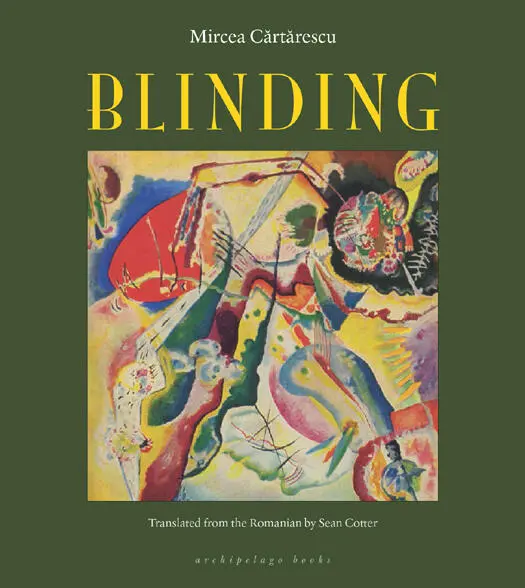
- Название:Blinding: Volume 1
- Автор:
- Издательство:Archipelago
- Жанр:
- Год:1996
- ISBN:9781935744856
- Рейтинг книги:3 / 5. Голосов: 1
-
Избранное:Добавить в избранное
- Отзывы:
-
Ваша оценка:
Blinding: Volume 1: краткое содержание, описание и аннотация
Предлагаем к чтению аннотацию, описание, краткое содержание или предисловие (зависит от того, что написал сам автор книги «Blinding: Volume 1»). Если вы не нашли необходимую информацию о книге — напишите в комментариях, мы постараемся отыскать её.
was one of the most widely heralded literary sensations in contemporary Romania, and a bestseller from the day of its release. Riddled with hidden passageways, mesmerizing tapestries, and whispering butterflies,
takes us on a mystical trip into the protagonist’s childhood, his memories of hospitalization as a teenager, the prehistory of his family, a traveling circus, secret police, zombie armies, American fighter pilots, the underground jazz scene of New Orleans, and the installation of the communist regime. This kaleidoscopic world is both eerily familiar and profoundly new. Readers of
will emerge from this strange pilgrimage shaken, and entirely transformed.
Blinding: Volume 1 — читать онлайн бесплатно полную книгу (весь текст) целиком
Ниже представлен текст книги, разбитый по страницам. Система сохранения места последней прочитанной страницы, позволяет с удобством читать онлайн бесплатно книгу «Blinding: Volume 1», без необходимости каждый раз заново искать на чём Вы остановились. Поставьте закладку, и сможете в любой момент перейти на страницу, на которой закончили чтение.
Интервал:
Закладка:
If he hadn’t been one of the hierarchs of the “Secu Monastery,” their enigmatic meeting hall, whose name suggested dryness and askesis of the spirit, the blind man would have ended up making hairbrushes, like the vast majority of those who lose their sight. The position of masseur at Colentina was created especially for him. It was well paid and close to home. His beautiful wife, who always dressed like an opera diva, brought him to work and picked him up every day, proudly braving the gazes of those who passed on the sidewalk along the hospital fence where bindweed grew. The blind man, with his chest out, seemed to oppose the trek as much as he could, as though he were being dragged toward the gallows by a pitiless guard. Something he said, one of the phrases he let snow gently and continuously over my head in his ragged talkativeness, made me pay special attention: “I don’t know if I am in this room because I went blind, or if I went blind because I was meant to be here …” His strokes paused for a moment. He touched the dusty skin of my face, and continued his chatter, describing the funereal process of his blinding. The beginning of his story would have been atrocious and shocking if the same tone from the tips of his lips (gently amused, as though he were talking about someone else) hadn’t emptied the vessels of his words, leaving them as airy as the rooms of a paper palace.
He had come home in the evening, after a day of listening (probably the listening that monks do in their cells, I translated) and entered the hallway of the block where he lived. The light bulb there, like all bulbs in all block stairwells, had been stolen, so thick stripes of velvet darkness had settled on the side by the elevator. From there, some guys leapt out, drugged him and took him, in a car, probably, to another part of the city. When he came to, he was in the center of an enormous hall, under a great vault like a basilica, maybe thousands of meters above. He was tied to a crystal chair, in the center of a checkered floor that extended as far as he could see, like an open field, with white and red squares crowding toward the edges, where they came together in a single line of fog. The air was gelatinous and frozen, crossed by oblique columns of light from round skylights here and there that perforated the gigantic semispherical vault. He sat, perhaps for days, fearfully following the movement of the spots of light over the floor tiles, which were polished like mirrors. The spots of light darkened into scarlet, the air vaporized from the endless hall, darkness fell, and then, inching upwards, the outflow of dawn began. At the edge of sight and straight in front of him, he thought some points were moving, barely perceptibly. For several days, the points advanced and grew, little by little, taking hours upon hours to cross one spot of light, entering the penumbra again, hours upon hours later, until, one morning, the man bound to the sparkling chair perceived, only a few hundred meters away, a disorderly column of men in white, stiff, vestments, which fell over their bodies not in graceful folds, but in sharp angles, like exoskeletons.
“Soon,” the blind man said, “the forty or so officiants of some Mystery formed a semicircle of rustling robes around me. They held incomprehensible and dreadful tools, the mere sight of which produced waves of sweat on my skin. Only one was empty-handed. On the ephod held at his shoulders by silver chains, there was a shining quartz box. Inside the box was visible a human tooth, with long roots, emanating a pale aura. The irritated-looking priest wore a steel miter on his head, with extended pipes that perforated his skull.
“The indictment — since, judging by the solemn and threatening expression of their insect faces, this is what it had to be — lasted for hours on end, until night fell in the giant sphere. Now the only light, like phosphorus, came from the complicated pliers, screws, and scalpels in the priests’ hands, and from the tooth in the crystal box. The words they shouted at my face, splattering me with saliva — now their Hierarch alone, now all in chorus, now one or another in a moment of inspiration — were signs scratched into my tympanum by an unknown language. Finally they crowded around me and put their hands on my head and shoulders. Their clothes, threaded with gold wires, smelled sharp and verminous. The Hierarch placed an iron circle on my head, tightened it with screws, and hung its mechanical peduncles in front of my eyes. Those small clamps took my eyelids, and with fine adjustments of the screws, they were pulled apart from each other until they began to hurt, tear, and bleed. My eyeballs remained wide, lacking defense, and I had already begun to guess the monstrous torment to come. Copper nails, reddened in fire, would pierce the fragile eggs within their sockets below my brow.
“Yet, that was not to be. The priests moved to one side of me, perhaps behind the crystal throne. A single voice, thin as thread, wove a sonorous tapestry in the cold gelatin of the hall, while an enormous eyelid began to slowly unstick from half the horizon and let a crescent of blinding light into the hall, like the blade of a golden scythe. I yelped like an animal, because that light was not light, but the light of a world of light, it was not a ghostly, white fire, but the fire of a world of fire and calcination. While my eyes, transparent as opals, died in inexpressible pains and voluptuousness, the skin of my naked body began to see. I saw with my chest and my arms, beyond the oven that the eyelid had slowly opened, forms and ghosts, slippages and contractions that were not of this universe. I knew, while I howled and tried to break my bonds, that I was inside an eyeball, that my own life was a miniscule speck of dust in the vitreous humor of an eye — of what god? of which giant Atlas? — and that this eye had now opened onto a world of a higher order. I had been stolen from the cerebral structures generating the dream of this being that kneaded our world in its sleep. I had been carried through the chiasm and the optic nerve, passed through the polychrome carpet of its retina and forced to look, from the middle of the crystalline ball, at a world that was blinding, blinding … The eyelid rose higher. The light from beyond light struck me like a monstrous column descending through the pupil, the hall filled with the unbearable color of blindness, and in the height of those pains, compared to which a simple pierced eyeball would have been a heavenly balm, a kind of voice, or a kind of calligraphic design on my seeing flesh told me the strange myth of Those Who Know, their global conspiracy, which spread as much in space as time (as one of the leaders of the secret services, I had a vague awareness of this — because all these services, sects, and cabals are connected, like networks of neurons), their self-rending toward heavens and hells in the inhuman effort to penetrate reality.
“I was blinded so that the ways of the Lord would show in me. I would be, from now on, chosen for atrocity — but also for prophecy — by an unknown force, so strong in comparison that the dark power of the blue-eyed boys is a degenerate caricature and a deformed metaphor. I would wait here, in my office, like a spider in the middle of its sparkling trap of hardened saliva, for the one able to recognize me, the one who would point his finger toward my eyelids, to touch them with his healing fingernail, to burst the bursting and blind the blindness of my eyes. He would be — they told me through that tattoo of speaking light when I cried out, crucified on the crystal chair — an adolescent with bones as thin as a birds’. I have been waiting for him for years, not just to restore my sight, because what more is there to see after the images I have seen, but to see Him, the one, he that will be sent, the Sent One, who, being already there, is here at the same time. Meanwhile, I have passed through all the bolgia of blindness: the trepidatious snuffing out of space; the expansion, like what bats enjoy, of the sonorous dominion, with landscapes of sounds; the hallucinations of the invented faces of those I talked to, in the most vibrant colors, fluorescent and electric, but the faces of acromegalics, Cyclopes, scalped beings, satyrs, grubs, skulls, and chameleons; the marble fears, when you feel that someone is coming toward you from all sides at once ; the voices that give orders, to you by name, to cut your own throat … And, at the end of the end, the bottomless pit of the mole, the deep blindness …”
Читать дальшеИнтервал:
Закладка:
Похожие книги на «Blinding: Volume 1»
Представляем Вашему вниманию похожие книги на «Blinding: Volume 1» списком для выбора. Мы отобрали схожую по названию и смыслу литературу в надежде предоставить читателям больше вариантов отыскать новые, интересные, ещё непрочитанные произведения.











Обсуждение, отзывы о книге «Blinding: Volume 1» и просто собственные мнения читателей. Оставьте ваши комментарии, напишите, что Вы думаете о произведении, его смысле или главных героях. Укажите что конкретно понравилось, а что нет, и почему Вы так считаете.