Mircea Cărtărescu - Blinding - Volume 1
Здесь есть возможность читать онлайн «Mircea Cărtărescu - Blinding - Volume 1» весь текст электронной книги совершенно бесплатно (целиком полную версию без сокращений). В некоторых случаях можно слушать аудио, скачать через торрент в формате fb2 и присутствует краткое содержание. Год выпуска: 1996, ISBN: 1996, Издательство: Archipelago, Жанр: Современная проза, на английском языке. Описание произведения, (предисловие) а так же отзывы посетителей доступны на портале библиотеки ЛибКат.
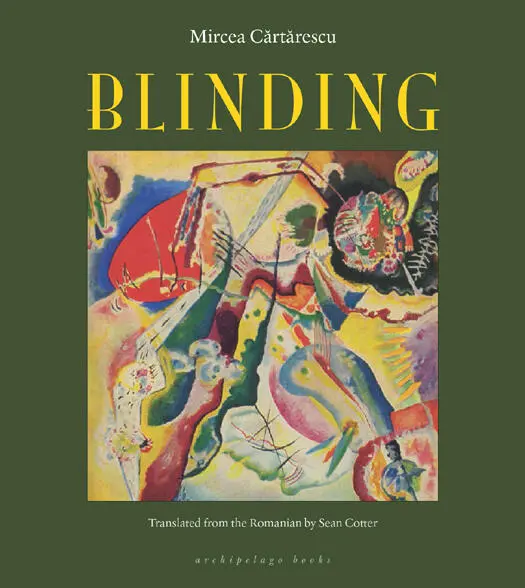
- Название:Blinding: Volume 1
- Автор:
- Издательство:Archipelago
- Жанр:
- Год:1996
- ISBN:9781935744856
- Рейтинг книги:3 / 5. Голосов: 1
-
Избранное:Добавить в избранное
- Отзывы:
-
Ваша оценка:
Blinding: Volume 1: краткое содержание, описание и аннотация
Предлагаем к чтению аннотацию, описание, краткое содержание или предисловие (зависит от того, что написал сам автор книги «Blinding: Volume 1»). Если вы не нашли необходимую информацию о книге — напишите в комментариях, мы постараемся отыскать её.
was one of the most widely heralded literary sensations in contemporary Romania, and a bestseller from the day of its release. Riddled with hidden passageways, mesmerizing tapestries, and whispering butterflies,
takes us on a mystical trip into the protagonist’s childhood, his memories of hospitalization as a teenager, the prehistory of his family, a traveling circus, secret police, zombie armies, American fighter pilots, the underground jazz scene of New Orleans, and the installation of the communist regime. This kaleidoscopic world is both eerily familiar and profoundly new. Readers of
will emerge from this strange pilgrimage shaken, and entirely transformed.
Blinding: Volume 1 — читать онлайн бесплатно полную книгу (весь текст) целиком
Ниже представлен текст книги, разбитый по страницам. Система сохранения места последней прочитанной страницы, позволяет с удобством читать онлайн бесплатно книгу «Blinding: Volume 1», без необходимости каждый раз заново искать на чём Вы остановились. Поставьте закладку, и сможете в любой момент перейти на страницу, на которой закончили чтение.
Интервал:
Закладка:
This may be the source of my discomfort regarding the blind. When I was small, I imagined they all lived in that swamp, like sinister tadpoles, amphibians with rigid necks that would project their awkward and prudent images onto a sea of multicolored lights, full of sunlight, but inside, in the subcutaneous night, they would project their tentacles and the bizarre sensory organs they used to communicate with other worlds silently, like abyssal fish — worlds of fear, perhaps, and depression. They knew what being was like when no one saw it. They were, furthermore, its agents, its spies, its avant-garde in the blank world. Through their often half-open eyes, through which you could see a puss-filled cornea, death and agony stalked you, the great ataraxia of nothingness. I didn’t know then that the blind, who seemed to all have the same mother and father, are actually diverse, and their blindnesses have a well-developed taxonomy. Later I saw newborns without eyeballs, cased in large cylinders of alcohol. They had no eyelids or eyelashes, and their flat brows, like ivory helmets, extended down to their lips. I heard about those born blind who remained blind all their lives, in spite of the fact that their eyes and their optical nerves were intact, virtually functional; and about those who, on the contrary, had normal development of areas of sight in the occipital husk, but still could not see because of some mysterious atrophy or dysfunction in the optical chiasm or retina; those with cataracts on both eyes or invasions of blood in the vitreous humor; those who had no notion of sight, the way we have no notion of what fish feel with the lateral line or what the ovum feels when the spermatozoid first touches it and the chemical capsule on its tip breaks, instantly making the enormous sun of reproduction opaque; those who have a notion of sight, but only on the left, not the right, without one eye being more damaged than the other; those who see images normally, but are not able to understand what they see; those who have the feeling they are surrounded by deep night and those who still perceive a vague luminescence coming from everywhere; those whose blindness is only the fleshly equivalent of some terrible psychodrama (since between the eyes and the testicles, the globes above and below, between castration and plucking out the eyes, there has always been a sadistic and at the same time redemptive transit); those who see as if they’re looking through a screen, and those who see as if they’re inside a dream … Blindness is ragged and gradated: no one sees in full, and no one is utterly blind. And just as all matter of all worlds came from an infinitely dense and burning point in space, just as all life branched out of the first coacervate in the bubbling ocean, sight has arisen in, and been clarified by, the flesh of animals, sprouting from the first point of chromatin in the body of the first paramecium. Its red dot saw only light, intense and pure, undifferentiated into forms and colors. It is the light that rose through the tubes of generations, separating itself from itself and filling with attributes, like the black thread of the snail’s eye rises through its scaly horn to appear on the tip. And perhaps at the end of the growth of sight, like in the Zen parable about the mountain, we will come again to contemplate, in a different way, pure light, with the body changing suddenly into the brain, and the brain becoming only an eye, and the eye disintegrating suddenly into light … And only then will the great unification take place, not of the four forces into one, but of the eye that sees with the world seen by it, in an eye-world continuum that may be called the All …
Over time, the masseur became more talkative, and toward the end of my hospital treatment, the ever more occult, more labyrinthine movements of his fingers on my face were accompanied by bizarre stories, neither flesh nor fowl, whispered, insinuating stories as if he were telling them to himself, as if he expected me to answer — the completion of a phrase left hanging, the flash of recognition at an allusion that for me was utterly obscure … When I entered his office and he recognized my voice (later he probably knew my footsteps, too, or other sounds: who knows, the swish of my clothes, the way I turned the doorknob or knocked) his unmoving face changed to the smile of an enormous Buddha. An odd crease appeared between his eyebrows, as if a bud were struggling to break through, an ocular bud, a seeing mole. He moved behind me, and, executing his ritual, he adorned it with eccentric myths that have stayed alive in my memory. At first, his stories did not have a completely unusual atmosphere, even though it was a little embarrassing that the blind man suddenly shared intimate things with a boy he didn’t know, things that were surely painful for him. Yet he did it with detachment and a kind of half-scientific interest, half self-deprecation that made the revelations bearable, like a few splashes of lemon over the fat spine of the fish on a platter.
Before going blind, he had worked with “the blue-eyed boys.” I didn’t know the expression then, so I asked, “Where?” to which he responded teasingly, “Eh, the guys with stars on their shoulders,” and continued to describe his professional life only in this kind of paraphrase, to the extent that, in the end, in my ingenuous mind of the time, the working-class child whose parents didn’t talk about politics at home, there formed a jumbled-up, fairy-tale image, where I saw the masseur in the middle of a kind of angelic hall of superhumans, all tall and blond, with shining azure eyes … I imagined them naked, statuesque, really white as marble, until their eyes became unsettling and haunting in their Hellenic faces. Their shoulders were decorated with glowing constellations, forming zodiac signs as clear as the decals on glasses. “The happy boys,” as the blind man also called them, could be Cancers, Scorpios, Capricorns, or Virgos, depending on their rank in the hierarchy. They moved among us but were unseen, they heard everything we said, even in the privacy of our homes, and still no one guessed where they held their mysterious meetings, in what network of underground highwaymen’s tunnels … If they were all azure-eyed, it was because their blood itself was azure, like that of gods and spiders. Incorruptible and distant, a race of masters from other areas of the Cosmos, these “boys” (a sign of their ritual virginity), with an unshakable and enigmatic happiness, had interfered somehow, from times immemorial (which went back, according to some rumors, to old king Burebista: because it was certain that Dekeneu, his great priest, due to the heights of the sacred mountain where he lived, had a blue fluid in his veins, with a strong smell of cyanide, blood much better suited to absorbing the scarce oxygen of those heights and transporting it through the systems and mechanisms of his astral body) in the political structures of humanity. More than ever in recent decades, their domination became complete, triumphant. Of a higher rank than the angels, these super-watchers, from their aerial palaces, aimed eagle-gazes over the ant hills that the workers of the earth raised in their cluelessness, and they unleashed themselves from time to time over frightened hoards, snatching mortals toward the sky. No one could penetrate their ways or understand their thoughts. Two men slept in one bed: the one was taken, and the other left; two women were grinding together, one was taken, and the other left. The vultures came in droves to the place where the cadaver lay.
I had this vision while the masseur, whose speech was neither fish nor fowl, pressed my eyelids with his talcum-covered fingers, as though he wanted to open my eyes. “The accident” that made him blind, five years before, removed him forever from that glorious sect. Naturally, those ranks would not admit any being with a deformity, anyone who would disrupt their perfection. The masseur went blind because he had seen too much, he said, and I drew the conclusion that destiny had reserved certain unpleasantness for these privileged beings. The quantity of information that they could receive was limited, and if they consumed their ration before death, they went blind or deaf or insensible for the rest of the years they had to live. Angels fallen into the concrete marsh of streets, metros, and fish markets, dragged the secret of their blue blood with them to their graves.
Читать дальшеИнтервал:
Закладка:
Похожие книги на «Blinding: Volume 1»
Представляем Вашему вниманию похожие книги на «Blinding: Volume 1» списком для выбора. Мы отобрали схожую по названию и смыслу литературу в надежде предоставить читателям больше вариантов отыскать новые, интересные, ещё непрочитанные произведения.











Обсуждение, отзывы о книге «Blinding: Volume 1» и просто собственные мнения читателей. Оставьте ваши комментарии, напишите, что Вы думаете о произведении, его смысле или главных героях. Укажите что конкретно понравилось, а что нет, и почему Вы так считаете.