Mircea Cărtărescu - Blinding - Volume 1
Здесь есть возможность читать онлайн «Mircea Cărtărescu - Blinding - Volume 1» весь текст электронной книги совершенно бесплатно (целиком полную версию без сокращений). В некоторых случаях можно слушать аудио, скачать через торрент в формате fb2 и присутствует краткое содержание. Год выпуска: 1996, ISBN: 1996, Издательство: Archipelago, Жанр: Современная проза, на английском языке. Описание произведения, (предисловие) а так же отзывы посетителей доступны на портале библиотеки ЛибКат.
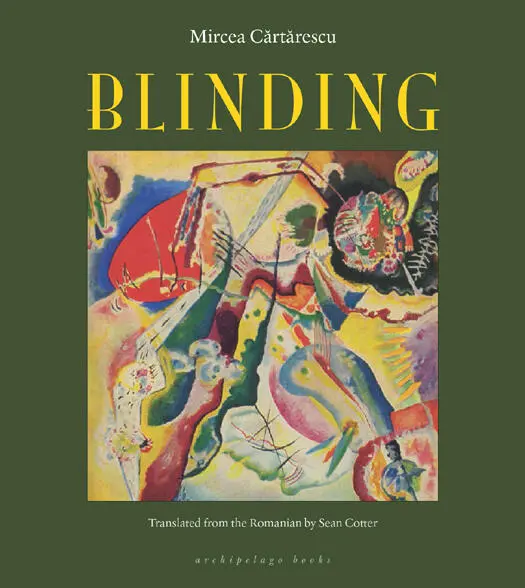
- Название:Blinding: Volume 1
- Автор:
- Издательство:Archipelago
- Жанр:
- Год:1996
- ISBN:9781935744856
- Рейтинг книги:3 / 5. Голосов: 1
-
Избранное:Добавить в избранное
- Отзывы:
-
Ваша оценка:
Blinding: Volume 1: краткое содержание, описание и аннотация
Предлагаем к чтению аннотацию, описание, краткое содержание или предисловие (зависит от того, что написал сам автор книги «Blinding: Volume 1»). Если вы не нашли необходимую информацию о книге — напишите в комментариях, мы постараемся отыскать её.
was one of the most widely heralded literary sensations in contemporary Romania, and a bestseller from the day of its release. Riddled with hidden passageways, mesmerizing tapestries, and whispering butterflies,
takes us on a mystical trip into the protagonist’s childhood, his memories of hospitalization as a teenager, the prehistory of his family, a traveling circus, secret police, zombie armies, American fighter pilots, the underground jazz scene of New Orleans, and the installation of the communist regime. This kaleidoscopic world is both eerily familiar and profoundly new. Readers of
will emerge from this strange pilgrimage shaken, and entirely transformed.
Blinding: Volume 1 — читать онлайн бесплатно полную книгу (весь текст) целиком
Ниже представлен текст книги, разбитый по страницам. Система сохранения места последней прочитанной страницы, позволяет с удобством читать онлайн бесплатно книгу «Blinding: Volume 1», без необходимости каждый раз заново искать на чём Вы остановились. Поставьте закладку, и сможете в любой момент перейти на страницу, на которой закончили чтение.
Интервал:
Закладка:
The masseur pushed my head more and more into his puffy stomach, like he wanted to somehow incorporate me there, into an impossible oval uterus. My face burned as though it had been torn off, and when I looked in the mirror that same day, right when I came back from the massage, I saw that my face was completely red and drawn, as though I had suddenly lost several pounds. It’s true that from that day on, I observed a small improvement of my peribuccal and orbicular muscles. Inexplicably, they came back under my will. But I didn’t care at that moment about the excoriated skin of my face, nor the signs of better health, because in the massage office, after the large fingers caressing me like butterfly wings had fluttered for the last time over my face, something wonderful and terrible happened to me. I put my pajama top over my shoulders again, and turned toward the masseur to thank him, as always, before leaving. I saw him filling the room, an iceberg as blind and as white as snow, a white and blind whale that smelled of silence. In front of him, face to face, I felt like a secret admirer, drained from fasting, shaken by the crystal elephantine monster. “You are Mircea,” he whispered then, barely audible. Then he opened two large, brown eyes, luminous, unspeakably human inside that head of ice.
23
AFEW months after the tanks of the Warsaw Pact entered Czechoslovakia, Romanian Securitate Department V received a series of new assignments, some of which contradicted best practice protocols and had never before been proposed, and were set at the highest levels of state secrecy. In this period, ordinary people’s children (both boys and girls) were kidnapped, blood was transported in the innertubes of military vehicles, underground buildings (nuclear command posts? bunkers? fallout shelters?) were constructed, and ultramodern linotype presses appeared, protected by reinforced walls in houses that, from the outside, seemed abandoned or inhabited by gypsies. At the Fundeni Hospital, a clinic that looked like a laboratory from outer space performed complicated plastic surgeries on citizens whose physiological, statural, or vocal resemblance to the chief of state had been detected. These citizens, now identical to the national hero, were recorded as killed in a car accident, and their funerals were arranged.
The extravagance and spy-novel mystery of these missions, the absolute power accorded to those who actually executed the horrors — doctors, police, factory workers, and priests — and the fact that they became more and more honored by the party and state apparatuses (at their party meetings, even members of the Executive Policy Office would attend) provoked profound changes in the psychology of the Securitate officers. Most officers were part of a new generation, which had grown up during the war and matured after the wave of atrocities in the 1950s had passed. Often you would hear them talk about “the old guys” like they were drunks and idiots, vulgar brutes who stomped on their victims with disgusting, sweaty feet, in chambers that stank like stables. The older colleagues in the trade, ever more marginalized, still looked like country boys whose uniforms would never stay in place. They could barely sign their own names, but when they met “for a little nip,” they bored the jejune “dandies” (as they, with impatience and hatred, labeled the newly arrived) with the same old fables about hunting enemies of the people around Făgăraşi. The gypsy Belate Alexandru, who had become the hero of the Securitate brigades and was lauded in the poems of writer-comrades, was insulted all the worse in these fairy tales: “Belate? Well let me tell you what happened with Belate. He died like the fool he was, on his feet, like he’d been ordered to, and they just had to tip him over, the crow. Comrade poet had things a little backwards in that poem they put on the coffin:
Cut down cowardly from behind
Inert lay now the nation’s boast
Belate! be in our hearts enshrined
… And his cigarette fell, one quarter smoked.”
When they heard about Belate and the Canal enemies, who, of course, “ended up drinking their own piss,” the young officers felt uneasy. They would never have dirtied their hands with crimes like those. In impeccable suits smelling of lavender, they toured the bookstores in search of fashionable reading. They paid each other visits, with their wives, having only a little coffee and a cognac (not sticking their guests at the table and drugging them with soups). Evenings, they gathered at the Select or Boehme … They had all spent their teen years dreaming of being what now, would you look at that, they really were. They all had passionately read At Midnight a Star Will Fall and The End of the Ghost Spy , identifying with the plainclothes officers, all without stain or blemish, Major Frunză and Captain Lucian, for example, who (the quintessence of both Hercule Poirot and the Hercules of myth) ended up solving enigmatic cases and catching the imperialist spies or war criminals returning to the country under false identities. “Who are you, mister Pietraru?” they dreamed of finally asking, at the end when the disarmed sunglasses-clad spy collapsed in his chair. “Isn’t it true that beneath this borrowed name hides Horst Müller, officer of the SS?” At which, before anyone could stop him, the man would bite down on the cyanide capsule hidden in his shirt collar …
No, the Securitate was no longer the old Siguranţa of the bourgeois-landowner regime, whose commissars were satirized in so many films, or even the Securitate that operated under Dej and Drăghici, with its camps and German Shepherds. It had become a modern institution, a corps of technicians from the ranks of the university, and it had a special social role, something almost messianic. The nation was industrializing, the Romanian miracle was on everyone’s lips in the West, and the annual growth of GNP was among the greatest in the world. The new Party leader was young, nonconformist, and admirably courageous toward the Russians. The joke was that he was like someone driving a car who signals left and goes right. Signs of prosperity — foreign-made cigarettes and liquor, full cafeterias, refrigerators and televisions for everyone, the chance that, if you ate bread and yoghurt for five years, you could flaunt a new car in front of your neighbors, a Dacia or even a Skoda or for the lucky a Wartburg (and why not a Fiat 600, at the end of the day?) — appeared in cities and villages everywhere. Political arrests halted, and some old communist leaders were rehabilitated. It seemed at the time that the only outlet for the elite corps of plainclothes Securitate officers would be industrial espionage. At any moment, in spite of the population’s growing social and patriotic consciousness, you could imagine that a bum on the beach talking to a foreigner would sell Romanian research secrets for a fistful of green money.
It became clear soon after the events of ’68 that things weren’t actually quite that way. It’s true that some colleagues of Lieutenant-Major Ion Stănilă, who meditated on all of this in a kind of somnolent reverie in his office in Dristor, on the second floor of a middle-class house with no sign, were still occupied with the surveillance of research laboratories: weapons at Tohan and Sibiu, chemicals at Turnu-Severin, something unclear but top secret in Apuseni, plus the routine industrial sites around Bucharest. Every day, they put on white coats and pretended to be scientists, working with minimal specialized knowledge from short courses of chemistry, physics, or metallurgy. Some of them, after years and years in research, came to understand their work pretty well and made something of a name for themselves in science. More envied were those who were sent to the West, our network of Securitate diplomats enwebbing the embassies and those who worked there. Lord, what a thought: to live in the West for years and years, sometimes decades, and save hard currency in the bank! Some, the best ones, infiltrated strategic points in the most disparate fields, under false identities and with proper paperwork. They lived there, got married, had kids, and no one ever knew their true identities. What would it be like, thought the lieutenant-major with fear and fascination, to be stuck in the ribs of a hostile world, to blend in until you almost had forgotten your own name and mission, to do your job and raise your kids in the culture of that place, to make friends and go to games and go out for drinks, when the whole time you are there with them, you are also extremely far away, a pseudopod, a peduncle of another world, voracious and merciless? How would you be reactivated, after years of dormancy, parasitism, and mimicry? What would it be like to suddenly receive the code word, to have it rise within you — suddenly, under the dull face that you wear of a mediocre engineer, inside your eyes that are bored with your obese wife — the demon of another empire? How would it feel to be possessed, not to belong to yourself, to be the glove into which, from time to time, an iron hand slides?
Читать дальшеИнтервал:
Закладка:
Похожие книги на «Blinding: Volume 1»
Представляем Вашему вниманию похожие книги на «Blinding: Volume 1» списком для выбора. Мы отобрали схожую по названию и смыслу литературу в надежде предоставить читателям больше вариантов отыскать новые, интересные, ещё непрочитанные произведения.











Обсуждение, отзывы о книге «Blinding: Volume 1» и просто собственные мнения читателей. Оставьте ваши комментарии, напишите, что Вы думаете о произведении, его смысле или главных героях. Укажите что конкретно понравилось, а что нет, и почему Вы так считаете.