Mircea Cărtărescu - Blinding - Volume 1
Здесь есть возможность читать онлайн «Mircea Cărtărescu - Blinding - Volume 1» весь текст электронной книги совершенно бесплатно (целиком полную версию без сокращений). В некоторых случаях можно слушать аудио, скачать через торрент в формате fb2 и присутствует краткое содержание. Год выпуска: 1996, ISBN: 1996, Издательство: Archipelago, Жанр: Современная проза, на английском языке. Описание произведения, (предисловие) а так же отзывы посетителей доступны на портале библиотеки ЛибКат.
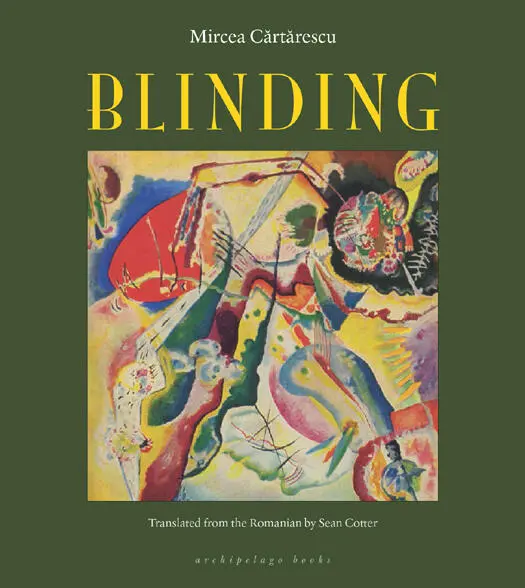
- Название:Blinding: Volume 1
- Автор:
- Издательство:Archipelago
- Жанр:
- Год:1996
- ISBN:9781935744856
- Рейтинг книги:3 / 5. Голосов: 1
-
Избранное:Добавить в избранное
- Отзывы:
-
Ваша оценка:
Blinding: Volume 1: краткое содержание, описание и аннотация
Предлагаем к чтению аннотацию, описание, краткое содержание или предисловие (зависит от того, что написал сам автор книги «Blinding: Volume 1»). Если вы не нашли необходимую информацию о книге — напишите в комментариях, мы постараемся отыскать её.
was one of the most widely heralded literary sensations in contemporary Romania, and a bestseller from the day of its release. Riddled with hidden passageways, mesmerizing tapestries, and whispering butterflies,
takes us on a mystical trip into the protagonist’s childhood, his memories of hospitalization as a teenager, the prehistory of his family, a traveling circus, secret police, zombie armies, American fighter pilots, the underground jazz scene of New Orleans, and the installation of the communist regime. This kaleidoscopic world is both eerily familiar and profoundly new. Readers of
will emerge from this strange pilgrimage shaken, and entirely transformed.
Blinding: Volume 1 — читать онлайн бесплатно полную книгу (весь текст) целиком
Ниже представлен текст книги, разбитый по страницам. Система сохранения места последней прочитанной страницы, позволяет с удобством читать онлайн бесплатно книгу «Blinding: Volume 1», без необходимости каждый раз заново искать на чём Вы остановились. Поставьте закладку, и сможете в любой момент перейти на страницу, на которой закончили чтение.
Интервал:
Закладка:
I remember, that is, I invent. I transmute the ghosts of moments into weighty, oily gold. And, somehow, it is also transparent, ever more transparent the deeper the fountain of my mind becomes (and I, a skeleton leaning over its walls, contemplate the wide, dreaming eyes reflected in the golden water). That hyaline cartilage, there on the shield where the three heraldic flowers meet — dream, memory, and emotion — that is my domain, my world, the World. There in that sparkling cylinder that descends through my mind. There, like a specimen in a green jar, pale and bloated with formaldehyde, it lies with its Asiatic eyelids half closed, with its ecstatic and lifeless smile, with its umbilical cord wrapped around its stomach. How well I know it! How accurately did I imagine it! Oh, my twin, open your painted eyelids, press your lipsticked, sweet lips, swell until the vat bursts and, through the shards of brain, through the organic mucilage, come into the light! With the eye between your eyebrows, enlighten the pearly-skinned pages of this book, of this illegible book, of this book.
8
ON HER left hip, my mother had a large violet-pink mark shaped like a butterfly. The vermiform body moved horizontally across her stomach toward her left buttock, one wing descending over her thigh, and the other rising toward her waist. I remembered this only when I was in my teens, and not during some vesperal reverie, but in a dream. I dreamed, one night in July, after hours of wandering streets downtown, and looking carefully at statues, that my mother was sitting on a bed with a white satin sheet, artfully wrinkled like the felt in jewelry boxes. She was huge and marble-white, capillaries and sweat glands showed through her transparent skin, and on her left hip a tropical butterfly, its colors shining intensely, had landed on thin, nervous little legs. When I woke up, I knew my mother had a lupus eritematos marked on her hip. I had often seen it, in the depths of time, when she walked naked around the house on sweltering afternoons. I knew what she looked like naked, my two- or three-year-old eyes had seen her and remembered. But then, after we moved to the apartment and my mother started to make Persian rugs, I only saw her naked to the waist, her nipples the same color as the butterfly on her hip, now off-limits. Because, later, when we moved again to the house in Floreasca, I wasn’t even allowed to see her breasts. It was as though this woman I came out of — a zone of wet skin, with pimples and moles — was once my domain, and then we were estranged, piece by piece, at the end of a series of unlucky battles. In each one, not only did I lose hectares of thighs, pubic hair, armpits and breasts and wrinkles on the stomach, but also I was wounded, mutilated by steel blades lettered in an unknown alphabet. In five years I lost my mother’s body irreversibly, and I moved away from it, I was moved away with such force that the thought of it and the memory lobotomized my brain with the same blood-covered blade. Therefore, when I dreamed of the butterfly on her hip, I woke with a horrible nausea. Where had my memory been keeping that image? Was it even real? More than the mark itself, I actually remembered my wonder in looking at it. Had my grandma, whom I didn’t remember at all, as though my grandpa made my mother by himself, stolen a butterfly? Or, when she was sunbathing naked on the banks of the Sabar, when she had my mother in her womb, was she touched by the shadow of a pair of delicate wings?
I lay in my bed until an intense night fell, cut in pieces by electric stripes on the ceiling and walls, sparks from the trams on Ştefan cel Mare. I was excited and sad. If I closed my eyes, beneath my eyelids I saw the dozens of statues I had looked at, eye to eye, trying to understand the thoughts of those men made of green bronze and stone, illustrious men whose rubicund muses held out goose quills or equally tarnished laurels, trying to understand how these woman with marble uteruses could make love. Yes, long into the night, when the trolley buses were in the station, the illustrious men climbed down from their plinths, grabbed the muses by their hair, and humped among the trees in the park. They pushed their polished-metal penises between the women’s dew-dampened stone labia. Atlases coupled with limestone gorgons with chipped noses, leaving oleander-filled balconies to fall onto the sidewalk. But I stopped my erotic reverie short, because a balcony like that, on the second floor, with pots of oleander and teasel, actually existed somewhere. It came from somewhere real, in very close connection to the lupus mark on my mother’s left hip — the mark the color of her dentures (ah, now I got it!), the sinister mark. Sinister. Silistra. There was a house on Silistra with a balcony supported by Atlas statues. When mother carried me home from the store, wrapped in my coat, my head passed right by the pubises of the two terrible bearded men bent under the weight of the balcony, which were painted a dirty yellow. I looked up and, framed against the white sky, I saw an old woman whose grey hair fell in waves like a girl’s. But the rest seemed to have melted into fog, pearly and unraveled, and truly the rest melted into dreams.
In the morning, I woke up nervous and distracted, to the birds’ strident chirping and the great yellow light of summer. I got out of the wrinkled bed, walked through rooms painted dull olive and beige, and went into the kitchen, where my mother was already doing her chores, moving among the food-stained chairs. I ate breakfast silently, dipping my bread in coffee and milk, rolling the wet crumbs into marbled balls, and flicking them into dirty cups in the sink. I went onto the balcony. The Dâmboviţa mill, once so flashy in its red-brick vestments, now was white with flour and dust over the roofs full of tin patches, over the huge walls, the round and rectangular windows, and the supports that had girded them for over a hundred years. The mixture of brick-red and white produced an indefinite color, something sad, the shade of all the ancient mills, factories, and workshops in ruin, worn away by time and vegetation. Pitch-black poplars grew everywhere, with carnivalesque green leaves, licking the old, pallid walls and covering them with waves of puffy seeds. Poplar seed puffs — in July, they came down like snow, they drifted around the mill’s foundation, they stuck to the holes and cracks between bricks, they latched onto the feet of pigeons that filled the roof, and they found a tiny bit of earth and extended roots through the panes of glass blocked out by flour. The giant corpse of a ruined but still-functioning mill dominated the back of our block. It scraped the clouds with its triangular pediments like a medieval castle, equally crumbling and melancholy. The mill had a large yard, a few small administrative buildings, deserted and quiet under the sun, and a bulky concrete fence to separate it from the territory of the eight floors of children who came out of the block every morning and played in its shadow, lighting it up with shards of glass and strident screams. Far away to the left of the mill, you could see the outline of Casa Scinteii, the building that published The Spark , with its little red star burning all night. On the right, the State Circus had been visible, but now it was obliterated by the flesh, nerves, muscles and bones of the poplars. You could see the circus only from the roof terrace, a flying saucer on the park expanse. The poplars had been planted only a few meters from the building, and they grew as high as the fifth floor, where we lived, so close we could lean out and touch their supple, leafy branches, splattered by pigeons. Last year, there was a pigeon who spent three weeks trying to hatch a ping-pong ball that had fallen into our balcony drain. I sat on the balcony in my pajamas for half an hour, watching the clouds, whiter than the very white sky, outlined in light, and when I went back into the kitchen, I felt I was entering a sinister cave. In the deep shadow, Mamma seemed like a gypsy woman forgotten on a chair beside the stove, all dark and sweaty, except for the globes of her eyes, which caught the blinding folds of the summer sky. Wasps in yellow plating crawled everywhere. They’d made a nest in the vent and had come through its metal grill. There were wasps as big as my fingers on my mother’s body, as though she were some kind of odd animal trainer. They pulled themselves along with their powerful buccal mechanisms, through her fine, thin, chestnut hair that was untouched by gray, spinning their wings like fans. I told her I was going for a walk. I got dressed and went into the blinding heat outside.
Читать дальшеИнтервал:
Закладка:
Похожие книги на «Blinding: Volume 1»
Представляем Вашему вниманию похожие книги на «Blinding: Volume 1» списком для выбора. Мы отобрали схожую по названию и смыслу литературу в надежде предоставить читателям больше вариантов отыскать новые, интересные, ещё непрочитанные произведения.











Обсуждение, отзывы о книге «Blinding: Volume 1» и просто собственные мнения читателей. Оставьте ваши комментарии, напишите, что Вы думаете о произведении, его смысле или главных героях. Укажите что конкретно понравилось, а что нет, и почему Вы так считаете.