Mircea Cărtărescu - Blinding - Volume 1
Здесь есть возможность читать онлайн «Mircea Cărtărescu - Blinding - Volume 1» весь текст электронной книги совершенно бесплатно (целиком полную версию без сокращений). В некоторых случаях можно слушать аудио, скачать через торрент в формате fb2 и присутствует краткое содержание. Год выпуска: 1996, ISBN: 1996, Издательство: Archipelago, Жанр: Современная проза, на английском языке. Описание произведения, (предисловие) а так же отзывы посетителей доступны на портале библиотеки ЛибКат.
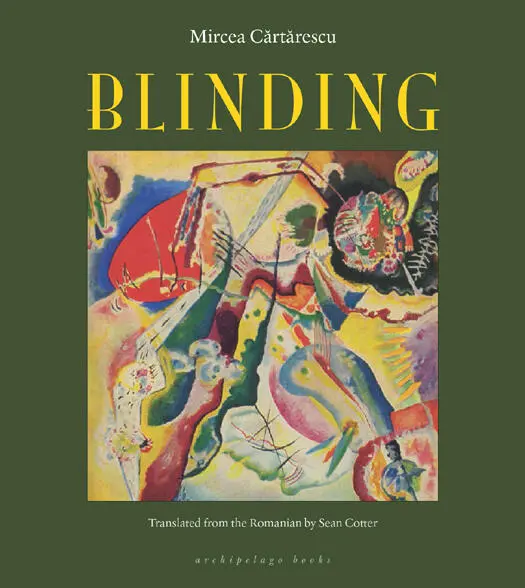
- Название:Blinding: Volume 1
- Автор:
- Издательство:Archipelago
- Жанр:
- Год:1996
- ISBN:9781935744856
- Рейтинг книги:3 / 5. Голосов: 1
-
Избранное:Добавить в избранное
- Отзывы:
-
Ваша оценка:
Blinding: Volume 1: краткое содержание, описание и аннотация
Предлагаем к чтению аннотацию, описание, краткое содержание или предисловие (зависит от того, что написал сам автор книги «Blinding: Volume 1»). Если вы не нашли необходимую информацию о книге — напишите в комментариях, мы постараемся отыскать её.
was one of the most widely heralded literary sensations in contemporary Romania, and a bestseller from the day of its release. Riddled with hidden passageways, mesmerizing tapestries, and whispering butterflies,
takes us on a mystical trip into the protagonist’s childhood, his memories of hospitalization as a teenager, the prehistory of his family, a traveling circus, secret police, zombie armies, American fighter pilots, the underground jazz scene of New Orleans, and the installation of the communist regime. This kaleidoscopic world is both eerily familiar and profoundly new. Readers of
will emerge from this strange pilgrimage shaken, and entirely transformed.
Blinding: Volume 1 — читать онлайн бесплатно полную книгу (весь текст) целиком
Ниже представлен текст книги, разбитый по страницам. Система сохранения места последней прочитанной страницы, позволяет с удобством читать онлайн бесплатно книгу «Blinding: Volume 1», без необходимости каждый раз заново искать на чём Вы остановились. Поставьте закладку, и сможете в любой момент перейти на страницу, на которой закончили чтение.
Интервал:
Закладка:
If our whole lives are only the shadows of our bodies projected onto time, maybe we have super-shadows too — projections that are truer and more complex than the objects themselves. Maybe these shadows live inside us, the way parasitic crabs extend their own substance into the bodies of the host-crabs, but not exactly, because here the parasite is far superior to the host. Our heavenly body, like our physical bodies, has a paradoxical anatomy. It’s assembled from spiritual material, gaseous crystal circulating in diamond veins and jade arteries, pearl capillaries and marble canals, turquoise interstices and opal lymph nodes, jasper kidneys and quartz skin and a zirconium heart and a beryllium brain and sapphire testicles, our interior angels and our interior shadows, and superimposed over the stench-ridden mud of our flesh.
There are seven chakras along the spinal cord, and seven plexuses in the viscera. Three of them are below the diaphragm, the pole of time, of sex, of vegetable life. Separating the spirit from matter, the diaphragm is the border between two kingdoms, because we are amphibious beings between heaven and earth. The diaphragm is the surface of the earth: below it, blind roots grope among the moles, and above it, the corona and its gifts push toward the sky. Under the diaphragm, Muladhara is wrapped like a snake around the sacrum, innervating the snake between the thighs with four petals of thick light. A bit higher, in the small of the back, Svadisthana has six multicolored petals, the queen of the kidneys and bladder, the Leyding cells and the rectum, the place of will and vitality. Manipura has ten petals and illuminates the solar plexus. It tames the anaconda of the bowels, the pallid tongues of the pancreas and spleen, and the blood-red liver with its sack of bile. Above the diaphragm are another three chakras, the pole of the animal, space, and brain. Between the shoulder blades is Anahata, the seat of the feelings, the one that washes our interior islands in blood, the one that nourishes the timus. The gland of childhood, Visuddha, with its sixteen transparent petals, illuminates the vertebrae of the neck, aids the rhythm of respiration, protects the lungs and thyroid, and opens the frozen eyes of the intellect. The triangle between the eyebrows is inlaid with Ajna of the three fires, because there, in the pituitary gland, the queen of the nervous system, is the seat of the soul. And beyond these symmetries, beyond space-time and brain-sex, but toward space and the brain, Sahasrara glistens — the diadem and the spherical eye on the crown of the head, the Aleph of Alephs, the diamond of a diamond world.
We ought to remember with our testicles and love with our brains, but that’s not how it is. Memory is in the middle of the mind, and love between the legs, as though our perverse souls sit in their organic coffins upside-down. Maybe once, surely once, before the wall of the diaphragm was built, and before the wall of apartment blocks on Ştefan cel Mare, the great wall of maturity, the seven chakras and plexuses were flipped upside-down, so that we actually did think and love with the same organ, and we ejaculated and remembered with the parts on the opposite ends. But then, the doppelganger of our chakras and plexuses and rays flipped over, the way that in the eighth month a child turns its head down in the uterus — the reversal that makes us so paradoxical, and so fascinating. Maybe the fetus turns itself over precisely because it senses the onset of birth. We are all women, we are uteruses, and we will tear ourselves apart and we will rot, so that in another world, under a new heaven, crystalline beings can emerge, translucent as crustaceans, with their seven hearts beating in the alpha rhythm, with seven brains, or with seven sexes.
Memory is in the middle of the mind, under the brain, pia mater and neocortex, where it spills over the sensory and motor zones, the homunculus with its swollen tongue and orangutan paws. In the center of the brain, formed in the limbic system, in the fornix and hippocampus, the mammillary bodies and the amygdalae, memory soaks in the striated waters of the thalamus and hypothalamus, it shapes neuronal sculptures, and it wets the marble of the mind with florescent liquids. It creates nets as flimsy as spiderwebs, turned on themselves like Möbius bands, and rippled like the petals of a colorless rose. It runs from the real to the virtual and back to the real, as though Escher’s hands were drawing each other a billion times a second. But does this glittering and tireless shuttle weave something truer, something less monstrous than the homunculus which is its starry sky? Could it be that time’s body and our life’s reverie, from the moment the spermatozoon adheres revoltingly to the ovum and its mind advances through the mucilage to mix with the sun’s mind, and up to the moment when we ourselves, spermatozoa of some inconceivable animal, adhere revoltingly to the great globe of our deaths, and our skulls break into shards and our brains (carrying half of whose information?) migrate through the mucous of death and fuse with the mind of death and then everything dies in a gigantic metabiological explosion called rebirth — could that be projected, reliably, onto the screen behind the retina? The teeth upon the gears of our lives are not only horribly uneven, but of different colors, made of different substances, blown around by the winds like the sails of a skiff, and their indicator needle, capricious, suddenly spins for dozens of revolutions until it disappears, as if it didn’t exist. Then it stops on a minute or for hours on end, licking and touching the minute, analyzing it minutely, coupling with it and giving it children, until it grows old and tarnished and falls, and only then will the indicator deem it ready to advance. From this comes another homunculus, more deformed, grotesque, and phantom-like than that of the sensorial-motor, that hunchbacked stillbirth of our life’s ultimate and hidden meaning. But even this stillborn fetus has a shining mark on its forehead that can smell God and on and on until the billionth dimension, as far as we can imagine, alongside a spatial world whose people and animals have suddenly disappeared, and instead, only their images remain, crowded together on streets and in houses. There are homunculi of people and dogs and cats and rats projected onto this shell — and a world in time, where instead of their actual lives there are only lives reconstructed in memory, lives where one gesture in childhood takes up more time and space than ten years of adulthood, and elephantine temporal organs hang on every side, while the sensory organs can barely be seen.
Memory weaves us, there in the depths of the three-petaled chakra, the forehead’s eye. However hideous (because time is an inferno and a creature of time is a devil from the inferno, or maybe a creature forever damned), it is our twin, and a strange desire pushes one toward the other, one into the arms of the other. When I’m lying on my bed in the afternoon, with kids shouting outside and poplar tufts floating in the sun-filled summer, I remember scenes and gestures and faces from long ago, obscure, enigmatic, melted into pure emotion, then I see it — co-created with my flesh but in another dimension, creating a caricature of me, frightening but at the same time dear to me. Every moment that passes, my memory separates from me a little more, it becomes more daring and independent, its shadow and power grow, and it rises over me, spreading its claws and bat wings. Its beak has crooked teeth, just like my mother’s dentures, and it has a single eye in the black and shining bone of its brow. It crawls out of me like an insect, still wet and soft, from the transparent shell of its former carcass. My memory is the metamorphosis of my life. If I do not plunge bravely into the milky abyss that surrounds and hides my memory in the pupa of my mind, I will never know if I have been, if I am a voracious praying mantis, a spider dreaming upon an endless pair of stilts, or a butterfly of supernatural beauty.
Читать дальшеИнтервал:
Закладка:
Похожие книги на «Blinding: Volume 1»
Представляем Вашему вниманию похожие книги на «Blinding: Volume 1» списком для выбора. Мы отобрали схожую по названию и смыслу литературу в надежде предоставить читателям больше вариантов отыскать новые, интересные, ещё непрочитанные произведения.












Обсуждение, отзывы о книге «Blinding: Volume 1» и просто собственные мнения читателей. Оставьте ваши комментарии, напишите, что Вы думаете о произведении, его смысле или главных героях. Укажите что конкретно понравилось, а что нет, и почему Вы так считаете.