Mircea Cărtărescu - Blinding - Volume 1
Здесь есть возможность читать онлайн «Mircea Cărtărescu - Blinding - Volume 1» весь текст электронной книги совершенно бесплатно (целиком полную версию без сокращений). В некоторых случаях можно слушать аудио, скачать через торрент в формате fb2 и присутствует краткое содержание. Год выпуска: 1996, ISBN: 1996, Издательство: Archipelago, Жанр: Современная проза, на английском языке. Описание произведения, (предисловие) а так же отзывы посетителей доступны на портале библиотеки ЛибКат.
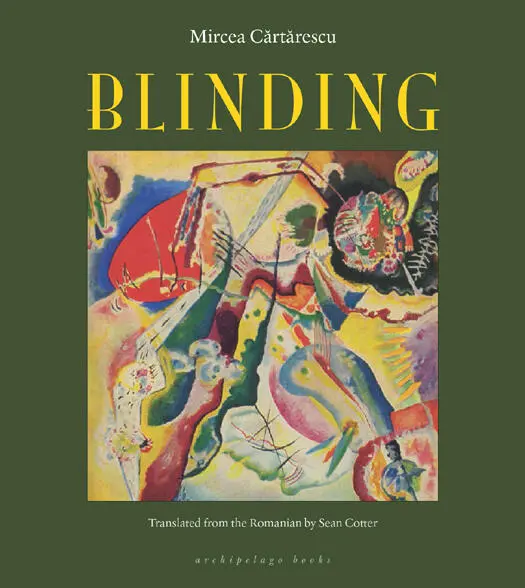
- Название:Blinding: Volume 1
- Автор:
- Издательство:Archipelago
- Жанр:
- Год:1996
- ISBN:9781935744856
- Рейтинг книги:3 / 5. Голосов: 1
-
Избранное:Добавить в избранное
- Отзывы:
-
Ваша оценка:
Blinding: Volume 1: краткое содержание, описание и аннотация
Предлагаем к чтению аннотацию, описание, краткое содержание или предисловие (зависит от того, что написал сам автор книги «Blinding: Volume 1»). Если вы не нашли необходимую информацию о книге — напишите в комментариях, мы постараемся отыскать её.
was one of the most widely heralded literary sensations in contemporary Romania, and a bestseller from the day of its release. Riddled with hidden passageways, mesmerizing tapestries, and whispering butterflies,
takes us on a mystical trip into the protagonist’s childhood, his memories of hospitalization as a teenager, the prehistory of his family, a traveling circus, secret police, zombie armies, American fighter pilots, the underground jazz scene of New Orleans, and the installation of the communist regime. This kaleidoscopic world is both eerily familiar and profoundly new. Readers of
will emerge from this strange pilgrimage shaken, and entirely transformed.
Blinding: Volume 1 — читать онлайн бесплатно полную книгу (весь текст) целиком
Ниже представлен текст книги, разбитый по страницам. Система сохранения места последней прочитанной страницы, позволяет с удобством читать онлайн бесплатно книгу «Blinding: Volume 1», без необходимости каждый раз заново искать на чём Вы остановились. Поставьте закладку, и сможете в любой момент перейти на страницу, на которой закончили чтение.
Интервал:
Закладка:
My short-sleeved shirts were too tight at the shoulders, so they creased across the front, making my chest look more sunken than it really was. As soon as I left the cool apartment, I started to sweat. Big drops dripped from my armpit hair onto my already wet skin. Under my pink or leek-green shirts, my crooked thorax drowned in transparent colors and water. The asphalt was soft under my shoes. I looked in the furniture store windows on the ground floor and saw myself among the ficuses and kitchen decor, a kid with a blade-thin face and a wobbly walk. If I felt someone looking at me, my steps became awkward and mechanical, as though I was afraid that I would forget how to walk, and that I might fall onto the asphalt at any moment. I walked toward Obor on the shady side of the boulevard, blinded by the shining windshields and windows, unconsciously registering the great curve of the blocks, and ending up in front of the Melodia movie theater.
From Obor, I knew I should go up toward Colentina. Here it already felt like the edge of town. Among the cars passed horse-pulled trucks with automobile tires, their azure or green panels painted with mermaids, stags, and floral patterns. They left a trail of yellow-green, globular scat. And the people changed. The women wore headscarves and print skirts; they bared their metal teeth at each other as they came out the factory door, lugging plastic bags and woven baskets. They looked like meaty hens with sagging crests. Clusters of gypsies filled the sidewalks, waiting for the tram, the women in layers of flowery orange and brick-red dresses and sport coats, the men in black suits and hats, sitting on puffed sacks, incredibly greasy. Still, I liked their smell, of the slums, of natural decay, like the unmistakable smell of the country, a combination of fruit fermenting in vats of ţuica, lye splattered in semi-circles on the ground, and sap from frightening vegetation that darkened my gaze in the summer. Workers on ancient, iron bicycles, with two or three soda bottles tied with wire to the little racks behind their saddles, pedaled deftly in bleached sneakers. The yellow road rose toward the east, framed by a green labyrinth of trees.
I crossed Suveica, where my mother had worked at the mechanical looms, and where she would emerge at dusk, drowning in gnats and plagued by the urge to vomit, smelling the rancid fat from the soap factory next door. All the way home, and all night at home, the noise of the looms where she spent her days would ring in her ears. Over the entry gate, in red block letters, arched the words “Long Live the Romanian Communist Party,” and on the wall of honor, in black and white photos the size of postcards, the vanguard of production smiled stupidly — women with crooked faces, like men or children, with immobile hair and dead eyes. Dresses that looked like school uniforms — with white collars and polka-dot prints in white on black, or black on white — seemed to be the universal fashion in their limited environment of factory, market, and home.
I stopped at Teiul Doamnei, feeling irritated. I could sense, in my mind’s nostrils, the effluvia of the house on Silistra. But where was it coming from? Since the moment we had moved away from that part of town, I couldn’t remember coming back except once: like in a dream, I saw a road and a tram, a market paved with square bricks, and the hazy ghosts of buildings, leaning forward menacingly … Nothing else. But now, lost, I wandered through the neighborhood of run-down houses, with watch repair shops and locksmiths, I asked an old man — yes, the street was somewhere around here, everyone knew it, but maybe they didn’t call it Silistra, something else, who knows what … and I would have gone back home, if, suddenly, in the rarefied air of my mind, the route I’d taken that day hadn’t come to me in a glimmering vision, from who knows where, as the crystalline skeleton of a bird’s wing, or a flying mammifer. The humerus stretched from my block to Bucur Obor, the radius and cubitus, stuck together — from Obor to Teiul Doamnei, and from there the finger bones separated, much too long and ending in powerful claws. When I saw, on one of the beast’s fingers, a massive gold ring, I knew that I had found (because any discovery is remembrance) the mystical street and house of my birth. I only had to cross the boulevard and drown myself in the streets of that neighborhood.
But it seemed the shining wing did not have only five fingers, but many, a tangle of fingers. I wandered for hours under a tropical sun along identical sad streets on the edge of town, with middle-class and country houses, with kites hanging from telegraph wires and pigeons singing in mulberry bushes. I rounded corners, I read the street signs: Bujoreni, Zorilor, Sadova, Major Anastasie Petru, Perişani … I was hypnotized by the abandoned buildings invaded by weeds, the doorframes and window frames torn out, and a dirty child pulling a band of cut copper behind him, muttering something in a room painted blue. I stopped old women wearing slippers and asked them where Silistra was. “Ah, Silistra, I think it’s two streets that way. But who are you looking for, sonny?” I froze when, deep into a far-away street, perpendicular to those I’d walked before, I saw, against a sky crossed by clouds, a melancholy and austere tower, the one I had seen for some time in my dreams. The actual tower had a window on the upper floor, with heavy bent shades. Standing there, petrified on the empty street, face to face with the high building, I felt certain I had been there before, and a strange magic made me open the unpainted wooden door. There was a spiral stairway, with a cold stone railing. I walked up, with all of my joints trembling. The paint on the wall was green and oily. There was a pot with a sick cactus, covered in mold, pale and ulcerous. I leaned on the cool railing and knocked at the only door on the miniscule landing. It had a large, outdated peephole. In the cloudy light that came through a single windowpane, Anca opened the door. I walked into a hall that smelled like dusty Persian rugs. The room was packed with old things, chipped porcelain and almost black silver servings. There was a picture of the tower, somewhat crudely painted, with Anca in front, playing hopscotch. Beside the tower, in the picture (not in reality) rose an olive-green cypress tree.
Still dizzy from so many twists and turns through Colentina, my shirt drenched with sweat, I was glad for the cold of the dark, quiet apartment. Anca brought a saucer with a spoonful of rose petal jam, and while I ate, looking at the filigreed spirals on the handle of the spoon, she told me about her childhood.
9
HER mother worked the stamping machine in a metal shop. Eight hours a day, Monday to Saturday, she sat on a rotting wooden box, in front of an enormous and greasy hydraulic press, jabbing rectangular pieces of sheet metal into the jaws of the machine. A shiny cylinder would fall in a flash with a deafening sound, stamping the sheets and rising just as quickly. In the shop, eight presses were operating constantly. At each one worked a woman in a blue coat. All of the women were practically deaf. They each had all of their fingers, because the ones whose fingers got caught under the cylinder did not come back. Anca’s mother worked in the shop until she went into labor (her daughter never had any trouble remembering the howl of the presses, because she had heard it, diffused by the liquid of the placenta, since she was no bigger than a salamander). She left for the maternity ward by tram, in a happy, sweating crowd on a Saturday afternoon.
Anca grew up in the tower, the former brick annex of a workshop from the beginning of the century, later demolished. A vacant lot with a few black, greasy pieces of machinery — wheels, belts, springs, and the frame of a tram wagon, with flaking paint and missing windows — spread its weeds and trash behind the tower. That’s where the girl would play, sitting on one of the wooden benches of the old tram and pretending to take a trip, catching gray and brown locusts that writhed in her fist and tried to escape between her fingers, touching her dress (with a bud of yellow velvet sewn onto her front pocket) to the greased machinery … When evening came and the sky turned purple, and a little window sparkled high on the tower wall, Anca knew that it was time to come inside. Still, sometimes she would stay in the field, flattening balls of paper with colorful pictures, listening to the factory whistle, or just running here and there until the light fell into the earth and the moon appeared.
Читать дальшеИнтервал:
Закладка:
Похожие книги на «Blinding: Volume 1»
Представляем Вашему вниманию похожие книги на «Blinding: Volume 1» списком для выбора. Мы отобрали схожую по названию и смыслу литературу в надежде предоставить читателям больше вариантов отыскать новые, интересные, ещё непрочитанные произведения.












Обсуждение, отзывы о книге «Blinding: Volume 1» и просто собственные мнения читателей. Оставьте ваши комментарии, напишите, что Вы думаете о произведении, его смысле или главных героях. Укажите что конкретно понравилось, а что нет, и почему Вы так считаете.