Mircea Cărtărescu - Blinding - Volume 1
Здесь есть возможность читать онлайн «Mircea Cărtărescu - Blinding - Volume 1» весь текст электронной книги совершенно бесплатно (целиком полную версию без сокращений). В некоторых случаях можно слушать аудио, скачать через торрент в формате fb2 и присутствует краткое содержание. Год выпуска: 1996, ISBN: 1996, Издательство: Archipelago, Жанр: Современная проза, на английском языке. Описание произведения, (предисловие) а так же отзывы посетителей доступны на портале библиотеки ЛибКат.
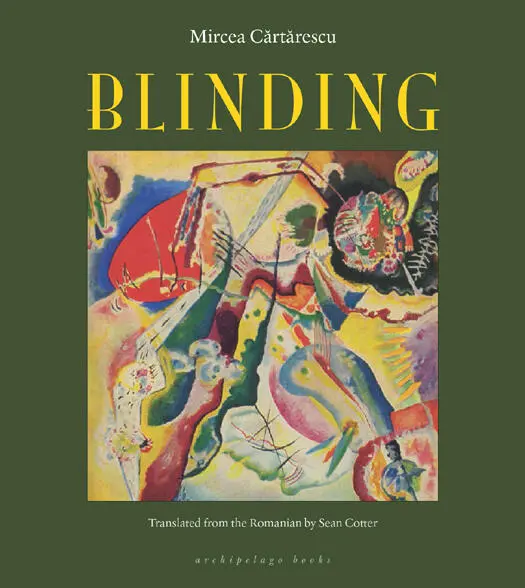
- Название:Blinding: Volume 1
- Автор:
- Издательство:Archipelago
- Жанр:
- Год:1996
- ISBN:9781935744856
- Рейтинг книги:3 / 5. Голосов: 1
-
Избранное:Добавить в избранное
- Отзывы:
-
Ваша оценка:
Blinding: Volume 1: краткое содержание, описание и аннотация
Предлагаем к чтению аннотацию, описание, краткое содержание или предисловие (зависит от того, что написал сам автор книги «Blinding: Volume 1»). Если вы не нашли необходимую информацию о книге — напишите в комментариях, мы постараемся отыскать её.
was one of the most widely heralded literary sensations in contemporary Romania, and a bestseller from the day of its release. Riddled with hidden passageways, mesmerizing tapestries, and whispering butterflies,
takes us on a mystical trip into the protagonist’s childhood, his memories of hospitalization as a teenager, the prehistory of his family, a traveling circus, secret police, zombie armies, American fighter pilots, the underground jazz scene of New Orleans, and the installation of the communist regime. This kaleidoscopic world is both eerily familiar and profoundly new. Readers of
will emerge from this strange pilgrimage shaken, and entirely transformed.
Blinding: Volume 1 — читать онлайн бесплатно полную книгу (весь текст) целиком
Ниже представлен текст книги, разбитый по страницам. Система сохранения места последней прочитанной страницы, позволяет с удобством читать онлайн бесплатно книгу «Blinding: Volume 1», без необходимости каждый раз заново искать на чём Вы остановились. Поставьте закладку, и сможете в любой момент перейти на страницу, на которой закончили чтение.
Интервал:
Закладка:
Space is Paradise and time is Inferno. How strange it is that, like the emblem of bipolarity, in the center of a shadow is light, and that light creates shadows. After all, what else is memory, this poisoned fountain at the center of the mind, this center of paradise? Well-shaft walls of tooled marble shaking water green as bile, and its bat-winged dragon standing guard? And what is love? A limpid, cool water from the depths of sexual hell, an ashen pearl in an oyster of fire and rending screams? Memory, the time of the timeless kingdom. Love, the space of the spaceless domain. The seeds of our existence, opposed yet so alike, unite across the great symmetry, and annul it through a single great feeling: nostalgia.
We are animals of nostalgia, abjections organized by geometry, as though our genitor spat into the cup of a lily and created us there, out of phlegm and perfume. But, unlike Akasia, because our memory only knows the dimensions of the past, our nostalgia is amputated, partial, a feeling that takes metaphors as reality and contorts itself around half-truths. We all have memories of the past, but none of us can remember the future. And yet, we exist between the past and future like the vermiform body of a butterfly, in between its two wings. We use one wing to fly, because we have sent our nerve filaments out to its edges, and the other is unknown, as if we were missing an eye on that side. But how can we fly with one wing? Prophets, illuminati, and heretics of symmetry foresaw what we could and must become. But what they see per speculum in aenigmate we will all see clearly, at least as clearly as we can see the past. Then, even our torturous nostalgia will be whole. Time will no longer exist, memory and love will be one, the brain and the sex will be one, and we will be like the angels.
We know from our cerebro-spinal trunk that we are the larvae of an astral being. With the marrow of our spines as its root and the two cerebral hemispheres in our skulls like two fleshly cotyledons, they perfectly resemble a plant in the first stages after sprouting. Their flesh is the earth into which they were sown and whose resources they will exhaust, and our brains will also be consumed and will wrinkle like a walnut kernel inside its dry fruit. Two small leaves will burst from its center, tender and filled with light — wings of the soul, wings of the spirit that will depart from the hothouse of this world, vested in the glory of a heavenly body, to be planted in a new earth, under a new sky.
Our painful love, born from the center of time, our daily nostalgia given to us today, itself the larva of the great and true nostalgia, projects into the past what it foresees as our destiny and future: it searches deep within the caves, cellars, basements, cells, and grottoes of time for what might be found in the rarefied air and metaphysical light of the attic. It desperately searches for something that must be found, a way out that must be uncovered, even though no organ exists that can sense it. We are constantly searching in the opposite direction, but the more mistakenly we search, the more we feel joy and certainty, because diametric opposites must lie on the same axis, and this itself is a powerful connection. We can only see our target in a mirror, in illusion, but we know that it exists somewhere in reality. Our blindness toward the future is like some patients’ corporeal agnosia: for them, the right (or left) half of the world has simply disappeared, along with the respective half of their bodies. There is not even nothingness for them. It is like the absolute silence of those born deaf, who lack any idea or intuition of sound. Metaphors, circumlocutions, approximations, the basest or most ingenious of verbal tricks, definitions by negation — you can try everything, but for someone who does not feel , for whom an area of reality does not exist , it quickly becomes tiresome to keep asking what it is like, what is comparable to something he will never know. Metaphorical speculations are, for him, simple parlor games, symbols of aesthetic value more than a deep need to define. Would we fall back on these kinds of glass-bead games, were it not for nostalgia? If passivity did not cause us pain? If we did not suffer like dogs when we weren’t searching, torturing ourselves with questions we know all too well we cannot answer, because the answer would not be a word or phrase but a deep and dramatic modification to our body’s schema and our being’s essence. We are not like someone blind from birth, but like someone who lost his sight in childhood, who sometimes dreams of things he cannot conceive: images and colors, shapes and shadows, lips, eyes, a hand that he only recognizes as an evanescent emotion, a foreboding that someday he will see again, not with his eyes, but with all the skin of his body, and not just with his skin, but his viscera, his veins and arteries, his trachea and esophagus, his pelvic bones and endocrine glands, his blood and saliva and the musk of his sweat. And not just with his body, but with the dogs and acacia and apartment blocks and cars and stores all around him, the seasons and constellations — a foreboding that he will see, someday, with the great eye, clear and pure as the whole, outside of which only non-existence exists.
Abjection and glory, like mucous that can just as well be holy myrrh, both vest the form of our body. Abjection, because we are worms, tubes with a double symmetry, nutrition in our center, relation and reproduction at our extremities, guts full of fecal matter between our brains and our genitals. The capacity for thought that we trumpet is no more wondrous a phenomenon than the ability of deep-water fish to generate light, or the power of an eel to produce electric shocks. Maybe we do have an organ to sense the divine, but it’s rudimentary, a plus or a minus, an “it is or it isn’t.” It perceives the divine the way paramecia sense light with a red dot, without actually “seeing.” What can be rescued in us? The soul? The astral body? Consciousness? A simple tumor wipes out all of those things, an epileptic nucleus shakes away memory, the sight of a woman’s hips stops a man’s thinking, an injustice drives us into the purest paranoiac delirium, a dream chills our necks and makes our hair stand on end. The harmony of a billion billion tiny, mushy things (systems and devices composed of tissues composed of cells composed of organelles: ribosomes, lysozymes, mitochondria, Golgi apparatuses, nuclei with chromosomes composed of chains of DNA and RNA composed of nucleic acids composed of molecules of hallucinatory stereosymmetry composed of atoms composed of nuclear particles composed of quarks) barely leaves any room for a splash of sparkling liquid, a clear thought, where the structured dust of worlds could develop. And this is only for a few of the billions of sentient worms that crowd together inside the stomach of a larger worm. They live as long as they’re given, and then they’re reabsorbed into the spiraling conglomeration of the earth. Everything is a grain of sand on a beach as wide as the universe. Where is there room for salvation? And why would you, you in particular, atomic bog, receive eternal life?
Glory is analogously disorienting because the symmetry of all worlds follows from the symmetry of our bodies. The human embryo recapitulates an abbreviated phylogeny of the living world. Swimming in the muscular pool of the uterus, feeling the warmth of the urinary and rectal canals, translucent and curled up, we envelop ourselves with the complications of embryonic layers, becoming, one by one, coelenterates and worms, fish with fluttering gills, amphibians, insectivorous mammifers and primates, until we break the blood-filled vulva and, dirty with meconium, we emerge headfirst into the new place where we live until our next birth. The same magical link exists between the stages of this life and the corporeal scheme of our flesh, as if we could see through time the way we see the panorama of space — as if our lives themselves were human beings made out of time, with structures identical to ours down to the smallest details, and analogous in surprising ways to a gigantic being, whose organs were the countless generations of all living creatures. In a way, by being born, playing, loving, maturing, aging, and dying, we live and breathe the gonads, vertebrae, sphincters, intestines, diaphragms, lungs, hearts, jugulars, jaws, brains, and skulls of our own lifespans.
Читать дальшеИнтервал:
Закладка:
Похожие книги на «Blinding: Volume 1»
Представляем Вашему вниманию похожие книги на «Blinding: Volume 1» списком для выбора. Мы отобрали схожую по названию и смыслу литературу в надежде предоставить читателям больше вариантов отыскать новые, интересные, ещё непрочитанные произведения.









Обсуждение, отзывы о книге «Blinding: Volume 1» и просто собственные мнения читателей. Оставьте ваши комментарии, напишите, что Вы думаете о произведении, его смысле или главных героях. Укажите что конкретно понравилось, а что нет, и почему Вы так считаете.