Mircea Cărtărescu - Blinding - Volume 1
Здесь есть возможность читать онлайн «Mircea Cărtărescu - Blinding - Volume 1» весь текст электронной книги совершенно бесплатно (целиком полную версию без сокращений). В некоторых случаях можно слушать аудио, скачать через торрент в формате fb2 и присутствует краткое содержание. Год выпуска: 1996, ISBN: 1996, Издательство: Archipelago, Жанр: Современная проза, на английском языке. Описание произведения, (предисловие) а так же отзывы посетителей доступны на портале библиотеки ЛибКат.
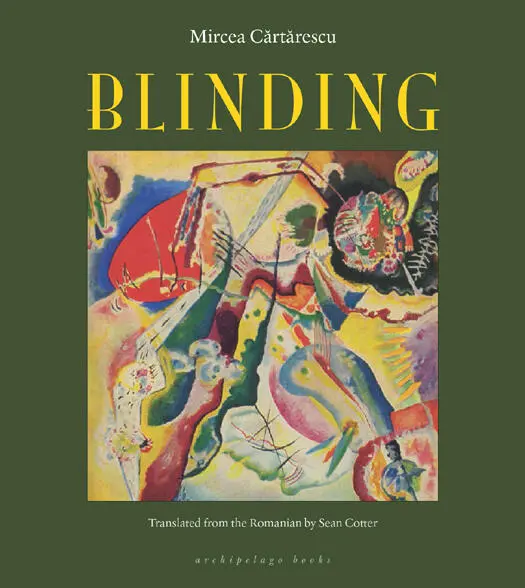
- Название:Blinding: Volume 1
- Автор:
- Издательство:Archipelago
- Жанр:
- Год:1996
- ISBN:9781935744856
- Рейтинг книги:3 / 5. Голосов: 1
-
Избранное:Добавить в избранное
- Отзывы:
-
Ваша оценка:
Blinding: Volume 1: краткое содержание, описание и аннотация
Предлагаем к чтению аннотацию, описание, краткое содержание или предисловие (зависит от того, что написал сам автор книги «Blinding: Volume 1»). Если вы не нашли необходимую информацию о книге — напишите в комментариях, мы постараемся отыскать её.
was one of the most widely heralded literary sensations in contemporary Romania, and a bestseller from the day of its release. Riddled with hidden passageways, mesmerizing tapestries, and whispering butterflies,
takes us on a mystical trip into the protagonist’s childhood, his memories of hospitalization as a teenager, the prehistory of his family, a traveling circus, secret police, zombie armies, American fighter pilots, the underground jazz scene of New Orleans, and the installation of the communist regime. This kaleidoscopic world is both eerily familiar and profoundly new. Readers of
will emerge from this strange pilgrimage shaken, and entirely transformed.
Blinding: Volume 1 — читать онлайн бесплатно полную книгу (весь текст) целиком
Ниже представлен текст книги, разбитый по страницам. Система сохранения места последней прочитанной страницы, позволяет с удобством читать онлайн бесплатно книгу «Blinding: Volume 1», без необходимости каждый раз заново искать на чём Вы остановились. Поставьте закладку, и сможете в любой момент перейти на страницу, на которой закончили чтение.
Интервал:
Закладка:
They founded the village of Tântava there, between the Argeş and Saba. First they dug cottages into the strangely soft clay, and as spring came closer, they built houses, each with an entryway and two rooms, gathered around the grandeur of the church like sheep around their shepherd. Beside the church, they dug long beds for vegetables, and by summer the little village was as happy among its greens and vines as it had been in the Rhodope Valley. Over the next quarter century, the first Badislavs in Muntenia became the land’s inhabitants — they lived, they procreated, and they forgot their old language and learned what the people around them spoke. They extended their lands and drank their brains out at the bodega that soon appeared in the village center. The bar was a place to toast the Devil, the Lord’s little brother (as the older ones believed), to kill each other with tomato stakes over a woman, to hold vigils over old men in agony, so that they wouldn’t have to die without a candle on their chests, and to look for rainclouds in the sky, all without ever imagining that, in fact, they weren’t building houses, plowing land, or planting seeds on anything more than a gray speck in a great-grandson’s right parietal lobe, and that all their existence and striving in the world was just as fleeting and illusory as that fragment of anatomy in the mind that dreamed them.
7
THE past is everything, the future nothing, and time has no other meaning. We live on a piece of plaque in the multiple sclerosis of the universe. An animal, small and compact, a single particle a billion times smaller than a quark, and a billion billion times hotter than the center of the sun, encompassed the entire design that our mind perceives in the moment it is given to perceive, uniting it in the breath of a single force, with balls of space and strings and the foggy droppings of the galaxies and the political map of the planet and the unpleasant smell of someone’s mouth you’re talking to on the bus and Ezekiel’s vision on the banks of the Chebar and every molecule of melanin in a freckle under the left eyebrow of the woman you undressed and possessed a night ago and the wax in the ear of one of the ten thousand immortals of Artaxerxes and the group of catecholaminergic neurons in the medulla oblongata of a badger asleep in the woods of the Caucasus. It encompassed everything our mind has never known and will never understand, because, in a sense, that point actually was our mind, the thought that thinks itself, like a sword so sharp it cuts itself to pieces. It was the absolute past, without fissure. It was metaphysical flesh, homogenous and fiberless, without any distinction, aside from some at first unobservable filaments of the future. When and why did the symmetry shift? Who created the initial estrangements, and how? Who could have withstood the first crack of the fissuring All? The future, that is, estrangement, separation, and cooling, broke the original globe into a thousand shards and gouged hideous wounds into the body of the oneness of being, spaces that widened ever more, separating the granules of substance and letting a photonic blood gurgle between them. A purulent night wrapped every corpuscle into being, in a dark and hopeless schizophrenia. The universe, which was once so simple and complete, obtained organs, systems, and apparatuses. Today, it’s as grotesque and fascinating as a steam engine displayed on an unused track at a museum. It demonstrates its rods and levers under a bell jar. And until the bell of our minds is incorporated into the universal desolation, it will function as an internal organ reflecting the whole, the way a pearl reflects the martyred flesh of an oyster.
And yet, the universe is not everything that happens, but much, much more. Because, if those parts of us that analyze, those parts of every living being — the eyes, the compound eyes, the camera eyes, the antennae with batteries of chemoreceptors, the lateral lines of fish, the ears with trembling cochlea, the osmic cells in the nasal passages, the taste buds, the organs a spider uses to feel vibration and the organs a tick uses to sense carbon dioxide, the touch receptors of the skin, the ones that twist around every fiber of muscle in the oral organs of the Sarcoptes scabia, the ones that feel cold and heat, the ones stimulated by the otolithic stalactites of the organs of balance and the hundreds of thousands of other senses that simultaneously ingest the vibrations of matter — if these vulvae, if these tentacles adhere to the symmetry of the stars, there is still everything that we cannot perceive except through the super-sensory organ of thought, a super -symmetry, structures twisted around themselves that annul, at a higher level, the flow from the past toward the future, from all toward nothing. The universe, at a higher level than the visions of galaxies and quasars, is reflected in itself, in a super-mind, whose foundation is memory. There is a universal memory, a memory that encompasses, houses, and destroys the idea of time. There is Akasia, and Akasia is the savior of the universe, and beyond Akasia there is no hope of salvation. She is the eye in the forehead of All, encompassing the history of All and all that is, was, and shall be. In Akasia there is no death, or birth — all is coplanar and all is illusion. All of the world’s events, and every particle of substance, and every quantum of energy are present in transfinite light, there, in Memory. And if our thought (by which we perceive, in privileged moments of ecstasy, Akasia) would ever be able to turn back upon itself — perhaps by adding a seventh layer to the neocortex or by creating another, bizarre, organic basis for itself — the way that once, in the mind of a fur-covered being, awareness turned on itself and became consciousness, we might be able, like the angels, to detect the Memory of the Memory of the world, and the Memory of the Memory of the Memory and so on and so on, infinitely. And if conscience became prescience, reflecting itself in itself, it would then become omniscience, rising above this telescoping memory to see the center of the rose with infinite petals, to see the enchanting spider that weaves illusion, modeling it quickly into universes, spaces and times, bodies and faces, with its infinite, articulating legs.
We ourselves, although an unimportant organ of the world, are in some way the entire world. The All is everywhere at once and in every moment. The shuttle’s first pass through the weft that began to describe the world — the way a rod, spinning quickly, creates a dense, still circle, or the way the sweeping spot of a cathode-ray tube creates a televised image — has stamped the same configuration onto all the fragments of being, from the bottom to the top, from the holon to the holonarchy, from the eon to the pleroma. Every object, imaginable or beyond imagination, in a poor example of universial homogeneity, has a bipolar structure. Everything has a dual structure, like magnets, with poles oriented in opposition. Animal and vegetable polarities are paired everywhere, in every object. The first belongs to space, the spirit, searching, and movement. The other belongs to time, the soul, and immobile passivity. We find masculine and feminine, sulfur and mercury, yin and yang in the emblem of the hill in light and the hill in shadow. We live in two media, just as a tree lives in both the air and earth, its branches aerial roots, and its roots underground branches.
The bilateral symmetry of our organism — our two arms, two legs, two cerebral hemispheres, two eyes, two lungs, two kidneys, and two gonads — often overshadows the subtler symmetry of top-bottom, the higher and truer symmetry. Our diaphragms, like walls between two kingdoms, divide our bodies into two zones with opposing polarities. Above our diaphragms, we’re dominated by the signs of air and fire, while below, we’re dominated by water and earth. It is easy to see that our arms correspond to our legs and our pelvises to our scapulae, but strange correspondences link the organs of our thoracic cavities with our abdomens. Any study of embryos will show that the heart corresponds to the liver and the lungs correspond to the intestines and kidneys, however diverse their morphology might appear. If we examined the entire, magical symmetry of a man hung upside-down on an imaginary Saint Andrew’s cross — the symmetry of a larva, the symmetry of a being whose evolution is incomplete — we would find the most fantastic, bizarre, and dizzying correspondence, and differences as well, between the organs at the ends of his body, in between his arms and in between his legs. The head corresponds to the genitals, and all our mystical, animal faculties are concentrated there. The cerebral hemispheres and the testicles or ovaries are the same organs, but opposing polarities pushed them toward opposing functions and forced them to diversify their morphologies. The brain moved toward the animal pole, which shaped it into an organ of relation, spatiality, and internal and external exploration, while the gonads anchored themselves in the fertile substance of time. And both, in different planes of existence, live and bathe in immortality. The sublime universe appears to us in the orgasm of the mind and the syllogisms of fecundity, in the sperm of the brain and the memory of the ovaries. Under two different faces — angelic and demonic, masculine and feminine — the sublime universe appears to us, touches the blood-filled jewel in which we live.
Читать дальшеИнтервал:
Закладка:
Похожие книги на «Blinding: Volume 1»
Представляем Вашему вниманию похожие книги на «Blinding: Volume 1» списком для выбора. Мы отобрали схожую по названию и смыслу литературу в надежде предоставить читателям больше вариантов отыскать новые, интересные, ещё непрочитанные произведения.









Обсуждение, отзывы о книге «Blinding: Volume 1» и просто собственные мнения читателей. Оставьте ваши комментарии, напишите, что Вы думаете о произведении, его смысле или главных героях. Укажите что конкретно понравилось, а что нет, и почему Вы так считаете.