Norman Rush - Mortals
Здесь есть возможность читать онлайн «Norman Rush - Mortals» весь текст электронной книги совершенно бесплатно (целиком полную версию без сокращений). В некоторых случаях можно слушать аудио, скачать через торрент в формате fb2 и присутствует краткое содержание. Год выпуска: 2003, ISBN: 2003, Издательство: Vintage Books, Жанр: Современная проза, на английском языке. Описание произведения, (предисловие) а так же отзывы посетителей доступны на портале библиотеки ЛибКат.
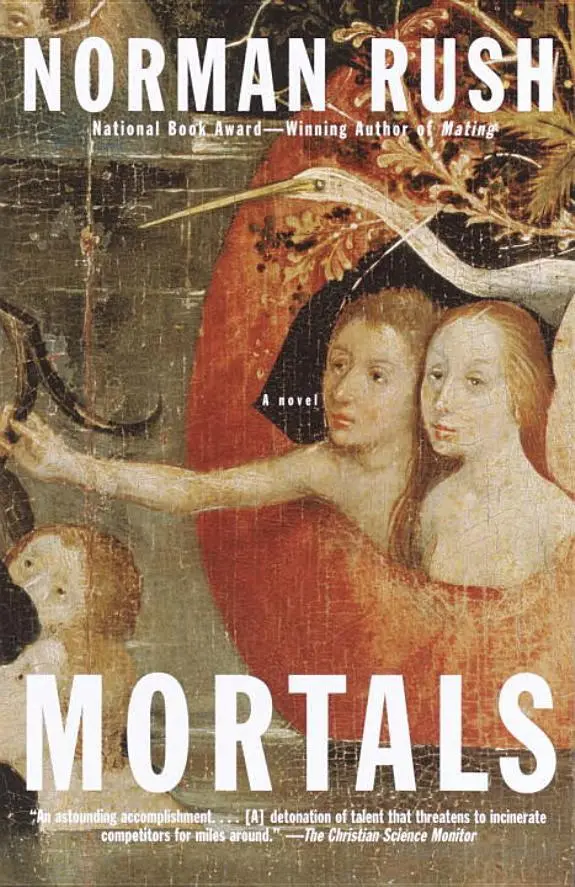
- Название:Mortals
- Автор:
- Издательство:Vintage Books
- Жанр:
- Год:2003
- ISBN:9780307789365
- Рейтинг книги:3 / 5. Голосов: 1
-
Избранное:Добавить в избранное
- Отзывы:
-
Ваша оценка:
Mortals: краткое содержание, описание и аннотация
Предлагаем к чтению аннотацию, описание, краткое содержание или предисловие (зависит от того, что написал сам автор книги «Mortals»). Если вы не нашли необходимую информацию о книге — напишите в комментариях, мы постараемся отыскать её.
As a spy, the compulsively literate Ray ought to have no trouble confirming his suspicions. But there’s the distraction of actual spying. Most of all, there’s the problem of love, which Norman Rush anatomizes in all its hopeless splendor in a novel that would have delighted Milton, Nabokov, and Graham Greene.
Mortals — читать онлайн бесплатно полную книгу (весь текст) целиком
Ниже представлен текст книги, разбитый по страницам. Система сохранения места последней прочитанной страницы, позволяет с удобством читать онлайн бесплатно книгу «Mortals», без необходимости каждый раз заново искать на чём Вы остановились. Поставьте закладку, и сможете в любой момент перейти на страницу, на которой закончили чтение.
Интервал:
Закладка:
At last he was at the end. The revolt had been frustrated.
“ ‘We beckon out the biggest rat ,
And ask him, with a friendly pat ,
To join our side the merrier—
We teach him how to bark: with shears ,
We dock his tail, and trim his ears ,
Give him some bones, to calm his fears ,
And tell him he’s a Terrier.’ ”
Keletso seemed unsure of what to say. Ray had read the piece, the bulk of it, partly in the spirit of experiment. He was curious about what a Motswana would make of this antique republican agitprop.
An awkward silence began.
“Rra, who are these cats and uprisen mice? What nation is that?”
“Well, it’s no particular country, it’s an imaginary country, a country made up so the poet can tell a story about how the terriers, who are the kings, the nobility, the big men, rule the rats in Britain. The cats are the ones in another country who are inquiring, to learn how they can dominate the mice in their country the way the terriers dominate the rats. But in any case now this poem is being reprinted and translated for the Batswana of today.”
Keletso was silent.
Ray said, “So, rra, if you were applying this fable, fable is what it is, to Botswana at this moment today, what would it mean?”
Keletso, giving Ray a sidelong glance, said, “Rra, what is your opinion?”
“Well, could we say that in Botswana the terriers are the big men and the chiefs and, well, Domkrag?”
“Ehe, you mean as when they can pinch away leaders from BoSo to make it weak? As we had in Gaborone when BoSo elected their man mayor, and then he switched across to Domkrag, like a flash …”
“Yes, right. That kind of thing.”
“Nyah, rra.”
“You say no?”
“Your eyes are too small, rra.”
“I don’t know what you mean.”
“Because if you would say who are the big dogs today in Botswana, it is the makhoa. Sorry.”
“White people, the white man, Europeans, you mean …”
“Ehe. When you put the question, I say the makhoa.”
“So we are the dogs, still, you feel?”
“Such is what you can take from this poem, rra.”
“And it is what you take from it?”
“Rra, it is.”
“You say it without hesitation.”
This was the wrong tack to take, and Ray knew it. But he couldn’t help himself.
He said, “So, is your view, then, that despite independence … and you’ve been independent since 1966, isn’t it?… that still the white man is … is maneuvering at the top?”
“He is, yes. You cannot always see him.”
“Ah well,” Ray said.
“Yah.”
“So it is, then.”
I’m hurt, stupidly enough, he thought.
Twice during the afternoon they had noticed lines of black smoke, like scratches, rising from distant fires far to the north. No discussion had come out of it. This was the wrong time of year for the veld fires the Bushmen employed to drive game into traps, if they were even still doing that. The Bushmen were operating under restrictions. He had no idea what they were still allowed to do. Their hunting was controlled. That had to be a joke, though. How could anything in the Kalahari be administered, that was the question. He didn’t know. He did know he should always say Basarwa and not Bushmen. And he did know that they were facing extinction. He knew that. Did they?
He wasn’t looking forward to turning in tonight. His pillow and to a lesser extent his sleeping bag had a consommé smell, rank. He had beaten his pillow and his pillowcase against a tree trunk. He had flicked aftershave on the pillowcase. The odor was in the pillow itself. Drifting off, he had to smell himself, as he fell … there was no escape.
They were nowhere, still. And they would sleep in another section of nowhere, beside the road, again. They were inching. There had been rain in the area. The road was viscous in spots and Keletso was being exquisite with his driving, as he should be doing. There was a movie with Yves Montand driving a load of dynamite over roads like this that had nothing to do with their situation that he could think of. Ah yes, atopia is where we are, he thought. Black cotton soil was the name for the treacherous sort of surface that showed up in places along the spoors after heavy rainfall. The guidebooks warned about it. He was studying Keletso’s technique. He had to get it down.
The silence of the desert was entering them. It was hard to talk, to converse, harder all the time. The stupid silence was conquering them. The desert was ruled by stupid life, except for the quick-witted Basarwa, geniuses of staying alive through their thirties, dancing away from death from the time they could toddle. All the things that could kill you in the desert were stupider than you, or they were automatic. Inanimate, he meant.
A couple of days back they had stopped at a Basarwa encampment set up at a crossroads. The inhabitants had come out of their huts and into the road to make them halt. There had been no more than five or so huts, dome-shaped, plastic sakkies mixed in with the leaves and sticks they used in constructing their shelters. The people had been dressed, half-dressed, many of them, in assemblages of rags and skins. It had been a beggar settlement, essentially, not a functioning hunting and gathering community. Old women lived there, mainly, with only a few younger women and three or four children in evidence. The community was an organism devoted to begging. The Basarwa had formed a cordon with the children directly in front of the vehicle. They had begged for salt and sugar and tobacco and tee shirts. They knew the word, tee shirt. He had given them a tee shirt and he had given them a box of salt and they had accepted two containers of cooking oil, Royl, disappointedly, he’d thought. There had been no tobacco to give them. They had refused canned goods. That was a mystery, unless it was something as elementary as their not owning a can opener, which hadn’t occurred to him at the time. Their poverty had been as bad as anything he’d seen, worse than anything in Old Naledi. He hadn’t given them the right things. Keletso had been eager to push on. He hadn’t had time to be creative with what they had on board that they could afford to give away. Keletso had been ashamed of those people. That had been it, he knew. If there had been more time, they could have done better by them. If it happened again when he was by himself he would do better. Not that he could ever find that place again on his own, but he might come across others. And he would do better next time.
He wanted to sing something. That was odd. He felt like singing. He didn’t know what it was he wanted to sing, but he definitely did want to. After he released Keletso he’d be able to sing all day. The Desert Song was a musical. He had seen the movie version. It had nothing to do with any of this.
Covertly Ray felt his sides through his shirt. He was losing weight, judging by the prominence of his ribs. Iris was funny. She had once said to him lewdly that she liked him to be thin because it made his penis look big. That was the sort of thing she was likely to come up with. She was unlike other women. She was.
It was night again. Ray had his fire. He had complained that he felt cold and Keletso had collected firewood for him, going to some trouble to search out a particular kind of wood that produced what he’d called sour smoke , a smoke that flying insects disliked. The fire had smoked copiously at first but now it was fine. The smoke had been something to endure. The wood was obviously saturated with resins, like greasewood, that made it flare and spit. He had forgotten what it was called. He should probably find out, for the future. Although knowing the name would be pointless if he was by himself. So forget that, he thought.
Читать дальшеИнтервал:
Закладка:
Похожие книги на «Mortals»
Представляем Вашему вниманию похожие книги на «Mortals» списком для выбора. Мы отобрали схожую по названию и смыслу литературу в надежде предоставить читателям больше вариантов отыскать новые, интересные, ещё непрочитанные произведения.



Обсуждение, отзывы о книге «Mortals» и просто собственные мнения читателей. Оставьте ваши комментарии, напишите, что Вы думаете о произведении, его смысле или главных героях. Укажите что конкретно понравилось, а что нет, и почему Вы так считаете.