Norman Rush - Mortals
Здесь есть возможность читать онлайн «Norman Rush - Mortals» весь текст электронной книги совершенно бесплатно (целиком полную версию без сокращений). В некоторых случаях можно слушать аудио, скачать через торрент в формате fb2 и присутствует краткое содержание. Год выпуска: 2003, ISBN: 2003, Издательство: Vintage Books, Жанр: Современная проза, на английском языке. Описание произведения, (предисловие) а так же отзывы посетителей доступны на портале библиотеки ЛибКат.
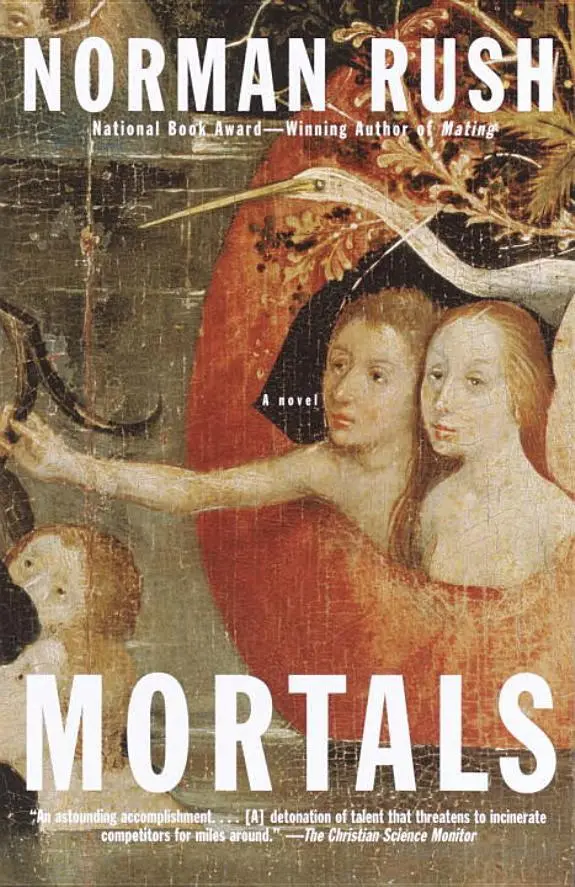
- Название:Mortals
- Автор:
- Издательство:Vintage Books
- Жанр:
- Год:2003
- ISBN:9780307789365
- Рейтинг книги:3 / 5. Голосов: 1
-
Избранное:Добавить в избранное
- Отзывы:
-
Ваша оценка:
Mortals: краткое содержание, описание и аннотация
Предлагаем к чтению аннотацию, описание, краткое содержание или предисловие (зависит от того, что написал сам автор книги «Mortals»). Если вы не нашли необходимую информацию о книге — напишите в комментариях, мы постараемся отыскать её.
As a spy, the compulsively literate Ray ought to have no trouble confirming his suspicions. But there’s the distraction of actual spying. Most of all, there’s the problem of love, which Norman Rush anatomizes in all its hopeless splendor in a novel that would have delighted Milton, Nabokov, and Graham Greene.
Mortals — читать онлайн бесплатно полную книгу (весь текст) целиком
Ниже представлен текст книги, разбитый по страницам. Система сохранения места последней прочитанной страницы, позволяет с удобством читать онлайн бесплатно книгу «Mortals», без необходимости каждый раз заново искать на чём Вы остановились. Поставьте закладку, и сможете в любой момент перейти на страницу, на которой закончили чтение.
Интервал:
Закладка:
He wanted to be light. He said, “When I get back to the States and somebody asks me what the main thing I learned in Africa was, it’s going to be never to take food into your tent, not under any circumstances.”
“Ehe,” Keletso answered, blankly, unresponsively. He hadn’t thought it was amusing, it was clear to see.
It was like a marriage, in some ways, with Keletso. Because in marriage when one partner was radiating dejection and discontent it turned life into a waiting period, a null time. There were times in a marriage when for one reason or another it was impossible to just wait for the mood to dissolve on its own. Action had to be taken. They were in a perilous place and action had to be taken. The problem was to know what would work. One route that was blocked with Keletso was humor. What did the Batswana find funny? What?
He was at a loss. He did know they thought it was funny to say of a man married to a harridan that he ate his overcoat. That gave Ray nothing. And he had been told that they thought it was funny to say that the penis was always landing up in trouble because it had only one eye. That was all he’d been able to glean. American jokes eluded the Batswana, was his distinct experience. It was conceivable that a whole people would find nothing funny in the jokes of their what, their oppressors, their colonial masters, their laughing masters, among whom he would be included, of course. It was possible there was nothing universal about humor.
Being read to was something Iris loved. It was almost magical, the effect it could have on her spirits. Undoubtedly what was happening when she was being read to was that she was regressing to experiences in her childhood that had been consistently pleasant. It was excellent to have pleasant tracts of childhood to regress to. He must have some. Of course he did.
They were proceeding slowly over level ground, so reading something aloud to Keletso wouldn’t be impossible. He pulled his sack of reading matter out of the back and sat with it on his lap, planless until the uneasy thought came to him that it was past time to dispose posthaste of all his Kerekang briefing materials. They were a liability, a potential threat to his imposture, should he and Keletso have to endure some hostile scrutiny, which could happen. He couldn’t believe that he had let it go for so long. Now he was anxious. He had to jettison this material as soon as he could manage it, and in some way not too peculiar and alarming to Keletso. They were getting closer to the epicenter of the trouble. It would be natural to slide the material into a cooking campfire. But they had been using the Coleman stove for cooking. Ray didn’t want to leave the material intact out in the desert. He knew there was a solution and that he was magnifying the problem out of anxiety. Ray had dispensed with campfires in the interest of maintaining general low visibility. He liked campfires.
“The kippers are finished,” Keletso said, gloomily.
Keletso loved kippers. They were a delicacy to him. Sometimes he would eat them twice a day. They were low on pilchards, too. The tinned fish was running out. He’s collecting grievances, Ray thought. That was a process that could get out of control and that he needed to interrupt.
There were three issues of Kerekang’s Kepu/The Mattock in his net bag. He extracted them. They were crude things, cyclostyled. He should just crush them up and bury them off in the bush when they made the next rest stop. An odd feeling of resistance came over him at the thought. He didn’t want to do it.
He strongly didn’t want to do it. He was surprised. He felt incapable of doing it. What was it, though? And then he knew. Kepu contained the only poetry in the iron bubble. Iris had forgotten to be sure his Modern Library Milton was in his reading midden. There had been the TLS back issues. But he had gotten rid of the TLSes as he’d finished them, not that he usually read the contemporary poetry they contained, but with the TLS es in the vehicle there had been poetry of some sort within reach.
Kepu was full of poetry. Kerekang was mad for it. His taste was for nineteenth-century English poetry in general, but he restricted himself to social protest verse in Kepu , with a heavy reliance on William Morris. Every selection was presented bilingually. When had the man had time to do all this translation work? What Kerekang felt about poetry, Ray thought he understood. It was a bond between them. I am an adolescent, he thought. He didn’t want to be in a situation where he couldn’t lay his hand on poetry. He realized that he always assumed poetry would be in his vicinity, somewhere, in the normal course of life. And now he had no choice but to destroy his copies of Kepu . You are being a child, he thought. He couldn’t remember who it was who’d said that poetry was as essential to civilization as hot water. With poetry it could be one poem one couplet one line, even, and you were immortal forever. For just one poem it would be Chidiock Tichborne, to name just one. It could come down to that, one little line of letters saving your name forever. People would want to know what you looked like, forever. That was what his brother was straining to do, generate just one sentence, one paragraph, one glorious thing. He wasn’t close. He would fail. He said to Keletso, “Rra, do you like poetry at all?”
“Ehe, the most when it is from the Bible.”
Ray looked for something to read aloud to Keletso. He paged through Volume One, Number Three, of Kepu . There was a William Morris verse.
He would read it to himself first.
A Death Song
What cometh here from west to east awending?
And who are these, the marchers stern and slow?
We bear the message that the rich are sending
Aback to those who bade them wake and know .
Not one, not one, nor thousands must they slay,
But one and all if they would dusk the day.
There was more of the same. This was not the ticket for cheering Keletso up. It was grim. It was hard to believe this was the same William Morris he associated with big improvements in wallpaper design.
He found something that looked lighter, by a poet unknown to him, Robert Brough. A note described Brough as a famous republican who had died of drink at the age of thirty. Kerekang was teetotal, Ray remembered.
“Would you like me to read you a poem?”
“Ehe, to pass the time.”
“I have the poem in Setswana and English. Dintsha le dilebodi le diPeba le dikatse. I’ll try it in Setswana.”
“It is to do with animals, then, rra?”
“Yes. Well, listen. Here I go.”
But after two stanzas in attempted Setswana, Ray concluded it was no-go. Keletso was laughing, and there was nothing that amusing in the verses he’d read to him, so it was his performance that was funny.
He began again, in English.
“The title is The Terriers and the Rats and the Mice and the Cats: A Fable . And this was written in England long ago, written against the king and the nobility that supported the king, at that time. And you’ll see, the dogs, the terriers he talks about, stand for the ruling system, Domkrag, with the king at the top. And under the dogs are the cats. The dogs are ruling the cats and the rats are ruling the mice. Anyway …
“Once on a time — no matter how ,
(By force of teeth, or mere ‘Bow-wow,’
Let studious minds determine)—
The Terriers upon Rat-land, seiz’d ,
Its natives hunted, worried, teas’d ,
In short — exactly what they pleas’d
Did, with the whisker’d vermin.”
He was going to have to skip. Looking ahead, Ray saw the piece was endless, all the verses showing that the mice were on the verge of revolt. He continued reading.
Читать дальшеИнтервал:
Закладка:
Похожие книги на «Mortals»
Представляем Вашему вниманию похожие книги на «Mortals» списком для выбора. Мы отобрали схожую по названию и смыслу литературу в надежде предоставить читателям больше вариантов отыскать новые, интересные, ещё непрочитанные произведения.



Обсуждение, отзывы о книге «Mortals» и просто собственные мнения читателей. Оставьте ваши комментарии, напишите, что Вы думаете о произведении, его смысле или главных героях. Укажите что конкретно понравилось, а что нет, и почему Вы так считаете.