Norman Rush - Mortals
Здесь есть возможность читать онлайн «Norman Rush - Mortals» весь текст электронной книги совершенно бесплатно (целиком полную версию без сокращений). В некоторых случаях можно слушать аудио, скачать через торрент в формате fb2 и присутствует краткое содержание. Год выпуска: 2003, ISBN: 2003, Издательство: Vintage Books, Жанр: Современная проза, на английском языке. Описание произведения, (предисловие) а так же отзывы посетителей доступны на портале библиотеки ЛибКат.
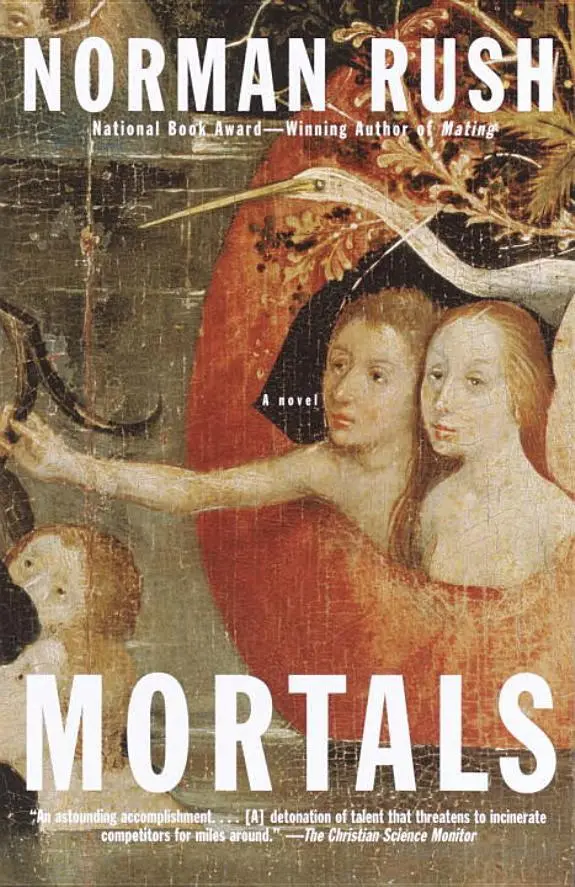
- Название:Mortals
- Автор:
- Издательство:Vintage Books
- Жанр:
- Год:2003
- ISBN:9780307789365
- Рейтинг книги:3 / 5. Голосов: 1
-
Избранное:Добавить в избранное
- Отзывы:
-
Ваша оценка:
Mortals: краткое содержание, описание и аннотация
Предлагаем к чтению аннотацию, описание, краткое содержание или предисловие (зависит от того, что написал сам автор книги «Mortals»). Если вы не нашли необходимую информацию о книге — напишите в комментариях, мы постараемся отыскать её.
As a spy, the compulsively literate Ray ought to have no trouble confirming his suspicions. But there’s the distraction of actual spying. Most of all, there’s the problem of love, which Norman Rush anatomizes in all its hopeless splendor in a novel that would have delighted Milton, Nabokov, and Graham Greene.
Mortals — читать онлайн бесплатно полную книгу (весь текст) целиком
Ниже представлен текст книги, разбитый по страницам. Система сохранения места последней прочитанной страницы, позволяет с удобством читать онлайн бесплатно книгу «Mortals», без необходимости каждый раз заново искать на чём Вы остановились. Поставьте закладку, и сможете в любой момент перейти на страницу, на которой закончили чтение.
Интервал:
Закладка:
He began paging along, reacquainting himself with what he had read, the part he remembered. The school business was still vivid to him. Charles Bovary’s first marriage, that too he had clear. His eye snagged on the last paragraph on page 36.
Before marriage she thought herself in love; but the happiness that should have followed this love not having come, she must, she thought, have been mistaken. And Emma tried to find out what one meant exactly in life by the words felicity, passion, rapture , that had seemed to her so beautiful in books.
His heart was beating too hard. The struggle was going to be to find out if Iris was speaking to him through this book, and if so, if so, if so, then what she was saying, exactly?
He was going to have to speed-read the rest of this thing, because he had to understand. He had to verify that the story was what he had assumed or picked up through his reading it was.
Emma had been put in a convent where she read contraband romantic novels and poetry. Then she had married a clod who became a successful country doctor doing his best and she had hardly been able to wait to betray him, first platonically, so to speak, with a young clerk, as he recalled. She was always waiting for something to happen. She has a child by her husband but sends it off to a wet nurse. She had hated the child for being female. She had gone to live in a provincial town, Yonville, inhabited exclusively by fools and jackasses. Over and over human stupidity was presented against landscapes of terrific natural beauty.
Ah, page 116, “What exasperated her was that Charles did not seem to notice her anguish.” And there was no sex in the fucking thing, no described sex. He wasn’t up to Rodolphe yet. Léon, the first guy, had been a tease. Was it possible Iris was saying she was at the Léon stage and she needed to be stopped before Rodolphe? That was probably insane. He didn’t know. He was up to Rodolphe. Rodolphe was introduced as a cad. Could Iris be saying Morel was a cad, using Rodolphe, making a cry? He would hold the thought. He had reached the point at which he’d stopped years ago, he was pretty sure. He mustn’t seize on details prematurely. He had to conclude on the basis of themes, or something. He had to finish reading this thing, at once.
By page 196 she was well into it with Rodolphe.
Everything in Charles irritated her now; his face, his dress, what he did not say, his whole person, his existence, in fine. She repented of her past virtue as a crime, and what still remained of it crumbled away beneath the furious blows of her pride. She revelled in all the evil ironies of triumphant adultery. The memory of her lover came back to her with dazzling attractions; she threw her whole soul into it, borne away toward this image with a fresh enthusiasm; and Charles seemed to her as much removed from her life, as absent forever, as impossible and annihilated, as if he had been about to die and were passing under her eyes.
He was reading furiously.
Rodolphe ditches her. Every line in his farewell letter is a lie.
Madame goes into a collapse. Rodolphe is gone but Léon is back and this time it’s not platonic.
Emma was bankrupting her husband and trying to borrow money from Léon … and then there was this, page 316 …
“Morel is to come back to-night; he will not refuse me, I hope” (this was one of his friends, the son of a very rich merchant) …
Morel. Morel! … but it could mean nothing.
Back to Rodolphe. She is desperate for money and can’t get any.
Then death. She takes poison out of remorse at what she had been, a fool. Her daughter ends up in child labor. She leaves a ruin.
He had no idea what to think. His mind was all over the place. There were no checkmarks or underlinings or nota bene s anywhere in the volume, no page corners turned down. What was the signal, the message? Was he Bovary, a fool distinguished by the fact he believed every lie she told? Was he on page 363?
Besides, Charles was not of those who go to the bottom of things; he shrank from the proofs, and his vague jealousy was lost in the immensity of his woe.
In the scene prompting that characterization Charles has construed an explicit love letter from Rodolphe to his wife as probably suggesting a platonic relationship only.
Was Madame Bovary a communication to him, was the question. He had to assume it was, since even if she’d put it in his pack by accident initially something would have gone off in her mind to say stop, halt, this will cause Ray to freak, what was I thinking?
So there it was. She was neither stupid nor cruel. So there it was. How he took Madame Bovary was critical. What kind of book was it? You could take it as a Christian homily if you wanted to, a tract saying marriage is an ordeal but violating your stupid vows is even worse. But that was farfetched. He had learned something by suffering through this book, which was that the TLS could be wrong. He remembered reading someone very authoritative writing in it that there was only one major novel, a thing called The Golovlyov Family , a nineteenth-century Russian novel Ray hadn’t read, in which every character presented, without exception, was loathsome. Surely Madame Bovary belonged in that category, if you didn’t count the poor child. Every adult in the book was vile.
He had to know if he was supposed to see himself in Charles Bovary. Every detail seemed to answer in the affirmative. For example, what did it mean that her husband botched an operation on some poor devil with a clubfoot, making it worse, making him lose his leg? Poor Charles does it out of hubris stoked by delusions about what he was competent to do. So was the analogy the agency, the agency’s interventions, the agency’s hubris, and his part in what she might think the agency was up to? He was feeling paranoid. He was hoping this was paranoia. He had to get up and move around. His back was killing him.
He walked in a circle around the dying fire. He was still enclosed in the quasi-tent, carrying it with him like a fool of some kind. He needed to list the options he had for interpreting what she had done to him, putting Madame Bovary in his hands. But fire interrupted him, a bloom of flame declaring itself around him, dragging the breath out of his lungs. The netting had gone up. He had dragged it across an ember. He pitched the burning mass away. He was all right. He was trembling. His hair had gotten singed in back, was all. He had made a spectacle. Keletso was coming to him.
Nothing in Africa is fireproof, he thought.
It was morning and somewhere in their cargo was a magnifying mirror. He needed it.
He found it in among the first aid paraphernalia. His reflected image was not gratifying. He was less presentable than was good and less presentable than he’d expected. He had a mild burn on the back of his right hand that looked worse than it was because the Vaseline he’d smeared on it seemed to highlight it. He touched it and it hardly hurt. If he ruffled his hair he could still produce a shower of black specks, bits of charred hair. A good shampooing would take care of that. He would never understand why people insisted on saying they had circles under their eyes, dark circles, when what they had were semicircles. No one had circles under their eyes. The lashes of his right eye were mostly gone. He asked himself if it might be a good idea to trim off the lashes of his left eye in the interest of symmetry and the answer was no, it was an extreme idea and in addition his hands were too unsteady. That would pass, like everything. He could keep the idea under advisement.
On waking he had found himself in possession of the conviction that yes, providing Madame Bovary had been deliberate, but that the point of doing it had been precisely to show him that she was fundamentally innocent, so innocent that she felt free to include the inflammatory thing in his reading because, precisely because, it meant nothing and was there only because it was something he had in fact said he hadn’t finished reading. So it had been a deliberate declaration of innocence. But that conviction had proved to be delicate. He had lost it. He had lost his grip on it during breakfast. He had held it too hard. He had crushed it.
Читать дальшеИнтервал:
Закладка:
Похожие книги на «Mortals»
Представляем Вашему вниманию похожие книги на «Mortals» списком для выбора. Мы отобрали схожую по названию и смыслу литературу в надежде предоставить читателям больше вариантов отыскать новые, интересные, ещё непрочитанные произведения.


Обсуждение, отзывы о книге «Mortals» и просто собственные мнения читателей. Оставьте ваши комментарии, напишите, что Вы думаете о произведении, его смысле или главных героях. Укажите что конкретно понравилось, а что нет, и почему Вы так считаете.