Norman Rush - Mortals
Здесь есть возможность читать онлайн «Norman Rush - Mortals» весь текст электронной книги совершенно бесплатно (целиком полную версию без сокращений). В некоторых случаях можно слушать аудио, скачать через торрент в формате fb2 и присутствует краткое содержание. Год выпуска: 2003, ISBN: 2003, Издательство: Vintage Books, Жанр: Современная проза, на английском языке. Описание произведения, (предисловие) а так же отзывы посетителей доступны на портале библиотеки ЛибКат.
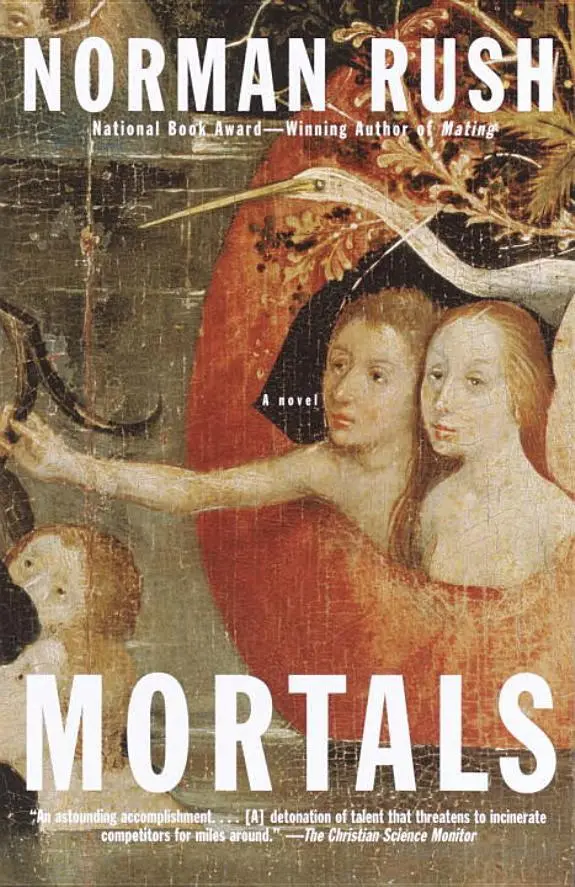
- Название:Mortals
- Автор:
- Издательство:Vintage Books
- Жанр:
- Год:2003
- ISBN:9780307789365
- Рейтинг книги:3 / 5. Голосов: 1
-
Избранное:Добавить в избранное
- Отзывы:
-
Ваша оценка:
Mortals: краткое содержание, описание и аннотация
Предлагаем к чтению аннотацию, описание, краткое содержание или предисловие (зависит от того, что написал сам автор книги «Mortals»). Если вы не нашли необходимую информацию о книге — напишите в комментариях, мы постараемся отыскать её.
As a spy, the compulsively literate Ray ought to have no trouble confirming his suspicions. But there’s the distraction of actual spying. Most of all, there’s the problem of love, which Norman Rush anatomizes in all its hopeless splendor in a novel that would have delighted Milton, Nabokov, and Graham Greene.
Mortals — читать онлайн бесплатно полную книгу (весь текст) целиком
Ниже представлен текст книги, разбитый по страницам. Система сохранения места последней прочитанной страницы, позволяет с удобством читать онлайн бесплатно книгу «Mortals», без необходимости каждый раз заново искать на чём Вы остановились. Поставьте закладку, и сможете в любой момент перейти на страницу, на которой закончили чтение.
Интервал:
Закладка:
They were fine. His right hand was numb but that was nothing. Ray looked around. They had passed the night in what was a beauty spot, for the Kalahari … a low, level, sandy spot near a stand of magnificent, mature cloud trees. The sun was up. In the early morning you could love the sun and not hate it.
Keletso was winded. He gestured vehemently at Ray’s bare feet. It was past time to dress for the day. He realized that, but he wanted to examine the snake and identify it if he could before Keletso buried the carcass, as he was evidently preparing to do.
Ray returned to the vehicle and dressed hurriedly. It occurred to him that it would be interesting to save the head and take it in for identification at the university.
For some reason Keletso had chopped the snake up further, into six pieces or so. And he had scraped a shallow trench in the sand. The snake’s head was already in the trench, at one end. The wide flat head and the black underjaw meant that it was an adder of some kind. The head was damaged but would still make a curio, once it was dried. But Keletso was laying out the chunks of snake in the trench in a semblance of their original order. Clearly he was following some Tswana protocol or other. Ray wanted the head but felt unable to take it or ask for it. Something he disliked was keeping him from acting. He knew what it was and he disowned it. It was a feeling that he might not be going back. He disowned it. He disowned it.
Keletso kicked sand into the trench, burying the carcass as far as the head. He paused. He composed himself. He spoke hotly under his breath in Setswana. He took something out of his shirt pocket. Ray was baffled. Keletso squatted, snatched up the head of the snake, and with a nail file dug out the snake’s eyes and flicked them aside, away from the trench. His hands were trembling. He thrust the mutilated head back into the trench and shot to his feet. Still imprecating, if that was what he was doing, Keletso gestured for Ray to participate as the trench was finally filled in.
Ray assumed he had just witnessed something customary, some ritualization of snake-hatred related to the practice of cutting down and burning any tree a snake had been caught in, which had struck him as extreme when he’d been told about it, considering the importance of trees for shade and shelter in arid Botswana. Noga meant snake, he remembered. The cry Noga! would bring villagers running with torches and hoes and axes. Or so he had been told.
Cleaning themselves up, and then later eating breakfast, they seemed to have nothing to say to one another.
En route again, Keletso asked Ray to go through the snakes section of the Safety Book, his name for a skimpy, anodyne pamphlet on safety in the wild issued by one of the safari camps. Ray didn’t know offhand where the pamphlet was. At one point Keletso had strung a rawhide thong through it and worn it around his neck. Keletso thought it must be in the glove box and it was. Plainly Keletso was laboring against the apprehension that he had fallen short in his duties to take care.
“Can you find some advices, rra, as to snakes coming for shelter beneath trucks at night?”
The booklet had a faintly rank smell. Ray began scanning it, but he was distracted. He was full of dark feeling. Maybe I should have committed suicide and gotten out of the way when I was in the mood, he thought. In early adolescence he had briefly been suicidal. There had been a philosophical dimension to it. But paradoxically the outrages of his brother and the rivalry and injustice that went with it had dragged him back toward life, life the necessary condition for revenge. He wouldn’t mind telling Iris about this someday, but he wondered what she would think of it if he did. Life was odd. He believed it was his indignation at the outrageous favoritism of his mother toward Rex that had relit his will to live. The drive to penetrate that impenetrable behavior had given him a vocation, or the seed of one. The agency, whatever else it was, was the nemesis of mystery, plots, secrets, the hidden. I hate a mystery, he thought. That was the story, in any case. Suicide was best for the young. Once dependents appeared on the scene it was impossible.
He was unhappy to be thinking about his temptation to not exist, that period of his life. It hadn’t come into his consciousness for years. The Kalahari was bringing it back because the Kalahari was saying something to him. It was saying to die, actually. He was being notional and he knew it. But in the first stillness of dawn, especially, there was an infinitely faint ambient whine or hum detectible. He had to hold his breath to hear it. A similar thing was alleged to happen in the Arctic. In the Kalahari he assumed insect song or activity to be the thing behind the whine, but that could hardly be the case in the Arctic. It didn’t matter. No, what the desert was saying was that you would die if you got out of your iron bubble of food and water and first aid. Nobody could live in such a terrain except the Bushmen and they died at what ages, early, worn out by the effort to exist. Everyone said they were happy in that place, liked it.
Keletso was impatient. Ray began browsing in earnest. The message of the pamphlet was not to worry. Wild dogs were pack hunters, were mostly nocturnal and not interested in humans unless excited , whatever that meant. And wild dogs were getting scarcer in the Kalahari in any case. He presumed that it was the dogs that had to be excited in order to be dangerous, and not their human prey.
“Rra, we must not excite the wild dogs,” he said to Keletso.
Leopards were nocturnal but rarely did they attack man. The implication seemed to be that any predator that was nocturnal could be forgotten about because at night the traveler would be sensibly sealed up in a vehicle or a tent with a floor lining . Also, leopards were in decline and were scarce, very scarce, in the dry parts of the Kalahari, which seemed to Ray to be all of it, that he had seen. And Cape buffalo were placid animals not interested in humans. But it was advisable not to be caught in the path of a stampede, and the same was true for all of the larger ungulates. Ray agreed completely.
Lions, again, were nocturnal hunters, but best of all they were very lethargic during daylight hours. Although if you stepped in amongst them while they were at rest the chances were that you would be eaten.
“Have you found about snakes as yet?” Keletso asked.
“Nearly there.”
Here was yet another reiteration of the warning against ever taking food into your tent. Even normally man-aversive animals like caracals would claw their way in if they smelled food. Chacma baboons were distinctly no problem unless teased. He came to the snakes section.
Only six types of snake were depicted, in a set of crude sketches. None of the drawings resembled the creature they had killed. Two of the sketches were identical, an obvious error.
He was up to a sentence he loved. It should be remembered that only half the snakes natural to Botswana are poisonous . And more good news was that one of the commonest snakes, the shaapsteker, even if it struck you would only leave you with a severe headache, so weak was its venom. There were no cautions given about checking under vehicles in the morning. Keletso seemed relieved. They had done everything they should have. They had avoided overhanging branches and they always made a sort of fuss and racket wherever they walked. They had the three antivenins listed, hypodermics, everything.
Keletso seemed morose. He wanted Keletso to cheer up, but he couldn’t think of how to make that happen. Death-thoughts were poisoning the atmosphere. Death where is thy stingalingaling was from something Irish, but what? What he really wanted was to tell Keletso how unhappy he was. But of course he couldn’t do that. Soon enough he was going to have to send Keletso back to safety. It was almost time to do that. And until then he would need Keletso to think all was well with him. Otherwise he would resist. So he had to cheer up, himself.
Читать дальшеИнтервал:
Закладка:
Похожие книги на «Mortals»
Представляем Вашему вниманию похожие книги на «Mortals» списком для выбора. Мы отобрали схожую по названию и смыслу литературу в надежде предоставить читателям больше вариантов отыскать новые, интересные, ещё непрочитанные произведения.




Обсуждение, отзывы о книге «Mortals» и просто собственные мнения читателей. Оставьте ваши комментарии, напишите, что Вы думаете о произведении, его смысле или главных героях. Укажите что конкретно понравилось, а что нет, и почему Вы так считаете.