Norman Rush - Mortals
Здесь есть возможность читать онлайн «Norman Rush - Mortals» весь текст электронной книги совершенно бесплатно (целиком полную версию без сокращений). В некоторых случаях можно слушать аудио, скачать через торрент в формате fb2 и присутствует краткое содержание. Год выпуска: 2003, ISBN: 2003, Издательство: Vintage Books, Жанр: Современная проза, на английском языке. Описание произведения, (предисловие) а так же отзывы посетителей доступны на портале библиотеки ЛибКат.
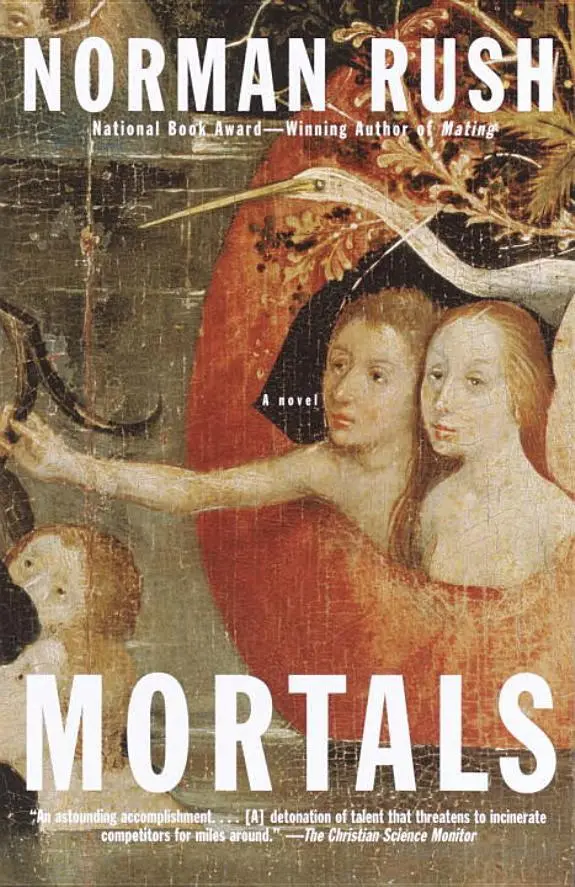
- Название:Mortals
- Автор:
- Издательство:Vintage Books
- Жанр:
- Год:2003
- ISBN:9780307789365
- Рейтинг книги:3 / 5. Голосов: 1
-
Избранное:Добавить в избранное
- Отзывы:
-
Ваша оценка:
Mortals: краткое содержание, описание и аннотация
Предлагаем к чтению аннотацию, описание, краткое содержание или предисловие (зависит от того, что написал сам автор книги «Mortals»). Если вы не нашли необходимую информацию о книге — напишите в комментариях, мы постараемся отыскать её.
As a spy, the compulsively literate Ray ought to have no trouble confirming his suspicions. But there’s the distraction of actual spying. Most of all, there’s the problem of love, which Norman Rush anatomizes in all its hopeless splendor in a novel that would have delighted Milton, Nabokov, and Graham Greene.
Mortals — читать онлайн бесплатно полную книгу (весь текст) целиком
Ниже представлен текст книги, разбитый по страницам. Система сохранения места последней прочитанной страницы, позволяет с удобством читать онлайн бесплатно книгу «Mortals», без необходимости каждый раз заново искать на чём Вы остановились. Поставьте закладку, и сможете в любой момент перейти на страницу, на которой закончили чтение.
Интервал:
Закладка:
They were inching north. They were tacking. They were tacking deeper toward the west than toward the east. They were vamping. They were finding veterinary roads, old trek routes, taking anything leading off the main north-south road and following it until they decided not to follow it anymore. Then they would camp. Or they might return to the main road, where at least they had the comfort of seeing, although at rarer intervals the farther north they got, passing trucks with people in them. Now Ray was fighting the lunatic conviction that he would know the moment when his betrayal definitely occurred, that there would be a sign, that he would feel something. It was possible that this was a useful lunatic conviction, because there had been no sign so far, which meant that nothing had happened. It meant she was resisting and he could be happy. What the sign would be, he had no idea.
He had had about enough for today. Keletso hated to drive at night, so it made sense to turn around now while they had a chance of making it back to Route 14 in daylight. They would have to sleep in the vehicle again, unless the attraction of some halfway normal accommodation in Sehithlwa, the next settlement up Route 14, would be enough to motivate him to drive at night, against all his better judgment. Ray realized he had no idea what he meant by halfway normal accommodation. Sehithlwa was a Baherero village. One thing that that meant was that everybody went to bed early. No one would be up when they got there. So it was likeliest that they would get back to Route 14 and just pull off and eat and sleep. Of course the sign that Iris had betrayed him was likelier to come at night than during the day, which meant it might come in the form of a dream, a nightmare. More betrayals took place at night, of course, that was obvious. He didn’t think he’d had any particularly striking dreams since leaving Gaborone. That was good.
Whatever Keletso thought of Ray’s site-assessment performances, he was keeping it to himself. He was a good soldier. Ray was putting less and less effort into his performances, his imposture. He would signal for a stop, descend, make sure his pants cuffs were jammed solidly into his boot tops, spray his lower self with insect repellent, pull the brim of his hat down all around, and set off with his binoculars and clipboard for some spot in the range of one hundred yards from the vehicle. They were within the baobab zone now and he had been selecting locations near particular specimens to carry out his site-assessment charades on. The species had come to fascinate him. They looked untenable, massive gray columns tapering upward and splitting and finishing at the apex in a frenzy of spindly limbs and branches bearing derisory foliage. He hadn’t yet observed anything resembling a grove of baobabs. They seemed to thrive in isolation, although perdure would be a better term for what they did. Birds seemed to avoid them for nesting purposes, if his limited familiarity with the tree could support such a conclusion. The hard, smooth bark of the baobab invited stroking. They inspired affection, of a certain sort. Whatever they were, they were perfect.
Ray signaled Keletso to stop. He saw a baobab he liked. He and Keletso had evolved a considerable repertoire of hand signals that saved them a lot of surplus talk. In lower gears, the engine made enough noise to render conversation effortful. And he and Keletso shared a preference for silent travel anyway. Ray amplified his hand signal to indicate that Keletso should turn the vehicle around for the return leg, while Ray was doing his assessing. Turning could require some art, depending on road conditions. They had been proceeding in what was in essence a broad, shallow ditch, sticking to the ruts, spoors as they were called, pressed into the soft sand by whoever had preceded them. There was a lay-by, or something like one, just ahead, where a turn could be managed. They had been wrong in choosing the road they had, misled by the fact that the first few kilometers had been freshly groomed, in the usual way, by a government truck dragging a monster bouquet of thornbushes along the surface. So it had seemed promising. But the grooming task had been abandoned. The thornbush bouquet had been jettisoned and pushed up on the shoulder. The government truck curved off straight into the veld, possibly in pursuit of opportunities to do some poaching. Keletso had detected duikers moving through this neighborhood, in the distance, twice.
Ray leaned against the baobab and watched Keletso delicately maneuvering the Land Cruiser for the return journey. How long these monumental vegetables lived was something he should be able to find out. They looked ancient. He wouldn’t mind being buried under one of them, being drawn up molecule by molecule into the ridiculousness and permanence they represented, if they were, in fact, longlived, like sequoias. He loved these goddamned things. They were like monuments, but slightly gesticulating monuments, when the breeze rattled their silly branches. He wasn’t being mordant. Everybody had to be buried someplace. He assumed he was going to be cremated when he died, but ashes had to go someplace too, and under a baobab would be fine with him. Molecules weren’t the smallest particles, though, nor were, what, electrons. All he could think of were monads, which came from Leibnitz and philosophy and not physics. He thought, Au fond we are monads, with gonads. He moved around to the far side of the baobab, where he was out of Keletso’s sight line.
The realization that you, yourself, are going to die, in fact, declares itself in funny ways, he thought. He could give a new example. Iris, in assembling the mountain of reading matter she wanted him to have, had included three months’ worth of unread Times Literary Supplements . And as he was reading through them, in the desert, he had noticed that his reflexive impulse to tear out and save advertisements for books he might want to read at some point was gone. A year or so back he had given up clipping titles from the Books Received listings of the TLS , which he could see had been precursory to this. Something was letting him know that there was enough on his forward reading list to occupy him for the rest of this life. In fact, there had been a longer progression. He had been serious about bibliography, cutting out ads neatly and gluing them to index cards color-coded for urgency. Then he had devolved to tearing ads out. And so on down. And now he had enough in his stuffed folders, enough. He had been serious. He had thought of literature and Milton in particular as subjects he would conquer like Shackleton or whoever it was had gotten to the Pole first, but not Shackleton, Peary or Amundsen, who? Definitely not Shackleton, he thought, shivering. He was getting old. He thought, In my time machine I would probably, before I went to Milton’s deathbed, go to Shackleton and the other one, Scott, and say Don’t go, leave the wastelands of the world and stay home … Grow old and perish at home in the arms of your wife … Goodbye and good luck.
It was time to write on his site-assessment form. It was something he had to do, had to be seen doing. He had put down a few scribbles already, during his approach to the baobab, for Keletso’s benefit. But, out of Keletso’s view, he would do something new. It had started as a joke but it had turned into something a little interesting. Instead of jotting down fake notes and observations, he had tried relaxing and closing his eyes and going blank and letting himself write in a dissociated state, or as much of one as he could attain. It was automatic writing, a weak variant. It was something to do. So far mostly he had gotten poetic flotsam, weird doggerel, grandiose self-instruction, pure nonsense, and sequences written so illegibly it was impossible to tell what was meant. He slid down to a squatting position and set the clipboard on the sand in front of him. Another nice thing about baobabs was that tampan ticks avoided them, the shade cast by the baobabs being so negligible. He got his Bic out. He tried. He had waited too long to get started. This wouldn’t work if he felt pressed. But he tried. He hummed to distract himself. He wrote a little. He hummed more vigorously, the Ode to Joy , always his first choice when he needed a tune to block something out, distract him. He was trying. It was no good. He couldn’t let go. He looked at what he’d written.
Читать дальшеИнтервал:
Закладка:
Похожие книги на «Mortals»
Представляем Вашему вниманию похожие книги на «Mortals» списком для выбора. Мы отобрали схожую по названию и смыслу литературу в надежде предоставить читателям больше вариантов отыскать новые, интересные, ещё непрочитанные произведения.



Обсуждение, отзывы о книге «Mortals» и просто собственные мнения читателей. Оставьте ваши комментарии, напишите, что Вы думаете о произведении, его смысле или главных героях. Укажите что конкретно понравилось, а что нет, и почему Вы так считаете.