Norman Rush - Mortals
Здесь есть возможность читать онлайн «Norman Rush - Mortals» весь текст электронной книги совершенно бесплатно (целиком полную версию без сокращений). В некоторых случаях можно слушать аудио, скачать через торрент в формате fb2 и присутствует краткое содержание. Год выпуска: 2003, ISBN: 2003, Издательство: Vintage Books, Жанр: Современная проза, на английском языке. Описание произведения, (предисловие) а так же отзывы посетителей доступны на портале библиотеки ЛибКат.
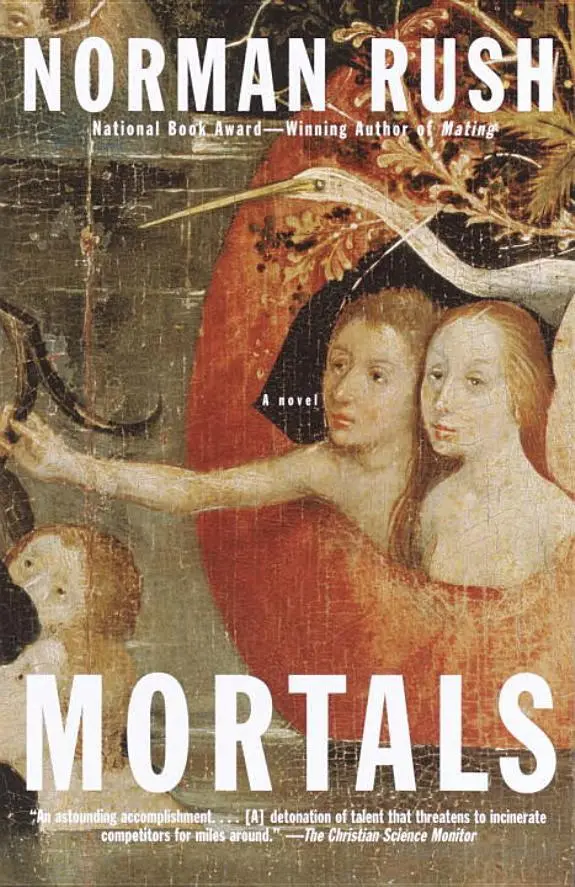
- Название:Mortals
- Автор:
- Издательство:Vintage Books
- Жанр:
- Год:2003
- ISBN:9780307789365
- Рейтинг книги:3 / 5. Голосов: 1
-
Избранное:Добавить в избранное
- Отзывы:
-
Ваша оценка:
Mortals: краткое содержание, описание и аннотация
Предлагаем к чтению аннотацию, описание, краткое содержание или предисловие (зависит от того, что написал сам автор книги «Mortals»). Если вы не нашли необходимую информацию о книге — напишите в комментариях, мы постараемся отыскать её.
As a spy, the compulsively literate Ray ought to have no trouble confirming his suspicions. But there’s the distraction of actual spying. Most of all, there’s the problem of love, which Norman Rush anatomizes in all its hopeless splendor in a novel that would have delighted Milton, Nabokov, and Graham Greene.
Mortals — читать онлайн бесплатно полную книгу (весь текст) целиком
Ниже представлен текст книги, разбитый по страницам. Система сохранения места последней прочитанной страницы, позволяет с удобством читать онлайн бесплатно книгу «Mortals», без необходимости каждый раз заново искать на чём Вы остановились. Поставьте закладку, и сможете в любой момент перейти на страницу, на которой закончили чтение.
Интервал:
Закладка:
He was through with himself, and with the fantasy conviction that if he could just find Kerekang and reintroduce himself and speak man to man he could talk him out of what he was doing, on some basis or other, on past acquaintance and their love of poetry and on an extensive apology about Pony, his part in that, something like Stanley and Livingstone. That kind of fantasy could go away now. Life is what? he thought. In all his years in Africa Livingstone had converted exactly one African to Christianity, one.
But he was through with himself. It was pointless to envy people like Keletso their simpler existences and pointless to go to the ultimate question of whether the world would be better off, net, once the main effort of your life had been added up, and especially pointless in his case because the main effort of his life had been to collaborate with others in preventing certain events from transpiring, so that his work product consisted of a null set, a sequence of zeros, unevents, very difficult to judge to say the least. His life was like the medals the agency gave its heroes and put into a vault and told nobody outside the agency about. Of course the true main effort of his adult life was and always had been to have Iris’s love, which sounded selfish put in that way, selfishly concentrating on his well-being, in essence, and not hers. But this subject was outside the realm of things he could deal with now, in the desert. And then there was poetry, Milton, where he had done something … a little something. But that was enough about him. He was through.
But speaking of poetry, he was having the odd feeling that poetry was trying to reassure him, poetry acting as a kind of fraternal entity. I came na here to view your works in hopes to be more wise/But being that I’m gang to hell it shall be na surprise , Burns of course, had come to him while he was scanning a particularly bleak piece of the territory. And then riding along in depression, the lines Zeno’s arrow in my heart/I float in the plunging years , author unknown, had lightened his misery. Very little Milton was showing up, which was strange given the surroundings. Of course he could summon Milton up anytime he needed him. Even poetic fragments of his own invention were declaring themselves, like The Stars Also Burn , a title, obviously, appropriate for a certain type of middlebrow crap novel. The drop that wrestles in the sea/Forgets her own locality was from Emily Dickinson, a poet he hadn’t read attentively enough, since clearly she had something to say to him. There was a lot of Dickinson manifesting. Of course her main subject matter was death, so the less said about that the better. Death was bad, but not as bad as someone else licking your wife’s cunt. Stop , he thought. That was the kind of thing lines of poetry were leaping up to quench. Poetry, his past reading, was turning out to be a god for him. The conceit forcing itself on him was that poetry was an autonomous friendly composite, interested in capturing his predicament favorably to him, a thing like an Arcimboldo portrait, but alive and not composed of different kinds of fruit but made out of friendly sentiments and aperçus jostling for his attention, like puppies in a basket playing and jumping up eagerly. The urge to declaim accompanied particular surges of poetry, especially in moments when he was off by himself. Urinating, he had found himself saying loudly I know that I shall meet my fate/Somewhere among the clouds above/Those that I fight I do not hate/Those that I guard I do not love . It had felt like a retort to what, to the Kalahari, to the heat. Keletso had probably noticed something, but he would assume it was religious. Keletso said things under his breath from time to time, often it was the Lord’s Prayer. For reading matter, Keletso had brought a Bible, that was all, and in fact it was the Olive Pell Bible, a version created for the use of girls in finishing schools and stripped of all the sex and violence. He had bought it at a jumble sale, for its compactness, and he kept it on his person at all times.
Ray was perforce becoming an authority on the left side of Keletso’s face, but not on much else about the man. Keletso’s ears were heavily wrought, the upper rims so thick they made the ear tips bend faintly downward. He needed to not exaggerate this tireless man’s qualities to a religious level. Not only was he tireless but he had the ability to fall asleep within seconds of lying down in unlikely positions, the unlikeliest, an ability no doubt attributable to the soporific effects of a spotless conscience. But of course that was an assumption. What he could say was that he was developing cracks in the corners of his mouth and Keletso wasn’t. It was stress, was all. Now it was time to get out and have tea. There were four minuscule bananas left, from the supply they had picked up back in Ghanzi. He wanted Keletso to have them all. He wasn’t hungry.
He stood next to their vehicle, actively appreciating it, patting it, honoring an impulse that kept renewing itself. It was supplicatory, partly. They needed good luck with their machine, their steed, their ship of the desert. The Japanese Land Cruiser was displacing the British Land Rover everywhere in Africa. It was a rout. The Land Cruiser was a superior machine, an oversized pickup truck with a shortened but still adequate open bed and a tall, roomy four-door cab that elevated its occupants high above the road, a crucial advantage in negotiating dangerous terrain. Land Rovers were earth-colored, uniformly. Their Land Cruiser was electric blue, very jolly. The back seat in the cab was narrower than the front seat, but it was still wide enough for sleeping on. They had been reduced to sleeping in the Land Cruiser a couple of times, and there would be more of that. They had agreed to take turns on the back seat. The ingenious Keletso had come up with a way to shroud the propped-open doors of the cab with mosquito netting, which allowed the sleeper to lie full length from time to time, feet extended out into the darkness. But generally they kept the doors closed, out of general fear, even though the received wisdom was that all animals shied away from motor vehicles. He needed to have the door open more frequently than Keletso. They had mosquito screens that fit into the space left by half-open windows and they used them faithfully at night, vigorous ventilating being the necessity it was for lives being lived at such close quarters. Keletso never needed to get up at night. Ray was discovering that his occasional needs in that direction had entirely evaporated, no doubt in response to the fear of being eaten alive and the like.
They should be all right. They had everything they could conceivably need, it seemed to him. In fact, there was too much. Keletso knew where everything was in the swollen load in back, under the tarps that covered it. Ray was developing his own mental map, against the day he sent Keletso home. They had water in a hundred-gallon drum, and paraffin, petrol, and motor oil in smaller drums. They had extra tires, an extra battery, various other automotive spares he needed to catalog for himself one more time, a mechanic’s tool kit, a foot pump, a winch, flares, mats for getting out of sand traps. They had hatchets, axes and extra ax handles, machetes, shovels, trenching spades, torches, lanterns. Bolted to the rear base of the cab was the general tool chest. It had a false bottom, beneath which his revolver and ammunition were kept, along with packets of rands and pula, about a thousand dollars’ worth in each currency. The false bottom was a chore to free and raise. It had to be pried out in a particular way. There had been a plan to devise access to the secret space through a slot behind the backrest in the rear seat, but there had been no time to get that done. They were hugely overequipped for camping. They had a tent, bolts of mosquito netting, multiple drop cloths, folding camp furniture, sleeping bags and blankets, both. They had metal cookware, a reflector oven and a Coleman stove, miscellaneous grills, enough plates and tableware for a festivity. They had a washtub and smaller basins, laundry powder, a steel mirror, a full crate of toilet paper. They had a portable shower unit, a black rubber bladder to be filled with water and fixed to something high up and out in the sun. The instructions that came with it advised that before releasing the sun-heated water the potential bather should lather up and be prepared to speedily rinse off. Like the reflector oven, the shower unit remained unused. The idea of standing naked in the Kalahari was something neither he nor Keletso was ready to embrace, at least not yet. The massive food locker contained, in addition to sensible goods like canned food and dry cereals, a silly array of condiments. There were three kinds of chutney. There was an aluminum cooler which would be useless unless they stumbled over an iceberg in the Kalahari. They had four down pillows. There were three air mattresses and a patching kit that went with them. They had both mosquito coils and citronella candles. They had spools of nylon rope, soft wire, and twine. The first aid chest was the size of a camp trunk and they had it just inside the tailgate where they could get at it instantly. Its contents were frighteningly comprehensive. Their personal gear, in two large duffel bags for Ray, a single suitcase for Keletso, was stowed on the floor in the back seat. There was a sewing basket. Everything was new. The tarps had a powerful, fresh, resinous odor. America, you are rich, he thought.
Читать дальшеИнтервал:
Закладка:
Похожие книги на «Mortals»
Представляем Вашему вниманию похожие книги на «Mortals» списком для выбора. Мы отобрали схожую по названию и смыслу литературу в надежде предоставить читателям больше вариантов отыскать новые, интересные, ещё непрочитанные произведения.



Обсуждение, отзывы о книге «Mortals» и просто собственные мнения читателей. Оставьте ваши комментарии, напишите, что Вы думаете о произведении, его смысле или главных героях. Укажите что конкретно понравилось, а что нет, и почему Вы так считаете.