Norman Rush - Mortals
Здесь есть возможность читать онлайн «Norman Rush - Mortals» весь текст электронной книги совершенно бесплатно (целиком полную версию без сокращений). В некоторых случаях можно слушать аудио, скачать через торрент в формате fb2 и присутствует краткое содержание. Год выпуска: 2003, ISBN: 2003, Издательство: Vintage Books, Жанр: Современная проза, на английском языке. Описание произведения, (предисловие) а так же отзывы посетителей доступны на портале библиотеки ЛибКат.
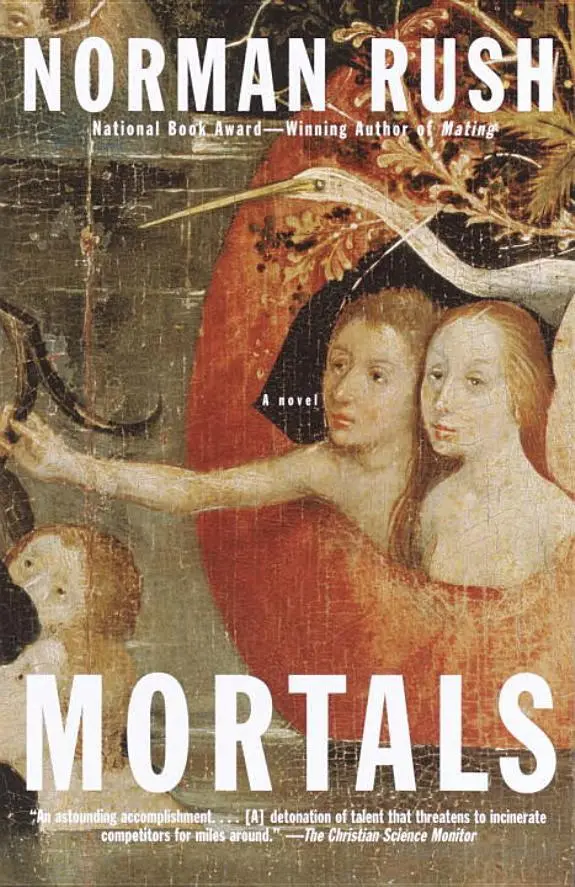
- Название:Mortals
- Автор:
- Издательство:Vintage Books
- Жанр:
- Год:2003
- ISBN:9780307789365
- Рейтинг книги:3 / 5. Голосов: 1
-
Избранное:Добавить в избранное
- Отзывы:
-
Ваша оценка:
Mortals: краткое содержание, описание и аннотация
Предлагаем к чтению аннотацию, описание, краткое содержание или предисловие (зависит от того, что написал сам автор книги «Mortals»). Если вы не нашли необходимую информацию о книге — напишите в комментариях, мы постараемся отыскать её.
As a spy, the compulsively literate Ray ought to have no trouble confirming his suspicions. But there’s the distraction of actual spying. Most of all, there’s the problem of love, which Norman Rush anatomizes in all its hopeless splendor in a novel that would have delighted Milton, Nabokov, and Graham Greene.
Mortals — читать онлайн бесплатно полную книгу (весь текст) целиком
Ниже представлен текст книги, разбитый по страницам. Система сохранения места последней прочитанной страницы, позволяет с удобством читать онлайн бесплатно книгу «Mortals», без необходимости каждый раз заново искать на чём Вы остановились. Поставьте закладку, и сможете в любой момент перейти на страницу, на которой закончили чтение.
Интервал:
Закладка:
He had it, the name of the character with the collection basket. He knew who he was. Admittedly it was inferential. But he knew he was right. The character was a thief, he was the thieving Paul Ojang, and Iris had given her donation to him. Good God, he thought. This Ojang was an asset of Boyle’s, someone he had bragged about, a prize catch in Boyle’s recruitment exercises among the more dubious elements of society, to be euphemistic. Ojang had, as a boy, done yard work for expatriates in Gaborone, and then moved on to church robberies, one or two of them pretty spectacular, and he was the ringleader of a band of pickpockets, shoplifters, and housebreakers, but one of his specialties was tapping public solicitation events, any occasion where cash was being publicly collected. He was a pest, a parasite. He had been caught infiltrating Rag Day activities, sending his underlings out costumed to blend in with the University of Botswana students in their academic robes running around the streets and rattling canisters of coins in the faces of the public as they collected for charity. And Ojang was suspected of working diversion schemes at open-air political rallies in various places, rallies run by the opposition party and not the governing party, it went without saying. And Boyle had used Ojang in instances where an investigative entry needed to be camouflaged as a routine house job. Ray wondered how this rather impressive-looking fellow had come to this vile calling. He had never met Ojang, who was out of Ray’s bailiwick, but he was sure he had his man. Boyle was so proud of Ojang. Ray had heard him lovingly described. Yes, and Ojang had a cover name … Curate. Remarkable, Ray thought.
They continued in silence all the way home. At their gate, he stopped and pulled her against him. He had to bring his news out before they went inside. He felt that urgently, he didn’t know why. He had been clumsy, pulling her to him. She was alarmed. He was clumsy.
So he rushed it out, all of it, the emergency, his lack of choice about going, and that he would be gone for three weeks, which she should be able to deal with, and that he was sorry about not having been able to give decent notice but that she had to realize he was in the same boat. He heard himself say both that the emergency was deadly serious and that it was essentially bullshit, not to be worried about. Too much of his own fear and dismay was coming through. Because he was clumsy.
She was saying nothing. He couldn’t read her. Clumsily, because he was miserable and she was saying nothing, he brought up something entirely different.
“Love, how much did you contribute this evening, out of curiosity?”
“All I had on me, a hundred pula. I know it’s a lot.”
“No, that’s fine.”
“I felt … I don’t know. These are people I admire. And I doubt I’ll ever see them again.”
“It’s fine, it’s fine.”
“Now you have to go away.”
“It’s nothing. It’s a situation. I’m sorry.”
“God but I hate it. You know how I feel. I couldn’t tag along with you, of course.”
“Not possible. It’s not that kind of thing.”
“Yes and that’s what’s so frightening. I don’t know what it is, what you have to do, how dangerous it is, if it is …”
“Forget that one. It’s … I’ll be reporting.”
“This comes exactly when we don’t need it. You’re saying three weeks.”
“About. It could be under and it could be a little over.”
“It’s too long.”
“I know. But don’t think you have to worry. I can’t tell you anything about what’s going on but the phrase opéra bouffe is a phrase orbiting around my mind right now.”
“Nothing is resolved about my sister. And we need to resolve it, we have to.”
“I know that.”
“You cannot conceive how I hate this, Ray. Oh and yes, of course, I’ll have some sort of drill to go through when people ask, some lying lying thing about where you are. You’ll give me the script.”
“Sorry.”
“Something has to change,” she said, her tone grievous.
“I know,” he said.
“I mean, it really has to change.”
“I agree,” he said.
“You do? Truly, do you?”
“Yes,” he said, as hard as he could. She wanted everything to be different and she was probably right and that was what was needed, or something close to it. He was planless. He was planless. She wanted him out of the agency. He understood it. But was that going to be the necessary and also a sufficient condition for going on together?
“I want to believe this.”
“Do believe it.”
“Okay then, but you’re going. So what should I do? I have to think. I have to do something …”
She hated being alone, generically. He knew that and was sorry.
“I know what,” she said.
Good, she had thought of something. Why was he afraid?
“You know what I could do? This just occurs to me. I could do an intensive with Davis. I could use your absence for that.”
“Do an intensive. What is an intensive?” He thought he knew.
“It’s a residential period you spend with Davis. It’s the equivalent of the immersion method in language learning. You get everything … diet, body work, counseling, healthy cooking, and you detoxify …”
She said more, promotionally. It was difficult to listen. He was barely hearing her. He was hearing as through a wall, poorly, which was a funny line of hers from better days. What he did understand clearly was that intensives were sleepaway propositions. And that Morel offered intensives so infrequently that this had to be looked at as a rare opportunity. And that indeed she did need to detoxify, everybody did, she did even though he was right that she was in basic good health. She was overselling, but that was natural. She wanted to do it. She was nervous, presenting this as just another good idea. He could tell.
“So you sleep over the whole time.” He hadn’t intended to make her say so again, but there it was, he had.
“Well that’s part of it, the immersion. I know I could walk home every night, we live so close by. It’s possible I could arrange it with him …”
“Nonono. No need, my girl. It’s the mystique. It’s a concept. I understand it. Things work a certain way.” Let her go, he thought. She wanted this. There was feeling behind it. Palpable. Whether she had wanted to do it before it had unexpectedly become possible for her to do, he didn’t know, but she wanted it now. Show trust or die, he said to himself, sternly. He looked up at the African sky. She wanted to do it and he could taste it. She was his light in this world, his one light. She gave out something no one else did. The stars over southern Africa were thick and florid, a feast of stars they were neglecting to enjoy. What ees the stars? he thought, the line spoken by the old fart in the O’Casey play the Brits had put on, the line they had reused comically ever since. What ees the stars? The constellations were different, over Africa. It was the laggard pace of progress that made the stars in their African majesty available, and the two of them were being oblivious, she as much as he. Attention must be paid, he thought.
“You go when?” she asked.
“Day after tomorrow.”
So she would do something and he would do something. He had to show trust in her, be absolute in that. So she would do something and he would do something and what he would do might not be the terror of the earth but it would be something . She would see.
“On we go,” he said.
II. In the Cup
24. Kerekang the Incendiary
Ray had been feeling like an idiot more or less continuously for the last six days. They were long past the easy part of the excursion, the reasonably civilized stopovers in Kanye, then Kang, then Ghanzi. They were well north now, deep into the sandveld, the tarred road two days behind them. There were aspects of this journey that he ought to be enjoying, like the spectacular emptiness of the land, the sheer extremity of the desolation, the occasional glimpses of exotic wildlife, ostriches mainly, so far. But unfortunately he was an idiot. He should enjoy having a driver, enjoy being essentially a passenger, enjoy having a driver he liked. Keletso was a taciturn man but pleasant, a scrupulous driver healthily fixated on the absolute primacy of keeping the Land Cruiser moving through a terrain no sane human would want to break down in. The Land Cruiser was their cottage, their fortress. Keletso was decent company, just communicative enough, and a demon about keeping all the fluids essential to life and locomotion topped up. Ray was minutely studying Keletso’s moves and routines to be certain he could take over on his own if he had to, depending on how things uncoiled, not a prospect he relished. Keletso was nothing like an idiot. They were on a lumpy stretch of gravel road, passing through a sea of high dead yellow grass. Since Ghanzi, the land had been interminably flat. Trees here were so occasional that the rare specimens possessed, for Ray, an exclamatory quality. That there were trees present at all was surprising, the poor crabbed things, thorn trees exclusively, with brittle-looking black-green crowns. It was hot, but this wasn’t the worst time for travel in the western Kalahari. Winter was ending. It was mid-September. The night frosts were over with.
Читать дальшеИнтервал:
Закладка:
Похожие книги на «Mortals»
Представляем Вашему вниманию похожие книги на «Mortals» списком для выбора. Мы отобрали схожую по названию и смыслу литературу в надежде предоставить читателям больше вариантов отыскать новые, интересные, ещё непрочитанные произведения.






Обсуждение, отзывы о книге «Mortals» и просто собственные мнения читателей. Оставьте ваши комментарии, напишите, что Вы думаете о произведении, его смысле или главных героях. Укажите что конкретно понравилось, а что нет, и почему Вы так считаете.