Norman Rush - Mating
Здесь есть возможность читать онлайн «Norman Rush - Mating» весь текст электронной книги совершенно бесплатно (целиком полную версию без сокращений). В некоторых случаях можно слушать аудио, скачать через торрент в формате fb2 и присутствует краткое содержание. Жанр: Современная проза, на английском языке. Описание произведения, (предисловие) а так же отзывы посетителей доступны на портале библиотеки ЛибКат.
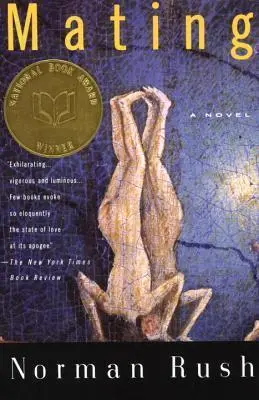
- Название:Mating
- Автор:
- Жанр:
- Год:неизвестен
- ISBN:нет данных
- Рейтинг книги:4 / 5. Голосов: 1
-
Избранное:Добавить в избранное
- Отзывы:
-
Ваша оценка:
Mating: краткое содержание, описание и аннотация
Предлагаем к чтению аннотацию, описание, краткое содержание или предисловие (зависит от того, что написал сам автор книги «Mating»). Если вы не нашли необходимую информацию о книге — напишите в комментариях, мы постараемся отыскать её.
Mating — читать онлайн бесплатно полную книгу (весь текст) целиком
Ниже представлен текст книги, разбитый по страницам. Система сохранения места последней прочитанной страницы, позволяет с удобством читать онлайн бесплатно книгу «Mating», без необходимости каждый раз заново искать на чём Вы остановились. Поставьте закладку, и сможете в любой момент перейти на страницу, на которой закончили чтение.
Интервал:
Закладка:
The Plaza
With great regularity Nelson would regret and then not regret siting the public buildings of Tsau on a terrace one hundred and twenty-five feet above the plain. Everyone at one time or another would curse Tsau for not being laid out all on one level. I got used to seeing people dragging themselves around strickenly for a while after reaching the terrace, particularly if they’d had to get up to it in a hurry. This came across to me as largely pro forma, though. It was never long before the tonic elements in the setting would take over. The breezes, were lovely there. You could promenade along the terrace rim and peer down into people’s yards. And the actual ascent was very gradual, with benches along the routes.
The view was dramatic. You appreciated the greenness of Tsau, as against the burning grays and yellows of the Kalahari. When there were cloud shadows, the Kalahari looked like a leopard pelt. People would sit and commune with the view. What Denoon would say in defense of the location was that civically important events should take place in an elevating setting. I knew he had images of Delphi in mind. I also knew he thought stair climbing was cardiovascularly good for you and I found myself wondering if that had had something to do subliminally with the choice. My bet, still, is that, all things considered, no woman would have voted to have the washhouse, the stores house, the central kitchen, and the Sekopololo offices located at the top end of a long though gentle ramp. We inhabit male outcomes. Every human settlement is a male outcome. So was Tsau, which was seventy percent complete when the first women moved in.
Gladys and Ruth Street delivers you to the center point of the plaza, which is kidney shaped, half a city block in extent, flagged at the margins and raked sand otherwise. The concavity is toward you. There are several small mopane trees to the rear west side of the plaza, but most of the shade is provided by beach umbrellas, for which there are sockets in the ground irregularly distributed over the open area. Straight ahead of you as you arrive, and set far back, is the stores house, a huge rondavel connected via a covered passage to a cave in the koppie. There are two imposing sister structures, ovaldavels, one at each of the far ends of the plaza. I had looked only superficially into the stores house — the front section of the rondavel and not deeper into the cave — but I had been impressed by the density of the array of goods and tools stacked, racked, shelved, binned, hoisted up and hanging suspended over you, to be found there, everything labeled and tagged, seemingly. You would have to be lithe to get around rapidly amid the profusion of goods in the front room and through the back room and into the cave, where the crowding was supposedly worse. The stores house rondavel and its sister ovaldavels were magnificent buildings, voluminous, with high, open vaults under the steep-pitched thatched roofs. The construction was not mud block like the homestead rondavels, it was concrete block, but you could only tell this from inside: the exteriors were finished in heavy mastic and enameled sky blue. One reason that Tsau gave such a spangled appearance from a distance was that the thatching closure on the roof peaks is always protected by tin cladding, either a conical cap, in the case of the rondavels, or long, pieced shielding like an overturned racing shell, in the case of the ovaldavels.
The ovaldavel to the right I classified as general administrative, since it housed the post office-bank, the library, meeting rooms for the mother committee, the disputes committee, and the committee as to names. I analogized the mother committee to a town council, although the interlocks between it and something called the sister committee, which had to do exclusively with the economic side of Tsau, meaning Sekopololo, were for a long time obscure to me. Denoon had no office anywhere in the public buildings, I was surprised to learn. There was some mousy shrubbery around the administrative building, and some freesias, I think. A ship’s bell hung from a hook next to the front door.
The ovaldavel to the left was Sekopololo itself — offices, record rooms, a veranda where the morning shapeups took place, and a combination shop and lounge devoted to stocks of the most commonly needed commodities, such as salt, toilet paper, cooking oil, and batteries. There were some smaller buildings behind Sekopololo, in one of which was the largest of the three generators in Tsau.
Wires could be strung across the plaza from high up on the different buildings so that, using support poles and sheets of burlap, large sections of the open area could be canopied for outdoor events in the hot season. In fact it was possible to accommodate the whole populace under shade in the plaza. Risers would be packed in along the inner curve of the terrace, a canopied dais would be erected out toward the terrace rim, and the fun would begin. It was unique.
I was informed I should report to the plaza at seven in the morning for my meeting with the mother committee. I was prompt. Just off the Sekopololo veranda a circle of chairs had been set up around a low round table with a crockery urn and nine mugs on it. The mother committee was prompt. Just as I arrived the eight members of the committee filed out of the administration building. I was motioned to sit anywhere I liked. They were new faces, only Joyce and Dineo being familiar to me. We all said our names before beginning, but I was concentrating so on what I was going to say that only one of the new names stuck with me, the name of a woman who seemed fascinated with me, Dorcas Raboupi. Her eyes never left me. She had perfectly straight eyebrows, like dashes. She was short, not young but not yet in the aunt category. She was lighter complexioned, almost a coloured, her face lumpy on one side, as though she had a fat-deposition disorder. She sat in a huddled way that I thought showed hostility. The day was cool but not cold. Several of the women had brought shawls with them, and I had been told I could get one to borrow at the counter in Sekopololo. I didn’t need one. Dorcas Raboupi was unnerving. She appeared to be someone’s nemesis, probably mine for no reason I could think of. I was prescient.
I expected Dineo to lead off and handle the meeting, but instead a bag was passed around and people drew disks out of it, with the one who drew a notched disk beginning the proceedings. This was a heavyset young woman, Mma Molebi, evidently nursing: there was a milkstain in her bodice over one breast. Judging by the way she wrung her hands before she commenced, she was uneager for her assignment. My back was to the desert.
Mma Molebi began with the obviously obligatory history of Tsau. As she spoke, the other women got up one by one and served themselves tea. I was struck by this, because it would be usual for the youngest woman present to serve the older women. There is so much reflexively hierarchical behavior in Africa — the young serving the old, women routinely serving men — that this self-service feature of life in Tsau leapt out at me. It reminded me that I had seen something else that was atypical, namely young males willingly shoveling up animal manure to use in composting. Admittedly I had seen this in Tsau only a couple of times. But it was not the Botswana I knew. If manure had to be collected, it would be usual for women to do it. I knew from my Peace Corps doctor that there was perpetual sturm und drang with the boys the Peace Corps hired as messengers over being required to take sealed packages containing stool samples from the medical office to the lab at Princess Marina Hospital. One of the messengers had quit rather than demean himself so. Finally the female receptionist had volunteered to take over the task herself.
I got the feeling that our meeting was taking place in a circle out in the open so that passersby would feel comfortable in hanging around to see what was going on. People did drift up and listen for a while. I found it both inhibiting and relaxing, more the second as time went on.
Читать дальшеИнтервал:
Закладка:
Похожие книги на «Mating»
Представляем Вашему вниманию похожие книги на «Mating» списком для выбора. Мы отобрали схожую по названию и смыслу литературу в надежде предоставить читателям больше вариантов отыскать новые, интересные, ещё непрочитанные произведения.












Обсуждение, отзывы о книге «Mating» и просто собственные мнения читателей. Оставьте ваши комментарии, напишите, что Вы думаете о произведении, его смысле или главных героях. Укажите что конкретно понравилось, а что нет, и почему Вы так считаете.