Norman Rush - Mating
Здесь есть возможность читать онлайн «Norman Rush - Mating» весь текст электронной книги совершенно бесплатно (целиком полную версию без сокращений). В некоторых случаях можно слушать аудио, скачать через торрент в формате fb2 и присутствует краткое содержание. Жанр: Современная проза, на английском языке. Описание произведения, (предисловие) а так же отзывы посетителей доступны на портале библиотеки ЛибКат.
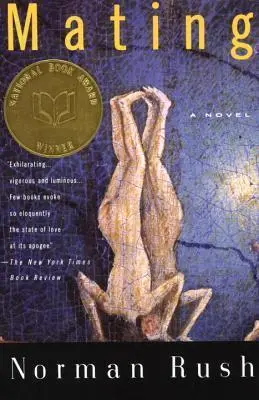
- Название:Mating
- Автор:
- Жанр:
- Год:неизвестен
- ISBN:нет данных
- Рейтинг книги:4 / 5. Голосов: 1
-
Избранное:Добавить в избранное
- Отзывы:
-
Ваша оценка:
Mating: краткое содержание, описание и аннотация
Предлагаем к чтению аннотацию, описание, краткое содержание или предисловие (зависит от того, что написал сам автор книги «Mating»). Если вы не нашли необходимую информацию о книге — напишите в комментариях, мы постараемся отыскать её.
Mating — читать онлайн бесплатно полную книгу (весь текст) целиком
Ниже представлен текст книги, разбитый по страницам. Система сохранения места последней прочитанной страницы, позволяет с удобством читать онлайн бесплатно книгу «Mating», без необходимости каждый раз заново искать на чём Вы остановились. Поставьте закладку, и сможете в любой момент перейти на страницу, на которой закончили чтение.
Интервал:
Закладка:
He was wiping his eyes. We walked around wordlessly. I felt close to him.
I decided not to intrude on his state of being unless he made some move to show that that would be welcome. He dropped me at Mma Isang’s and went off. I was being extremely careful. I think this was the beginning of our courtship.
Of course, life being what it is, in fact the thing that moved him in Mariam’s story was not what I had thought. It was something more abstract that her story had suggested. Much later I somehow brought this scene up, and he, on his own, straightaway corrected my view of what he had been feeling that night. I was saying, I think, how much it had moved me that he had been so moved by Mariam.
The more abstract thing was manmade violence in general. Before going to Mariam’s he had been writing poetry, or rather trying for the thousandth time to turn a very clear concept that he had into a real poem. There had been an overflow of emotion at Mariam’s because the subject matter of her story was an example of what he had been trying to get into his poem. He explained it to me. He wanted to write a poem that would make the point that anyone who embraces violence should be seen as an ally of all the inescapable natural enemies of humanity, from earthquake through the panoply of diseases. It was so clear to him. He obviously thought that if he could get this into a halfway decent poem it might have some effect. He let me see some of what he had done. It was Whitmanic. He was working with titles like Allies of Famine and Victualers of the Maggot or Votaries of the Maggot. I remember that Claymore and Gatling were characterized as allies of the maggot or the blowfly. You’re not a poet, I had to tell him. This is not a poem. A genius could do it, he said. We laughed over it. Your problem is that you want to be everything, I told him. That isn’t the worst, he said.
I asked him what the worst was.
The worst was that in the course of things he had gotten to know pretty well a couple of authentic poets, people whose names I would know but which he was too ashamed to tell me. He had actually sent them each a précis of his poem idea, in an attempt to get them to write such a poem. One had never responded. One had responded politely. He seemed not to be friendly with either of them anymore.
You must be the greatest believer in the power of poetry there is, I told him.
More Courtship
Substantive courtship went on for a month, with me ultimately forcing the pace when I felt the balance between our public and private gettings-together was not improving. Public occasions far predominated, where we would find ourselves together at corso or some performance or other or at the movie. Our private occasions tended to be chaste long walks in the gloaming, which frequently turned out to end at some utilitarian destination such as a windmill in need of a touch of maintenance. Until the very end, there were no declarations toward me.
The studied pace of all this was something to be borne. I was working with the rabbits. On the few occasions Denoon and I were alone together I felt that he was more interested in how it was going in the rabbit pens than in getting to know all about me. He was always keenly interested in whatever I had to say analytically about Tsau, which served to confirm my notion that it was my reading of the place that he really wanted from me. We were going so ploddingly through the stages of courting — from handholding to a little mournful standing-up necking — that I for one found it embarrassing. It was quaint, not to say retrograde, for people our respective ages. But I went along with it, accepting the sickeningly familiar vigil for cues from the sovereign partner as to when it was time for the next plateau. There were great things at stake, I told myself, and his grasp of the ramifications of our getting together was greater than mine.
One thing I now know I was misinterpreting was Nelson’s taste for bouts of self-communing, which I mistook as being longeurs for him just as surely as they were for me. He liked us to walk around together in total silence much more than I did. When we finally discussed it I made him laugh by saying I get bored when I’m not talking. I remembered that he had mentioned to me that a normal social occasion for his parents might be to invite friends over and sit around with them, nobody speaking for hours, while a recording of the Missa Solemnis was played. His mother and father, just the two of them, would often do the same thing. Mightn’t seeing that kind of thing have had something to do with the development of your taste for silence? I asked. No, he said, because by the time he might have been influenced by it he had figured out that the scene was really only another device of his father’s for having an apparently normal social evening while in fact being drunk: it was a sham, an excuse for sitting on a sofa with his eyes closed, only nominally present, making it to bedtime with the amount he had gotten away with secretly drinking going undetected. It was a con in every respect. For instance, his father’s record selections ran heavily toward sacred music, a lot of Bach, which Nelson saw as a transparent inducement to his mother to partake.
Can’t anything be innate? he wanted to know, objecting to my probing into his childhood yet again. Does everything have to be an exfoliation from the minutiae of our miserable childhoods? I happen to love silence, he said. Why do we have to be swamped in narrative? Our lives are consumed in narrative. We daydream and it’s narrative. We fall asleep and dream and more narrative! Every human being we encounter has a story to tell us. So what did I think was so wrong with the pursuit of some occasional surcease of narrative?
In retrospect I suppose I could have pursued the reasons for his bouts of indwelling, but when you’re being courted you develop such a gooseneck persona, even if only temporarily, that you’re out of position to catch clues that would normally alert you to things you need to pursue. But of course nothing is more profitless than going back over what interventions might have changed the shape of things to come. I want to scream at myself when I do that.
I realize that I may have contributed to his wanting to be silent during our walks by my too concentrated and cathected soundings re the books in his life. I was groping gingerly for his intellectual keystone, but not gingerly enough. There are certain quagmires to be avoided with people. You can find yourself liking someone who appears intellectually normal and then have him let drop that his favorite book of all time is The Prophet. That wasn’t the particular danger with Denoon, but there were others. A guy who tells you the best novel ever written is Clarissa, which also happens to be the first or second novel ever written, is also not unlikely to tell you that the only music he likes to listen to is motets and that art has never really advanced over the cave paintings at Lascaux. I suppose I was on the qui vive for some variant of this reflex because Denoon had said his favorite novel was War and Peace, so I was thinking, Oh no, it’s going to be Beethoven for music and Shakespeare for plays. It isn’t that these positions are not defensible, but taking them may mean someone is not very individual. One thing you distinctly never want to hear a man you’re interested in say softly is that his favorite book in the whole world is The Golden Notebook. Here you are dealing with a liar from the black lagoon and it’s time to start feeling in your purse for carfare. Anyway, when I sensed the depth of Denoon’s desire for a little silence, I desisted. What I got out of this first attempt to look at his literary underpinnings was a paperback called L’Afrique Noire est Mal Partie to read and comment on.
Читать дальшеИнтервал:
Закладка:
Похожие книги на «Mating»
Представляем Вашему вниманию похожие книги на «Mating» списком для выбора. Мы отобрали схожую по названию и смыслу литературу в надежде предоставить читателям больше вариантов отыскать новые, интересные, ещё непрочитанные произведения.





Обсуждение, отзывы о книге «Mating» и просто собственные мнения читателей. Оставьте ваши комментарии, напишите, что Вы думаете о произведении, его смысле или главных героях. Укажите что конкретно понравилось, а что нет, и почему Вы так считаете.