Norman Rush - Mating
Здесь есть возможность читать онлайн «Norman Rush - Mating» весь текст электронной книги совершенно бесплатно (целиком полную версию без сокращений). В некоторых случаях можно слушать аудио, скачать через торрент в формате fb2 и присутствует краткое содержание. Жанр: Современная проза, на английском языке. Описание произведения, (предисловие) а так же отзывы посетителей доступны на портале библиотеки ЛибКат.
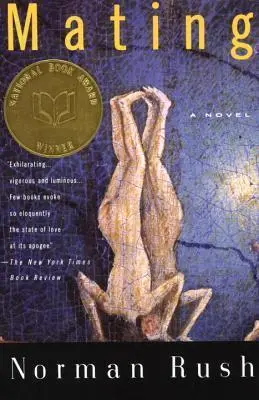
- Название:Mating
- Автор:
- Жанр:
- Год:неизвестен
- ISBN:нет данных
- Рейтинг книги:4 / 5. Голосов: 1
-
Избранное:Добавить в избранное
- Отзывы:
-
Ваша оценка:
Mating: краткое содержание, описание и аннотация
Предлагаем к чтению аннотацию, описание, краткое содержание или предисловие (зависит от того, что написал сам автор книги «Mating»). Если вы не нашли необходимую информацию о книге — напишите в комментариях, мы постараемся отыскать её.
Mating — читать онлайн бесплатно полную книгу (весь текст) целиком
Ниже представлен текст книги, разбитый по страницам. Система сохранения места последней прочитанной страницы, позволяет с удобством читать онлайн бесплатно книгу «Mating», без необходимости каждый раз заново искать на чём Вы остановились. Поставьте закладку, и сможете в любой момент перейти на страницу, на которой закончили чтение.
Интервал:
Закладка:
The Octagon
Denoon was abruptly missing for four days, having said nothing about going anywhere.
Unbeknownst to me, there was an innocent explanation for his absence. He had a custom of retreating once a month to a lean-to a mile down the sand river for reading and reflection. The date had crept up on him. He’d discovered it was time to go by turning a page in his daybook. He’d looked for me, hadn’t found me, hadn’t wanted to leave anything in written form for my information — the problem being, I was nonplussed to hear, that written communications in Tsau weren’t necessarily that secure — and most of all he hadn’t wanted to put off doing something that everyone knew he had always done religiously, like clockwork, up till then. These scruples related to his delicate stage-management of our relationship in terms of the way it was important for it to appear to the watchership of Tsau. Everything in our getting together had to appear to be the result of accident and natural evolution. Everything had to be convincingly gradual.
I couldn’t ask where Denoon was because I felt I had to be wary about the undoubtedly larger than suspected percentage of women in Tsau who privately assumed I had come there with premeditation to chase Denoon. So I couldn’t ask, but what I could do was instantaneously convince myself that Denoon was involved in a covert liaison. Somebody must have given him an ultimatum and forced him to go away for a confrontation. There must be a grotto someplace, I thought, or some other hideout where they were meeting. Who might my rival be? I instantly had two candidates — Dineo, and Kakelo Modise, our surly nurse. It seemed to me that both of them had been out of the public eye sufficiently during Denoon’s absence to make either of them plausible. I, at least, hadn’t seen much of either of them lately, insofar as I could reconstruct.
It had to be Kakelo, probably. She was less than twenty-five and had a very cute figure, which she tailored her nurse costume to exploit. She went everywhere in full kit — always including her miniature toque of a nurse’s cap — lest we forget who she was. She had a beautiful au lait complexion. In her presence you were never unaware that here was someone in no doubt she was wasting her fragrance on the desert air. She was in fact the sole user of perfume in the entire village, to my knowledge. I had sympathy for her, but I was never able to exercise it. She was tremendously rude. There was a protocol obtaining in small groups in the event someone wanted to start speaking in English. It was more pro forma than not, because I never saw anyone give the decline signal. If you wanted to go into English you were supposed to lock your little fingers together for a moment to give people the theoretical option of signaling no with a thumbs-down. But whenever she had intersected any group I was in she had tramplingly ignored the protocol and gone straight into clipped, rapid English. Naturally if she was Denoon’s secret inamorata her rudeness toward me was more than explained. She was clearly seething over something. And any lonely male would be interested in her, if she was interested, it seemed to me. I constructed a complete psychology for her. I imagined myself in her place, nubile and posted involuntarily to a city of women: what would make more sense than trying to go sexually for the indirect author of my distress, to wrench him down? Folklore vis-à-vis young nurses from my adolescence helped me along. Thanks to the amusing reports on the male world I extracted from a gay male friend, I knew what high school guys in my day thought about nurses. My high school had been located two blocks from a college of nursing. My friend described a locker room scene in which a letter man, a lacrosse champion, becomes unhinged and begins pounding the lockers: he has just gotten the news from the team physician that he has contracted a social disease. His worldview is crumbling because he has contracted it from a nurse, or nursing student, rather. Nurses were assumed to be sexually active both out of horniness — they lived under parietal rules — and because they knew all about hygiene and were contraceptively astute and could even give each other abortions if something went wrong. Nurses were supposed to be sexually sanitary in every way. And here a nurse has gotten him infected.
My suspicion of Kakelo was shortlived, though. I had a look around in her office and couldn’t help noticing the thickness of the file of carbons of savingrams she had sent to the Ministry of Health appealing for transfer before her tour was up. Many of the appeals were recent. If she had ensnared Nelson, why would she be pressing so insistently for reassignment? Also a little inquiry revealed that her nonattendance at the health post recently had been due to bronchitis or hypochondria, both of which she had had spells of in the past according to everyone. And, finally, it was brought home to me that she bullied everyone about speaking English, whether I was in the group or not. Her first name translated into Obedience, funnily enough.
The last day Denoon was missing I went prowling around his place like a nut, very early in the morning. I had my pretexts ready in the event I came to anybody’s attention, including his, should he be in situ. He wasn’t. I got there circuitously, slipping down from the brushy hillside above the house instead of going publicly up the path from the plaza. Denoon had a terrace all to himself, an area about the size of two tennis courts end to end.
The house was a concrete block octagon, formerly the command center of the Belgian construction outfit that had built Tsau. There was something disparate and notional about the tall, double-peaked thatch roof. This was a feeling that turned out to be prescient: I was looking at something that would become a personal material headache. In fact the original perfectly good corrugated iron roof had been taken off at Denoon’s instruction and replaced with this thatch fantasia not structurally appropriate to the shape of the building. He wanted to live under thatch like everybody else. At first my heart went out to Denoon over his having to live in such a peculiar albeit spacious building. It looked vaguely industrial, or even military industrial, like a blockhouse in World War I, or I may mean pillbox, except for the absence of guns sticking out of the narrow rectangular windows set horizontally at a higher than normal level in the walls. But then the more closely I looked at his house and grounds the more interesting and deceptive his choice of domicile seemed to me to be.
It amused me to refer to the whole yard area stretching away from the front of the house and ending in a precipice as the patio. Nelson never fully got the humor in the term. It came to me during that first reconnaissance. In truth what the yard resembled was a sculpture garden of broken or half-repaired or obsolescent machines and machine elements. In among the machines were other sorts of matériel — vats in which machine parts seemed to be marinating in solvents, piping bundled according to caliber, unopened crates. His yard was an antipatio, although there was a clear space near the outer edge of the terrace where any normal person would long ago have put a table and chairs or a hammock. This spot was shaded by the most perfect umbrella tree in Africa, incidentally. As a gardener, Denoon was nominal. There was a measly presentation of parsley and some other herbs in tubs near his doorstep. More could be done. To the back of the terrace, behind the house, was the privy and a sketchier thatched structure like the places you get drinks from on the beach in the Caribbean, except that it contained a huge authentic porcelain bathtub. The bathhouse walls were litani mats held together at the overlaps by clothespins. I marveled at this facility briefly, noting that here was the only place in all of Tsau where you could stretch out full length in hot water. Later I would discover that there was at least one other English bathtub in Tsau, at Dineo’s. I tried the tap, and nothing. The bathtub wasn’t reticulated to the water system. Water had to be brought in in canisters and emptied into the donkey boiler — essentially an oildrum set over a stone firebox — for heating. Here was exactly the peculiar amalgam of amenity and discomfort that I was picking up as a suppressed motif. You could have your own bathtub, but it would have to be somewhat of an ordeal to make use of it. It’s an unfair simile, but what I thought of in scanning his accommodations was the signs you see protesters carrying in demonstrations in movies where the supposedly homemade lettering is so obviously the art director’s version of what an enraged untrained hand would produce. This thought was unfair but I had it.
Читать дальшеИнтервал:
Закладка:
Похожие книги на «Mating»
Представляем Вашему вниманию похожие книги на «Mating» списком для выбора. Мы отобрали схожую по названию и смыслу литературу в надежде предоставить читателям больше вариантов отыскать новые, интересные, ещё непрочитанные произведения.












Обсуждение, отзывы о книге «Mating» и просто собственные мнения читателей. Оставьте ваши комментарии, напишите, что Вы думаете о произведении, его смысле или главных героях. Укажите что конкретно понравилось, а что нет, и почему Вы так считаете.