Norman Rush - Mating
Здесь есть возможность читать онлайн «Norman Rush - Mating» весь текст электронной книги совершенно бесплатно (целиком полную версию без сокращений). В некоторых случаях можно слушать аудио, скачать через торрент в формате fb2 и присутствует краткое содержание. Жанр: Современная проза, на английском языке. Описание произведения, (предисловие) а так же отзывы посетителей доступны на портале библиотеки ЛибКат.
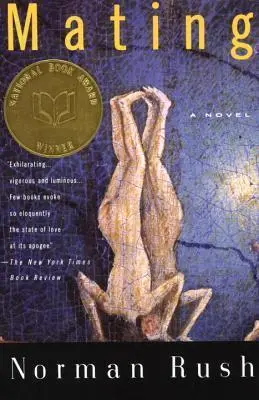
- Название:Mating
- Автор:
- Жанр:
- Год:неизвестен
- ISBN:нет данных
- Рейтинг книги:4 / 5. Голосов: 1
-
Избранное:Добавить в избранное
- Отзывы:
-
Ваша оценка:
Mating: краткое содержание, описание и аннотация
Предлагаем к чтению аннотацию, описание, краткое содержание или предисловие (зависит от того, что написал сам автор книги «Mating»). Если вы не нашли необходимую информацию о книге — напишите в комментариях, мы постараемся отыскать её.
Mating — читать онлайн бесплатно полную книгу (весь текст) целиком
Ниже представлен текст книги, разбитый по страницам. Система сохранения места последней прочитанной страницы, позволяет с удобством читать онлайн бесплатно книгу «Mating», без необходимости каждый раз заново искать на чём Вы остановились. Поставьте закладку, и сможете в любой момент перейти на страницу, на которой закончили чтение.
Интервал:
Закладка:
 Entertainments. A woman, a Morolong originally from Mafikeng, will come and stand outside your house and for scrip the equivalent of twenty-eight cents will play keening versions of Lady of Spain and Die Stem and a few other tunes on her violin. Her name is Prettyrose Chilume and she dresses up in tartesque town clothes to do this, eschewing the local sandals in favor of the towering platform shoes just going out of style in Gabs. She is very frail-looking, in her middle thirties, and was at one time a prostitute. Preceding that, she had been a kind of household slave to a Boer rancher, who taught her the violin as a joke. There are two choirs, one all queen and one all auntie, which are very rivalrous. Children get into traditional undress and do line dancing or have praise-poem-shouting contests. There are chess tournaments and speed contests with the abacus, which Denoon has introduced and popularized. There are reading circles, including several strictly for Bible study. In fact a surprising amount of reading goes on, in English and Setswana. People doing repetitive work can have someone come and read aloud to them. There are classes. Denoon lectures on almost anything. Afterdinner household intervisitation is somewhere between extremely popular and totally out of control. Since I moved to my own rondavel I’ve felt a certain pressure to light the welcome light each night, because if I don’t I’m denying people access to a curiosity: myself. But I also feel compelled to preserve time for myself. This is a physical life and by nine I’m already falling asleep. Also I felt it incumbent on me to try to memorize as much as I could from the Field Guide to the Birds of Southern Africa, for which I needed privacy. I think I have never hated a subject more. I feel guilty when I hear people coming by, clearing their throats, milling around, and discussing why my light is off. People do have radios, but the reception from Radio Botswana is very weak here. There are tape players. Copies of the government newspaper arrive about a month late and are circulated, but we get only a sampling of issues. Illiterate people get read to. I said something that led Denoon to feel I was being clinical or superior to what people did for entertainment in Tsau, which I denied. I said I fully appreciated that eight tenths of what our set did for entertainment back home we could do in Tsau. I meant reading, listening to music, going occasionally to a movie. I omitted eating out, which is in fact a major form of entertainment but which my circumstances had always kept me from doing very often, and shopping. My concertgoing and playgoing had always been pretty much limited to amateur and college-level productions, so there was no great loss there. Movies came in once a month from the British Council via the Barclays plane. He grumbled about showing movies, and at first I thought it was out of irritation at having to start up the big diesel generator with its inky smoke and general balkiness. But it was deeper. After all, he had to start the generator to run his radio transmitter occasionally, or for welding, and he did that without complaining. Gradually I extracted the bases of his objection to movies. His mind wandered during them, he said. He only liked black and white. He only liked certain recherché classics by Carl Dreyer and a few other early masters. He was always aware of a blackish flicker: the frame speed was too slow for him. Movies were ludicrous objects because background music told you how to feel about everything. But even worse, movies were things that made you passive, somehow. They happened to you. You couldn’t make them go faster, get on with it, even to the degree that you could with actors in a play — by groaning, say. In any case, for the time spent, he would always rather be reading. He never said so, but I think he hoped Tsau would someday be above moviegoing. I treated all this as an eccentricity, but I think now it was a form of puritanism coming from god knows where. I told him I thought he liked reading because it was more like work. He said something passé like touché. He wasn’t annoyed. All this was much later. He would say only slightly facetiously that the main effort of arranging your life should be to progressively reduce the amount of time required to decently maintain yourself so that you can have all the time you want for reading. There was irony here, because until I came and superintended some small upheavals in his use of time he was always falling behind in his beloved reading and having to put it off, falling months behind in the case of the Economist, which mounted up in a stack that was always collapsing until I got an agreement out of him that I could pull out and discard the bottom oldest few copies when the stack got too high. That was fine, but I had to show him the copies I was discarding. I would, and then and only then would he read them. Our true entertainment was arguing, which we both loved. We liked to stay up late and argue. If we started arguing while we were lying down, I could always tell we had reached a serious point because he would want us to proceed in a sitting position. He never knew I noticed this. We argued about everything, but a lot of it devolved into arguments about his basic philosophical anthropology. His assumptions were too romantic for me. I wanted him to grasp something I thought I saw clearly, or to confute me. We had various climactic arguments. I made some headway with him with my notion that, along with getting food and keeping warm, male competition for females and female reproductive power as a commodity is at the root of the hideous hypertrophied structures that keep renewing themselves and reappearing unstoppably in human affairs. Survival of the species is served by the best males getting to reproduce the most, tout court, was my point. So we are placed in the position of hating and trying to undo the results of something obviously imposed on us from the depths of our beings and, sub specie aeternitatis, a good thing. This is my definition of original sin. I am convinced that everything we really hate in society derives ultimately from this. Denoon would seem to grant me everything but then say something like You may be right, but it can still be defeated. He would say it passionately. I wanted to shake him on this and once said I doubt you’d be quite so sanguine about how much we can change things if you knew anything about fraternal interest group theory, which is a school of analysis in anthropology you only have glimmerings about due to your long absence from the groves of academe. Give me a syllabus, then, he said, mad at me. Besides, I read two or three years of Man at a time whenever I get near a decent library. They have it in Gaborone. No good, I said, because this school is American and Man is British. So then it was Then give me a syllabus, to which I had to say I’m not in a position to do that right away, obviously, but as soon as I can I will, I promise. Our arguments could get heated, which was all right, and once when he was becoming more recalcitrant than I had intended to make him I said, to close it off, Well, you can lead a horse to the river but, you can’t make him admire the view. I think this was one of the first times he looked at me with intellectual appreciation a cut above just letting me see he thought I was adequately smart. Another was during an early argument when I was defending Samuel Beckett. Death and approaching death are about as interesting a literary subject as peristalsis, was his position. But I said The fact is that people don’t live as if death made any difference. There are innumerable institutions set up to encourage them in this, they spend years of their lives specifically defending against thinking that death is real and devoting themselves to the contemplation of various fictitious afterlives. But, I said, the world would be better if people incorporated the apprehension of death into the way they run their lives. Beckett makes you want to do that. Therefore he’s a moral writer and important. He looked at me as if to say I had a point, and then said That’s a very decent point. He would try Beckett again, he said.
Интервал:
Закладка:
Похожие книги на «Mating»
Представляем Вашему вниманию похожие книги на «Mating» списком для выбора. Мы отобрали схожую по названию и смыслу литературу в надежде предоставить читателям больше вариантов отыскать новые, интересные, ещё непрочитанные произведения.






Обсуждение, отзывы о книге «Mating» и просто собственные мнения читателей. Оставьте ваши комментарии, напишите, что Вы думаете о произведении, его смысле или главных героях. Укажите что конкретно понравилось, а что нет, и почему Вы так считаете.