Norman Rush - Mating
Здесь есть возможность читать онлайн «Norman Rush - Mating» весь текст электронной книги совершенно бесплатно (целиком полную версию без сокращений). В некоторых случаях можно слушать аудио, скачать через торрент в формате fb2 и присутствует краткое содержание. Жанр: Современная проза, на английском языке. Описание произведения, (предисловие) а так же отзывы посетителей доступны на портале библиотеки ЛибКат.
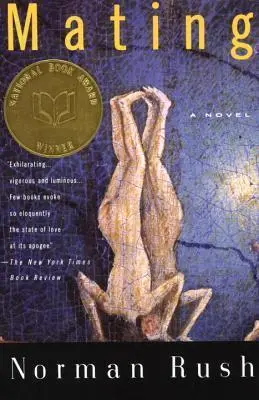
- Название:Mating
- Автор:
- Жанр:
- Год:неизвестен
- ISBN:нет данных
- Рейтинг книги:4 / 5. Голосов: 1
-
Избранное:Добавить в избранное
- Отзывы:
-
Ваша оценка:
Mating: краткое содержание, описание и аннотация
Предлагаем к чтению аннотацию, описание, краткое содержание или предисловие (зависит от того, что написал сам автор книги «Mating»). Если вы не нашли необходимую информацию о книге — напишите в комментариях, мы постараемся отыскать её.
Mating — читать онлайн бесплатно полную книгу (весь текст) целиком
Ниже представлен текст книги, разбитый по страницам. Система сохранения места последней прочитанной страницы, позволяет с удобством читать онлайн бесплатно книгу «Mating», без необходимости каждый раз заново искать на чём Вы остановились. Поставьте закладку, и сможете в любой момент перейти на страницу, на которой закончили чтение.
Интервал:
Закладка:
Dineo said that in not above five days I would meet with all the sisters of the mother committee and they would say what must be. Until then I must go all about Tsau and look everywhere to see what kinds of works could be raised up by women if only they lock together as one.
My Journal
Today when I look at the journal I started in Tsau and see how microscopically I felt I had to inscribe my initial entries I know I was more than hyper. I must have been rather disturbed.
My normal handwriting is above average in size. The idea behind writing in miniature was to create something that would be unforthcoming in the case of someone giving a quick, furtive scan, which is also why I resorted so berserkly to abbreviations and code words as well as studding my text with bogus ornithological observations as further camouflage. The result is a bolus not completely intelligible to me without serious concentration and the effort to think myself back into the moments that led me to choose particular codes and evasions. I could have used Pitman’s, which I know, but was afraid it would look suspicious to an unsophisticated person taking a quick snoop. Also I was speaking very little English for long stretches and found it a relief to use it in my journal: writing minutely served the need to enforce some selectivity on myself in dealing with the cascade of novelties and rarae aves Tsau confronted me with. There are also glyphs. Crossed swords mean sex. A truth about me is that when I visit a house where there are letters or other interesting-looking private papers lying around, I may have a quick look. I’m not convinced of my uniqueness in this tendency, although my excuse for it is anthropology. I would never do anything with information I got from my quick snoops, which are really quite disinterested. Anyone who could see into my heart would exculpate me and realize I was doing it pursuant to my consuming interest in the mystery of the world.
So the below represents an anthology, in effect, from my notes for early May 1981, up to and just through my full-dress meeting with the whole mother committee. I’ve tried to collect things under headings. Saying “the below” is yet another residue of Denoon, who thought that since people say “the above,” as in None of the above, it was unreasonable not to use “the below” identically, and also amusing. The below is an impure text, in that I have, where necessary, drawn out and restored what I was concealing in my abbreviations and enigmatica.
 200 homesteads, 12 new ones under construction, all laid out NE to NW quadrant on level ground and on slopes almost to the plaza terrace. Thus, at 2.5 persons per compound, circa 450 total population. 50 men, at most: uncles soi-disant, long-lost-type cousins or brothers, but some authentic prodigal husbands retiring from migrant minework in RSA. Children 40, up to preadolescence. All the rest women, 70 percent past childbearing age, 30 percent otherwise. Younger women known as queens or kgosigadi, older women aunts or aunties or mmamogolo: these terms used openly and not unfriendlily by both sides. Denoon’s house a separate isolate cement octagon high NW on the koppie, above the plaza terrace. E below the koppie: sheds, workshops, kraals, mealie fields, nethouses, kiln, blockyard. S all the way around to W raw koppie, overlooking sand river as it turns due S. NE subterrace, on several levels, below plaza terrace: primary school, laundry, kitchen complex, infirmary, sewing house. How are longlost male collaterals, who seem to be increasing, getting to Tsau? Not overland from Kang. Some were arriving one by one by plane, was part of the answer. Tsau had an airstrip to the southeast, where the Barclays Bank plane stopped every two weeks to bring in mail and exchange banking documents. This was a revelation to me. There had been a way into Tsau I had failed to discover, not that I would have been able to make use of it. The individual men who would occasionally be dropped off at Tsau were ones who had convinced the government that they were legitimate male relatives of residents of Tsau. I calmed myself over not knowing about the Barclays plane link by telling myself that it made my trek look even more heroic and authentic.
The longitudinal thoroughfares that converge on the plaza are called streets and are named for eminent African women, with one exception: there is a Blessed Mary Slessor Street. She was a Scots clergywoman who hunted through the bush in Ashantiland rescuing children, female infants, left out to die. There was a struggle over honoring her, which ended when it was decided that it was enough that she was a woman and that she had performed her good deeds in Africa. The names committee is apparently a hotbed of contention. Latitudinal thoroughfares are called ways. You live streetside or wayside. Ways are named after different social virtues, like Ipelegeng, or pulling together. There is a network of unnamed paths running everywhere, to the top of the koppie and throughout its wild slopes. Where trees are sparse along the streets and ways, efforts are being made to install lattices and to entice vines to grow out, creating stretches of loggia. The deep summer here is blinding and brutal, everybody says, and more shade is wanted. People use parasols in the summer and wear straw sun hats imported from Lesotho. There is a plan to set up toriis like the one next to the gatehouse at the mouth of each of the six main streets. But this is stalled because the gum tree plantation started eight years ago is just now producing trees of adequate height, and there are competing ideas of what to do with them. The gum tree plantation is deep SE, near the airstrip. Rra Puleng is the one who would most like the toriis set up, I sense. There is no map of this place. Everyone knows where everything is. The backlog of unnamed landmarks and venues is growing and causing grumbling.
There is no modular outfit supplied to men. Men here look like men in any poor village: there is a range of quality in their clothing from new to fairly ragged, with self-evident castoffs predominating. Everything is laundered to a fare-thee-well, though, and clothes are changed frequently. Men were never issued clothes gratis, as an entitlement, in the way women were, but a very serviceable coverall was made available below cost. All clothes went free to the washhouse. Urgings to men to sign up at least occasionally to take a turn in the washhouse came and went and were usually answered by the men asking when they could expect to see women taking turns in the tannery. The reek in the tannery was unbearable.
The political economy seems to go like this: Women are deeded their houses and plots. Ownership entitles you to a voting membership in Sekopololo, The Key: Sekopololo is a voluntary labor credit system. At your own discretion or inclination you exchange your labor or craftwork for scrip, which entitles you to anything in the stores house, where the range of imported and locally produced goods is surprising. The value of the scrip earnable at different tasks is continually under revision, to induce people to opt for the most needful jobs. Dineo seems to be in charge of this. With your house comes a share in the collective cattle herd and your own patch in the mealie fields. Sekopololo is also a mechanism for external trading: commodities exported run from knit goods to karosses to carvings and, I gather, glass oddments. There are some other items Tsau exports, the knowledge of which appears to be proprietary and which I am clearly not eligible to know about as an outsider. Men can only be nonvoting members of Sekopololo. Unclear how this is justified. They seem to work like dogs.
Интервал:
Закладка:
Похожие книги на «Mating»
Представляем Вашему вниманию похожие книги на «Mating» списком для выбора. Мы отобрали схожую по названию и смыслу литературу в надежде предоставить читателям больше вариантов отыскать новые, интересные, ещё непрочитанные произведения.








Обсуждение, отзывы о книге «Mating» и просто собственные мнения читателей. Оставьте ваши комментарии, напишите, что Вы думаете о произведении, его смысле или главных героях. Укажите что конкретно понравилось, а что нет, и почему Вы так считаете.