Norman Rush - Mating
Здесь есть возможность читать онлайн «Norman Rush - Mating» весь текст электронной книги совершенно бесплатно (целиком полную версию без сокращений). В некоторых случаях можно слушать аудио, скачать через торрент в формате fb2 и присутствует краткое содержание. Жанр: Современная проза, на английском языке. Описание произведения, (предисловие) а так же отзывы посетителей доступны на портале библиотеки ЛибКат.
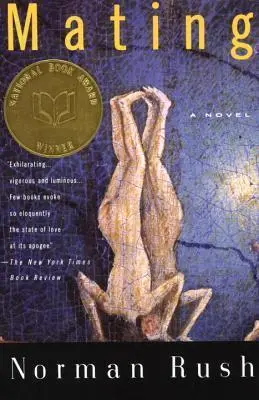
- Название:Mating
- Автор:
- Жанр:
- Год:неизвестен
- ISBN:нет данных
- Рейтинг книги:4 / 5. Голосов: 1
-
Избранное:Добавить в избранное
- Отзывы:
-
Ваша оценка:
Mating: краткое содержание, описание и аннотация
Предлагаем к чтению аннотацию, описание, краткое содержание или предисловие (зависит от того, что написал сам автор книги «Mating»). Если вы не нашли необходимую информацию о книге — напишите в комментариях, мы постараемся отыскать её.
Mating — читать онлайн бесплатно полную книгу (весь текст) целиком
Ниже представлен текст книги, разбитый по страницам. Система сохранения места последней прочитанной страницы, позволяет с удобством читать онлайн бесплатно книгу «Mating», без необходимости каждый раз заново искать на чём Вы остановились. Поставьте закладку, и сможете в любой момент перейти на страницу, на которой закончили чтение.
Интервал:
Закладка:
The Mother Committee
Three women arrived. These are of the mother committee, Mma Isang said.
Breakfast would be al fresco, I had already observed, at a table under the cloud tree.
I wondered if everyone in Tsau was always beautifully dressed. I already knew that no one, children included, went barefoot. People wore sandals or moccasins. If they went out into the bush they were supposed to strap on leather leggings, like shin guards, as protection against snakes, but these were unpopular. There was a definite municipal costume. It was modular. People wore either a long sack dress, sleeveless, belted or unbelted, or a tunic and shorter-skirt combination. There was another type of skirt, much fuller and with complexly arranged buttoning panels that would supposedly permit the skirt to be fastened back into pantaloons, which only a few women wore any longer. It had been an experiment. Everything was made from the same material, a tan muslin. But here uniformity ended. Garments were individualistically decorated, either dyed in different solid or combined colors, or printed with motifs like eyes, crosses, stars, ankhs, letters of the alphabet — some quite majuscule. The printing, some dense and some sparse, was done with dies cut from different local tubers. There was some not overambitious embroidery around neckholes and armholes. Headscarves were universal but entirely individual as to color and tie-style. Headscarf art at Tsau would make a coffeetable book. Plain modes were the norm, but there were always triumphs of excess turning up: anything went, and stuffings were sometimes used to create truly startling ridged and tiara effects. When jewelry was worn it was usually glass, what else? or the Basarwa ostrich-eggshell-chip bracelets and chokers that are staple trade goods all over the Kalahari. I felt quite drab and masculine as we went to the table.
Mma Isang muttered a Setswana phrase to me that translates as We are walking on our toenails. This equates to our Walking on eggs.
There were two women in Mma Isang’s age range and one, Dineo, in her forties. Introductions were in Setswana. It was formal. I sat down with the delegation. There were only four chairs, regular European straight chairs, so Mma Isang went to get a chair for herself, placing it at a little distance from the setting around the table. We served ourselves tea. In English Mma Isang again said I should be patient because these sisters were bringing our breakfast behind them, which was meaningless to me until a young boy appeared propelling a vermilion cart into the yard. He was in the standard schoolboy kit of khaki shorts and short-sleeved shirt and appeared to be in a hurry to finish with us and get somewhere else. He was cutely officious, expertly prying the fitted lid off a sheet metal chest, inside which was straw, beneath which was another box, containing our breakfast of scones, socalled, and hardboiled eggs. It was done like lightning. The boy was given a token. He shot away. Everything was hot. We ate off cloth serviettes.
You must eat so many eggs as you please, Mma Isang said, again in English, for which she drew a reproving gesture from Dineo. I gathered that it would be Dineo who would determine when English would be spoken at this interview.
Dineo was clearly primus inter pares here. She was sinewy. Men would find her sexually interesting, I thought. She was tall for a Tswana, true black, Nilotic, with what the Batswana call long eyes. She had a hard, narrow face. Her dress, slit to the knee on one side, was printed with bands of tiny black crosses, black on tan, which gave a faintly sacerdotal air to her presence. She had presence. She was wearing an amber headscarf draped like the one the Sphinx wears. There was a trick, possibly starch, to the way the delta panels of the scarf stayed spread at the sides of her neck. This was her signature headdress. I only saw it varied a few times. She had force. I liked it that white though I am, she was looking me straight in the eye, unlike her companions, who were doing the more typical side-glancing and down-glancing as they absorbed themselves in studious tea drinking or egg peeling. Something in her expression reminded me how stern Batswana women can be about malingering, and I readjusted my plan to look more done in than I actually felt. I felt myself involuntarily wanting to appease her.
The other two were subalterns. I came to think of them as the twins and then learned that other people used that term for them. These two women were fairly inseparable. One, called Dimakatso, had a ruined, white left eye. Joyce’s hands were badly gnarled by arthritis. Dimakatso peeled Joyce’s egg for her. Joyce was only a nominal participant. But I had the feeling that Dimakatso was listening keenly the whole time, and this was confirmed when at the end she took out a ballpoint pen and made some sort of notations on the flesh of the palm of her hand.
Mma Isang brought out oranges, honey, and paring knives. Dineo had some preliminary things to say to me in English about speaking English. I must not be misled to think that no one in Tsau could speak English save for very few women and Rra Puleng. But I must well understand, because there were some sisters still who could not speak English, that it was decided for all time to never have meetings conducted in English as they were at district council and parliament, where even should women attend it could never be told by them what was happening. That was an injustice I would never find in Tsau. At all events we must now speak in Setswana and later in English again.
The questioning was polite but acute, led by Dineo. There was interest in how I had learned to speak Setswana so well. I gave them a truthful Botswana curriculum vitae except that I substituted ornithology for anthropology. I especially disliked doing this to Mma Isang. I invented a Kalahari itinerary that would have taken me ultimately in a long curve to Lake Ngami — a place that is in fact a wellknown ornithological three-ring circus. They could well understand how I had come to grief on such a long expedition undertaken alone. Here I had to improvise about a companion who had been unable to join me at the last moment. Going alone into the desert was something for Bushmen, and my questioners weren’t satisfied until I was more demonstrative about how foolhardy I had been to proceed with it. Then Dineo pressed me rather hard around my assertion that Tsau was a surprise to me, that I had never heard of it. She slipped into English. How was it that I hadn’t heard any stories or whispers about what the people of Tsau were doing, making a city in which no one was poor, which no Europeans could yet say they had done in their own countries? Had I not heard whisperings of Rra Puleng, a man famous among Europeans, being at Tsau? I was steadfast in my claims of ignorance and finally she let up.
The coda was in English. Unfortunately Tsau was not yet ready to receive visitors of any kind except in cases of distressful accident such as mine, so that unfortunately the mother committee and Rra Puleng himself must tell me I must go away when that could be arranged and I was fully able for going. Unfortunately Rra Puleng was the strictest of them all as to this. Tsau was like a tree not yet ready to drop its fruits. No visitors could come except helpers like doctors at times. When Tsau was ready to drop its fruits, as many visitors would be free to come as would be pleased to. As for herself, she welcomed me as a sister, and she would be very pleased to have me stay too long with them and not rush away to be only with birds to discuss with.
I was asked what I wanted and if I was in eagerness to return elsewhere.
I said I had never been in a place I wanted to see more than I did Tsau and that I regarded everyone there as a sister or mother to me. I wanted to stay for as long as it could be allowed. I said that the birds would be waiting for me at Lake Ngami in any case at whatever time I got there. We were all nodding in accord.
Читать дальшеИнтервал:
Закладка:
Похожие книги на «Mating»
Представляем Вашему вниманию похожие книги на «Mating» списком для выбора. Мы отобрали схожую по названию и смыслу литературу в надежде предоставить читателям больше вариантов отыскать новые, интересные, ещё непрочитанные произведения.






Обсуждение, отзывы о книге «Mating» и просто собственные мнения читателей. Оставьте ваши комментарии, напишите, что Вы думаете о произведении, его смысле или главных героях. Укажите что конкретно понравилось, а что нет, и почему Вы так считаете.