Joseph O'Neill - Blood-Dark Track
Здесь есть возможность читать онлайн «Joseph O'Neill - Blood-Dark Track» — ознакомительный отрывок электронной книги совершенно бесплатно, а после прочтения отрывка купить полную версию. В некоторых случаях можно слушать аудио, скачать через торрент в формате fb2 и присутствует краткое содержание. Год выпуска: 2010, ISBN: 2010, Издательство: Knopf Doubleday Publishing Group, Жанр: Современная проза, на английском языке. Описание произведения, (предисловие) а так же отзывы посетителей доступны на портале библиотеки ЛибКат.
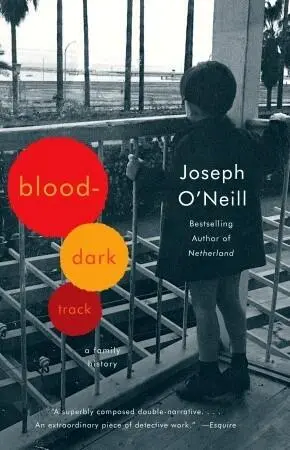
- Название:Blood-Dark Track
- Автор:
- Издательство:Knopf Doubleday Publishing Group
- Жанр:
- Год:2010
- ISBN:978-0-307-74265-0
- Рейтинг книги:4 / 5. Голосов: 1
-
Избранное:Добавить в избранное
- Отзывы:
-
Ваша оценка:
Blood-Dark Track: краткое содержание, описание и аннотация
Предлагаем к чтению аннотацию, описание, краткое содержание или предисловие (зависит от того, что написал сам автор книги «Blood-Dark Track»). Если вы не нашли необходимую информацию о книге — напишите в комментариях, мы постараемся отыскать её.
, a fascinating, personal, and beautifully crafted family history.
Joseph O'Neill's grandfathers-one Turkish, one Irish-were both imprisoned for suspected subversion during the Second World War. The Irish grandfather, a handsome rogue from a family of small farmers, was an active member of the IRA. O'Neill's other grandfather, a debonair hotelier from the tiny and threatened Turkish Christian minority, was interned by the British in Palestine on suspicion of being an Axis spy.
With intellect, compassion, and grace, O'Neill sets the stories of these individuals against the history of the last century's most inhuman events.
Blood-Dark Track — читать онлайн ознакомительный отрывок
Ниже представлен текст книги, разбитый по страницам. Система сохранения места последней прочитанной страницы, позволяет с удобством читать онлайн бесплатно книгу «Blood-Dark Track», без необходимости каждый раз заново искать на чём Вы остановились. Поставьте закладку, и сможете в любой момент перейти на страницу, на которой закончили чтение.
Интервал:
Закладка:
Patrick told me that his grandfather Henry Rickards, a general’s son, arrived in Mersin in the 1880s and invested his gold in the Mersin — Adana railway. Henry married Maryam, a sixteen-year-old Syrian from a humble family of builders who was girlish enough to attend school on the morning of her wedding. Horrified by a union that was inappropriate in every respect, the Rickards family cut off Henry. Even so, he managed to live comfortably on the income from his investments and to educate his four children in France and England. Henry Rickards died from pneumonia in 1939. ‘He wasn’t the sort of person I would like,’ Patrick Grigsby said. ‘He was a disciplinarian and a very strong Presbyterian — very English, very much the product of the Empire.’
From what I was told by Patrick Grigsby and others I spoke to, it was clear that, like his father Henry, William Rickards was a difficult, inflexible, eccentric man. Every morning he went for a constitutional walk with a Panama hat on his head and an English newspaper under his arm, striding without acknowledgement past acquaintances he came across. The walk was followed by a cold shower and a fruit juice. Lunch, taken at noon on the dot, was followed by a sieste , for which he would don blue pyjamas. Then he would have another cold shower and present himself at the dinner table to be fed by the women of the family. He never did anything for himself; domestic work was for women, whom he regarded as mindless, chattering cretins. At 9 p.m. — no later — he would go to bed. He adhered strictly to this routine. Like his father Henry, William disliked work and lived off the proceeds of family properties. He was an intensely self-absorbed man who embraced with great seriousness a succession of belief systems: he joined the Fabian Society and the Freemason Brotherhood (he was the grand master of the Nicosia Lodge), and finally he was drawn to the mystical and contemplative practices of Mevlana, with their emphasis on tolerance, simplicity, love and charity. Perhaps this accounted for William’s frugality — when he died, his worldly possessions amounted to a chamber-pot, a safe with some money, a cupboard, and a bed — and for his philanthropy: he paid for the education of nephews, nieces, and poor Turkish children. Otherwise, he had difficulty in translating his spiritual principles into action. William Rickards’ unfeeling and anguished disposition was perhaps rooted in his experiences of the Great War. He served as a volunteer at Ypres and Passchendaele, in Belgium, from 1914 to 1918. ‘It must have affected him all his life,’ Patrick Grigsby said.
Patrick did not know that his uncle had been a British informer during the Second World War or, for that matter, that he’d held the Lloyd’s agency in Mersin. He knew of Arthur Maltass, though, and remembered him clearly. ‘Maltass was a likeable individual. He dressed immaculately, like the actor Edward Everett Horton, who played diplomats and butlers. His dinner table, I remember, would be laid with flowers. He was fantastical about his background and went to great lengths to impress. He would say that his parents were titled and living in England with servants and stately homes. I remember he told a story about his father asking the butler about the absence of cruet at the table. “Can you see anything missing, Roberts?” “No, sir,” Roberts said. “Well, get a ladder.” Roberts got a ladder. “Now, climb the ladder and have another look”.’
Patrick remembered Desmond Doran, too, as a tall, sandy-haired, handsome man. It was news to Patrick that his aunt Olga Catton had been Doran’s lover, but he wasn’t surprised, because Olga loved the company of men and had led a notoriously tangled amorous career. Wherever she went, it seemed, she got into a passionate, ill-starred romance. After nursing college in Whitechapel, London, she was employed in 1933 as a nurse-companion to a girl who’d been paralysed in a riding accident. The girl’s family were landed gentry and Olga, by her own account, mixed in grand circles, received a proposal from the Duke of Bedford, and fell in love with the son of the house, who later died in the North African desert. It was during this time in England that Olga looked into her origins and learned that the Rickards family had a coat of arms — a tower with, appropriately enough, a Saracen’s head. But when she visited the Rickards’ London home, her aunts refused to acknowledge the existence of their brother Henry or the kinship of this woman with a strange accent. Olga was turned away at the door.
By the time she returned to Turkey in 1939, Olga Rickards had acquired a taste for the grand life and a streak of snobbery and racism that led her to look down on Turks and Jews (‘I hate Jews,’ she’d hiss) and Arabs, her mother’s people. She had a disastrously short-lived marriage with John Catton, Britain’s Honorary Consul in Mersin, bore a daughter, and had her affaire with Doran. After her wartime service commanding a women’s internment camp, Olga took a job as the matron of an English boarding school for girls — Tolmers, near St Albans — so that her daughter might be educated there. In 1958, Olga arranged for my mother, who was then eighteen, to spend some months at Tolmers. ‘I taught French conversation and took A-level courses in English and History,’ my mother said. ‘I used to watch TV with Olga in the evenings. She was always nice to me.’ My mother added, ‘She was a single mother. She always had to fend for herself and daughter.’
My mother did not mention that Olga was a terrible gambler and — Patrick’s phrase — ‘an exceedingly lavish person’. In the ’sixties, when she returned to Mersin, Olga would take a carriage to the Club every evening, not leaving until three in the morning. She lived with a maid in a modest apartment and kept a photograph of the Queen of England on her sideboard. Olga retired to England in the early ’eighties and moved into a residence for the elderly in Bedford: she didn’t want to die in a Muslim country, she said. At the time, I was a student in Cambridge, which is not far from Bedford, and my mother urged me to visit Olga: ‘It would give her such pleasure, Joseph, you must go.’ But I never got round to it, even though the journey would have been easily made and Olga, trapped in her unapproachable homeland, would have been thrilled to see me. She surfaced a final time before she died: my parents and I were in the car in The Hague one Sunday morning when the BBC World Service played a request by Olga Catton for O Silver Moon . Aunt Olga died not long afterwards. Her last wish was for her ashes to be returned to Mersin.
Olga’s passing represented another unravelling of the Levant, a realm, as was implied by its very name — from the French for the rising sun — that was a creature of the occidental mind. In its narrowest sense, the Levant designated the eastern littoral of the Mediterranean; but the term was also applied to places (typically, ports and trading centres) that, although remote from the littoral, shared its distinctive ethnic, religious and linguistic diversity and flavour. Cities like Salonika and Alexandria and Adrianople could be considered to be in the Levant, as could Istanbul. The British diplomat Sir Charles Eliot wrote of the Ottoman capital in 1907:
Nothing, perhaps, gives one a better idea of its inhabitants than what is styled an Almanach à l’usage du Levant . Every leaf which is daily torn off […] bears inscriptions in six languages: Turkish, French, Bulgarian, Greek, Armenian, and Spanish in Hebrew letters. It records the flight of time according to five systems […]. Nay more, the Almanach extends the same large impartiality to all religions. It registers the disagreeable ends of Greek, Bulgarian, and Armenian martyrs, and bids the believer rejoice, according to his particular convictions, over the Immaculate Conception of the Blessed Virgin, the Prophet’s journey to heaven on a winged steed, and the dedication of the Temple of Jerusalem — all these exhilarating events being commemorated on the same date. Besides this, it informs us that the day in question is the thirtieth after Kassim, that twelve o’clock Turkish, or sunset is at 4.30 à la franca, and that midday is 7.23 Turkish […]. The little Levant almanack does, it is true, give a certain pre-eminence to Mohammed and his celestial tour; he sprawls over the middle in triumphant Arabic flourishes, crowding the Bulgarian and Armenian martyrs into corners, and casting vowel points and spots parlously near the Immaculate Conception. But though recognizing the predominance of Islam, it addresses a public which has no one language, religion or code of institutions.
Читать дальшеИнтервал:
Закладка:
Похожие книги на «Blood-Dark Track»
Представляем Вашему вниманию похожие книги на «Blood-Dark Track» списком для выбора. Мы отобрали схожую по названию и смыслу литературу в надежде предоставить читателям больше вариантов отыскать новые, интересные, ещё непрочитанные произведения.



Обсуждение, отзывы о книге «Blood-Dark Track» и просто собственные мнения читателей. Оставьте ваши комментарии, напишите, что Вы думаете о произведении, его смысле или главных героях. Укажите что конкретно понравилось, а что нет, и почему Вы так считаете.