Paul Theroux - Hotel Honolulu
Здесь есть возможность читать онлайн «Paul Theroux - Hotel Honolulu» весь текст электронной книги совершенно бесплатно (целиком полную версию без сокращений). В некоторых случаях можно слушать аудио, скачать через торрент в формате fb2 и присутствует краткое содержание. Год выпуска: 2002, Издательство: Mariner Books, Жанр: Современная проза, на английском языке. Описание произведения, (предисловие) а так же отзывы посетителей доступны на портале библиотеки ЛибКат.
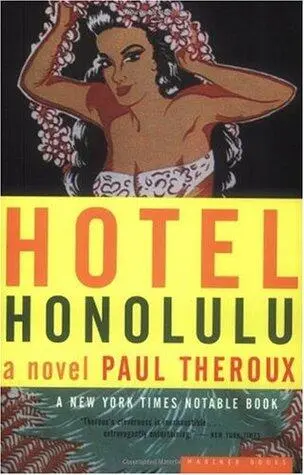
- Название:Hotel Honolulu
- Автор:
- Издательство:Mariner Books
- Жанр:
- Год:2002
- ISBN:нет данных
- Рейтинг книги:4 / 5. Голосов: 1
-
Избранное:Добавить в избранное
- Отзывы:
-
Ваша оценка:
Hotel Honolulu: краткое содержание, описание и аннотация
Предлагаем к чтению аннотацию, описание, краткое содержание или предисловие (зависит от того, что написал сам автор книги «Hotel Honolulu»). Если вы не нашли необходимую информацию о книге — напишите в комментариях, мы постараемся отыскать её.
Hotel Honolulu — читать онлайн бесплатно полную книгу (весь текст) целиком
Ниже представлен текст книги, разбитый по страницам. Система сохранения места последней прочитанной страницы, позволяет с удобством читать онлайн бесплатно книгу «Hotel Honolulu», без необходимости каждый раз заново искать на чём Вы остановились. Поставьте закладку, и сможете в любой момент перейти на страницу, на которой закончили чтение.
Интервал:
Закладка:
There was no point in letting a harmless expression like "tiny little details" bother you, and yet it did bother Alex. He made the mistake of mentioning it to Becky that evening in the stifling apartment in Kaimuki, and she turned on him.
"You're never satisfied! Here he is, designing a chair for your own butt, and you criticize the way he talks."
She was angry because he had also mentioned the architect's harping on "home" and repeating "very unique." Under this onslaught Alex was embarrassed ever to have thought of himself as a hunter-gatherer.
Not long after that, he was in Los Angeles and eager for news of the house, which was nearly finished. He called Becky. She surprised him by saying, in a telephone voice she kept for strangers, "Yes, what is it?"
He had heard her say that into a phone to telemarketers.
"It's me," Alex said, hoping that she was speaking this way because the line was bad.
"I know it's you."
Then he knew something was wrong.
"What is it?" he said. "Is Kristen smoking again?"
Becky said, "We have to talk," and hung up.
The headwinds that impede a plane flying from Los Angeles to Honolulu most winter days can add as much as an hour to the normal five- hour flight. That happened the morning in January Alex Holt flew home, knowing that something was seriously wrong but not sure what. He was heartsick. Becky met him at the gate at Honolulu Airport among the people offering leis and shouting in glee and carrying signs saying Paradise Tours Meeting Point, or uniformed drivers with placards reading Dr. Kawabata or Mr. Dickstein. And when he greeted her, he found himself too weepy and inarticulate to speak. Becky hurried on ahead while Alex found a skycap to help him with his bag. Driving from the airport down the H-1 Freeway, she glanced at him in the passenger seat, saw his tears, and said, "Listen carefully. I have something to tell you. I've been seeing Ray." Ray, of course, was the architect, whom Alex had never thought of as having a
name you needed to know, any more than the skycap who had jogged his bag on the luggage cart.
"Seeing Ray" was supposed to mean everything. In the silence that followed Becky's saying this, Alex imagined some of the implications.
Seeing the man naked was mainly what he imagined. Seeing him laugh, seeing him talk, seeing him make promises, not seeing anyone else.
At the Kaimuki apartment, also in silence, he said, "Where's Kristen?"
"She's staying with friends. She doesn't want to see you."
The apartment seemed more spacious, but that was because it had been emptied of most of the furniture.
Becky said, "I've moved my things."
"Where to?"
She seemed genuinely amused. "Where to!"
"Kahala?" He saw the house in his mind as Becky began to leave. He said, "You said we needed to talk."
"We just talked." Again she turned to go.
Alex said in a pleading voice, "Can't we talk about our marriage?"
"Don't do that to me," Becky said. "You're trying to bring me down."
"What was wrong?" Alex was in tears again.
"It doesn't matter," she said. "I've already processed it."
"Processed" was one of his words — had to be.
Becky filed for divorce. She asked for child support. Kristen stayed with her. "She needs a stable home." They were by then living in the house in Kahala, and Alex suspected but could not prove that the child support was going toward the mortgage. Alex challenged her on this, lawyers were hired, a suit filed, and in her deposition Becky said that Alex had been neglectful, constantly away on the mainland, and verbally abusive. She said that she suspected him of child abuse, "inappropriate touching and fondling" and spending much more time than was normal with her teenage daughter.
"She hit me with a pretty good lawsuit," Alex told me.
Without money for a lawyer to contest her claims, Alex dropped the suit. At that point he checked into the Hotel Honolulu and, after telling me his story, got very depressed. "Kind of suicidal, but it wore off." Then, some months later, he heard that Becky, calling it "tough love," had thrown Kristen out of the house for smoking pakalolo, and that Kristen was living with her Samoan boyfriend somewhere in Nanakuli. Alex said he was sorry about it, but "I pretty much try not to let it bother me."
I said, "I want to know a bit more about Kristen."
But he wouldn't tell me more. He said that talking about this whole thing, and especially about her, had only made him feel kind of worse.
48 The Happiest Man in Hawaii
Once, after an excellent bottle of wine in the hotel, Royce Lionberg fixed his lawyer's lie-detector eyes on me and said, "I know you're going to write about me." I had first met him at the "service" for Buddy's wife Stella, the happy funeral. Apart from Leon Edel, he was the only person in Hawaii I had met who had read my books. He expressed genuine shock that I now managed a hotel. The statement about using him in my writing was intended to take me by surprise. I told him what was in my heart, "Never," and he believed me.
I did not tell him the reason I said it. I would not have attempted to deceive him. He lived on the North Shore, up the hill from Buddy, a mansion on a cliff. He visited the hotel once or twice a month and indulged himself in a Buddy Burger (Peewee spiked the ground beef with vermouth) and a bottle of Merlot. He had retired early because of his brilliant instincts and his sense of timing. He was a man without any regrets. He also used to say, "People come into my house and think, What can he do for me? What can I get out of him?" He smiled when he said it, knowing that he was way ahead of these people.
But I wanted nothing from him — that was why we became friends. I said "never" because he was impossible to write about, though I could not explain this without offending him.
I could have told him, as I had once tried to tell Sweetie about Stephen King, that it takes only a modest talent to write about misery — and misery is a more congenial subject than happiness. Most of us have known some suffering and can understand and respond by filling in the gaps. But great happiness is almost incomprehensible, and conveying it in print requires genius. The thankless result for such luminous prose is a character so happy he can seem undeserving, like those skillful boardroom portraits of smug company presidents that make you want to spew. Gloom finds kindred spirits, but write about pleasure and readers feel mocked and excluded. Happiness is almost repellent in black and white — even in life: apart from Buddy, Lionberg had few close friends. He was the happiest man I had ever met.
Craving anonymity, Lionberg gave his mansion a street number but no name. He lived alone, on the highest part of the bluff, facing west over Sharks Cove. A dense, blossomy hibiscus hedge around his property camouflaged a thick steel fence and security cameras. Visitors to the North Shore sometimes detoured to look at the high gates, but not because of Lionberg. He was a recluse, whose justified paranoia was summed up in his attributed question "What can he do for me?" A rumor that Elvis had lived briefly in Lionberg's mansion in 1968, when he was here making Blue Hawaii, brought out the gawkers.
"If I had known about that Elvis connection, I wouldn't have bought the place," Lionberg said.
Yet he was so happy that he hardly left the property. At first I had taken Lionberg to be one of those Hawaiian millionaires who was secretly snooty, always measuring himself against his competitors. His dismissiveness about Elvis seemed like the proof. A rich recluse is usually someone who craves the right company, an intensely social but fussy snob. But after I got to know him better I understood that when Lionberg said he wanted to be left alone, and not written about, he meant it.
Читать дальшеИнтервал:
Закладка:
Похожие книги на «Hotel Honolulu»
Представляем Вашему вниманию похожие книги на «Hotel Honolulu» списком для выбора. Мы отобрали схожую по названию и смыслу литературу в надежде предоставить читателям больше вариантов отыскать новые, интересные, ещё непрочитанные произведения.









Обсуждение, отзывы о книге «Hotel Honolulu» и просто собственные мнения читателей. Оставьте ваши комментарии, напишите, что Вы думаете о произведении, его смысле или главных героях. Укажите что конкретно понравилось, а что нет, и почему Вы так считаете.