Karen Russell - Swamplandia!
Здесь есть возможность читать онлайн «Karen Russell - Swamplandia!» весь текст электронной книги совершенно бесплатно (целиком полную версию без сокращений). В некоторых случаях можно слушать аудио, скачать через торрент в формате fb2 и присутствует краткое содержание. Год выпуска: 2011, Издательство: Knopf, Жанр: Современная проза, на английском языке. Описание произведения, (предисловие) а так же отзывы посетителей доступны на портале библиотеки ЛибКат.
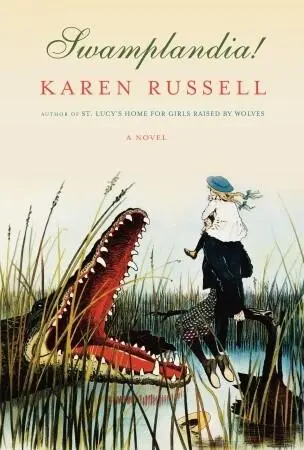
- Название:Swamplandia!
- Автор:
- Издательство:Knopf
- Жанр:
- Год:2011
- ISBN:нет данных
- Рейтинг книги:4 / 5. Голосов: 1
-
Избранное:Добавить в избранное
- Отзывы:
-
Ваша оценка:
Swamplandia!: краткое содержание, описание и аннотация
Предлагаем к чтению аннотацию, описание, краткое содержание или предисловие (зависит от того, что написал сам автор книги «Swamplandia!»). Если вы не нашли необходимую информацию о книге — напишите в комментариях, мы постараемся отыскать её.
Ava, a resourceful but terrified twelve year old, must manage seventy gators and the vast, inscrutable landscape of her own grief. Her mother, Swamplandia!’s legendary headliner, has just died; her sister is having an affair with a ghost called the Dredgeman; her brother has secretly defected to the World of Darkness in a last-ditch effort to keep their sinking family afloat; and her father, Chief Bigtree, is AWOL. To save her family, Ava must journey on her own to a perilous part of the swamp called the Underworld, a harrowing odyssey from which she emerges a true heroine.
Swamplandia! — читать онлайн бесплатно полную книгу (весь текст) целиком
Ниже представлен текст книги, разбитый по страницам. Система сохранения места последней прочитанной страницы, позволяет с удобством читать онлайн бесплатно книгу «Swamplandia!», без необходимости каждый раз заново искать на чём Вы остановились. Поставьте закладку, и сможете в любой момент перейти на страницу, на которой закончили чтение.
Интервал:
Закладка:
Elated, wanting never to leave, he signed another contract, this time to dredge a canal clear across the swamp to the Gulf Coast for the Model Land Company. They were going to drain the swamp and develop and sell it, and they needed a team of skilled muck rats to do it.
But nobody had explained to Louis just how deep into the swamp they would have to go now, and how quickly their bosses at the Model Land headquarters in St. Augustine, Florida, would expect the crew to drain the floodplains with a single bucket arm — a Herculean task for any machine, especially for the ancient and fumey Model Land dredge, which made the government vessel look like some futuristic spaceship by comparison.
The dredge was there to dynamite the marl, spud down into the blasted muck, and spud up with a bucket of oozing crust. And this task in a swamp where you could sink a support platform through twenty-four feet of peat before hitting stabilizing rock.
And the crew had changed, too — none of the CCC boys had signed on with him. LaVerl was going back to his family’s horse farm in Savannah, and the lone Indian on the crew, Euphon Tigertail, who had survived subhuman conditions while working on the Panama Canal, decided that he couldn’t work in the swamp any longer. He’d been undone by minuscule foes, the chizzywinks, and the deer flies. “You sure you want to be a dredgeman for this outfit, Lou?” Euphon had whispered, both of them staring at the hulk of the dredge. Its digger arm was as tall as a house and sunk deep into a quagmire. A pair of enormous cast-steel feet gave the contraption a drunken, donkey-legged appearance. The stack slumped toward the saw-grass prairie, which looked like a drowned and shimmering field of wheat. For a second Louis thought of the distant Auschenbliss pastures and shuddered.
“You’d be better off gum tapping in the turpentine woods. It’s all soup doodly in those prairies, it ain’t like the pine rocklands. There’s nothing piney about it. No elevation, Lou. No lakes or trees or breaks. It’s just saw grass till you want to scream. You won’t have a dry day again for months. You’ll go in there and never come out.”
How could you make a mistake when you had one option? Louis felt that his hellish past exempted him from all regrets. But he was humbled by his friends’ defection — and a little shocked, hearing their complaints about the last months. Ultimately, Louis felt an almost romantic embarrassment, listening to the grizzled guys talk — it turned out that the same nights and routes that he recalled as heavenly had been, to the other CCC men, “godawful months, a nightmare” and “the valley of the shadow — only full of mosquitoes!” When the dredge anchor hit at Chokoloskee their whole CCC fraternity came loose like a knot, and he and Euphon and LaVerl all parted at the dock like strangers.
His first job on the dredge was described by the splinter-toothed captain as “involved”: he had to dive overboard with a knife clenched in his teeth and cut the slimy ropes of cattails away from the dredge’s wheel and shaft. “Removing detritus” was what the captain called this labor, which tasted like brine and sour blood. Dee-tree-tus. A name from a book, Louis T. figured as he removed the knife from his mouth and spit copper. He had split his lower lip. Five times his first day he’d had to jump overboard into that stinking gator marinade and hack at the weedy ropes.
“What do I do if there’s a gator?” Louis asked the first night at supper.
“You put that knife between the blamed scaly-back’s eyes, he’ll lay offa you. Or get the base of his neck, sever his spinal cord.” Ferguson, one of the cranemen, had gone gator hunting with some white glade crackers once and now claimed to be the crocodile expert.
“Don’tcha go for the eyes themselves, though. The crocs can retract those.”
He held up two gnarled fingers and jerked them back into his fist.
“Thanks for the advice,” said Louis. He imagined screaming underwater and the tiny needles of salt against his gums and eyeballs. Louis, curiously modest, refused to strip before diving. He jumped in with his pants and cotton underwear on and kicked beneath the dross of slimy marine plants. His legs floated like two planks behind him, every muscle tensed, ready to jerk away from an alligator’s teeth.
The dredge was there to dynamite the marl, spud down into the blasted muck, spud up with a bucket of oozing crust. And this task in a swamp where you could sink a support platform through twenty-four feet of peat before hitting stabilizing rock!
Louis T. wasn’t a particularly quick learner, but he was strong and docile and within one month he was doing all sorts of jobs on the dredge: trimming greenish fat off the pork in the cookhouse, helping the sweating firemen to keep up steam. The men looked like beekeepers in their cotton gloves and mosquito veils, their lungs filling with black mangrove smoke from the smudge fires they burned constantly to keep the insects away.
“Line up, boys! Take your medicine,” the cap said, pressing indigo flecks of charcoal and sulfur into Louis’s cupped hands. Every time you asked what they were for you got a different answer: ear infections, hay fever, styes, skin lesions. Gideon Tom said the pills were placebos, although Louis noticed that he still queued up to receive them like a good Catholic boy in line for communion.
“Ahhh,” Gideon said, extending his chaw-stained tongue.
“Stick out your palm, you jackass, I’m not your damn mother!” the cap howled. If the pills were making a difference, it was hard to imagine how bad you could go without them. Men held their fallen orangey scabs up to the sun and cataloged them like entomologists. Week 1: Men couldn’t sleep for the bug bites; scratching at them, and fending off new ones, was an eight-hour endeavor. The insects had been a chronic irritation on the CCC barge, but out here on the marshy open prairie they felt pestilential, their sawing sound filling the air like a cruel ventriloquy of the men’s own thirst. Their dense bodies put a fur on the steel hull of the Model Land dredge. More mosquitoes rose out of the cattails at dusk like tiny vampires. Theodore Glyde, the dredge’s dour engineer, grumbled that he was working back-to-back shifts on the dredge, quitting the deck at sundown to work a second job as a bug killer. Week 2: Everybody’s legs acquired the cracked sheen of cockroach wings. Louis, who had hosted much more colorful bruises back in Auschenbliss country, poured a little vial of alcohol over his shins and returned to work. Back on the CCC barge, they had never been more than twelve miles from a port with a doctor, but now they had entered an unmapped part of the swamp where wounds had the opportunity to fester. Week 3: Sores began to ooze. Of all the dredgemen, only Louis T. was indefatigably happy. He volunteered to haul water off-shift and shared his larded fried eggs with whomever.
“Louis, are you on a diet or what?” Gideon Tom grumbled; he was leaning against the starboard railing next to Louis, gobbling down a plate of Louis’s eggs with a guilt-racked expression. “You should eat, kid. It’s not good to share the way you do out here. What the heck are you always staring at?”
“The landscape.”
“The landscape!” Gid snorted. His broad nose wrinkled as it often did when someone said something he didn’t like, as if he were trying to sniff out what was wrong with their reply. “There’s something … something womanly about watching that, Lou.”
Louis grinned over at Gideon Tom, shrugged; even the other men’s ribbing made him happy. Daybreak, sunset: he liked to watch the red sun pour through the tiny doors of his mosquito screen until his blue eyes filled. Behind the screen he had the face of a man in church.
Читать дальшеИнтервал:
Закладка:
Похожие книги на «Swamplandia!»
Представляем Вашему вниманию похожие книги на «Swamplandia!» списком для выбора. Мы отобрали схожую по названию и смыслу литературу в надежде предоставить читателям больше вариантов отыскать новые, интересные, ещё непрочитанные произведения.



Обсуждение, отзывы о книге «Swamplandia!» и просто собственные мнения читателей. Оставьте ваши комментарии, напишите, что Вы думаете о произведении, его смысле или главных героях. Укажите что конкретно понравилось, а что нет, и почему Вы так считаете.