Karen Russell - Swamplandia!
Здесь есть возможность читать онлайн «Karen Russell - Swamplandia!» весь текст электронной книги совершенно бесплатно (целиком полную версию без сокращений). В некоторых случаях можно слушать аудио, скачать через торрент в формате fb2 и присутствует краткое содержание. Год выпуска: 2011, Издательство: Knopf, Жанр: Современная проза, на английском языке. Описание произведения, (предисловие) а так же отзывы посетителей доступны на портале библиотеки ЛибКат.
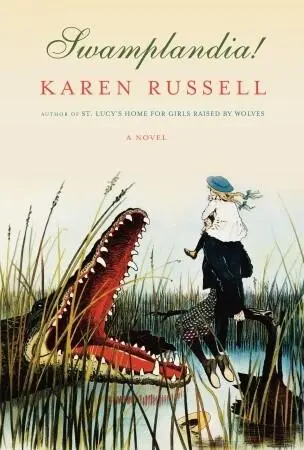
- Название:Swamplandia!
- Автор:
- Издательство:Knopf
- Жанр:
- Год:2011
- ISBN:нет данных
- Рейтинг книги:4 / 5. Голосов: 1
-
Избранное:Добавить в избранное
- Отзывы:
-
Ваша оценка:
Swamplandia!: краткое содержание, описание и аннотация
Предлагаем к чтению аннотацию, описание, краткое содержание или предисловие (зависит от того, что написал сам автор книги «Swamplandia!»). Если вы не нашли необходимую информацию о книге — напишите в комментариях, мы постараемся отыскать её.
Ava, a resourceful but terrified twelve year old, must manage seventy gators and the vast, inscrutable landscape of her own grief. Her mother, Swamplandia!’s legendary headliner, has just died; her sister is having an affair with a ghost called the Dredgeman; her brother has secretly defected to the World of Darkness in a last-ditch effort to keep their sinking family afloat; and her father, Chief Bigtree, is AWOL. To save her family, Ava must journey on her own to a perilous part of the swamp called the Underworld, a harrowing odyssey from which she emerges a true heroine.
Swamplandia! — читать онлайн бесплатно полную книгу (весь текст) целиком
Ниже представлен текст книги, разбитый по страницам. Система сохранения места последней прочитанной страницы, позволяет с удобством читать онлайн бесплатно книгу «Swamplandia!», без необходимости каждый раз заново искать на чём Вы остановились. Поставьте закладку, и сможете в любой момент перейти на страницу, на которой закончили чтение.
Интервал:
Закладка:
“Hey, Gid?” he asked his friend when they were baling wastewater later, the sun a pinhead of color behind the green trees. “Gid … are you anxious to get back?”
Warily his friend turned to him. “Get back where?”
And what Louis really meant was Anywhere . Back to land. Back to themselves, back to their names without jobs, back to any motionless, dirty place — or back to either of the twin poles that the swamp road they’d been digging was meant to connect. He had heard of hydrophobes, and he wondered if there was another word like that, for him. Or for what he was becoming. Terraphobia? It was a fear of the rooted, urban world, of cars and towns and years on calendars. He wouldn’t be the dredgeman there, that was for sure. Sometimes, at night, Louis thought in a dreamy way about becoming the dredge’s saboteur — plucking parts like flowers from the engine room. It was only a thought, and a crazy one; but the closer they got to the Gulf the sicker he felt. His sweats got worse when he pictured the dawn horizon solidifying — a sudden break in the mangroves that revealed the swallowing saltwater ocean, the big success for which the bosses of the Model Land Company had hired the dredge and her crew.
“Jesus, Louis, you’re just like what’s-his-name? Greek guy. Narcissus! Just making puppy eyes down at your face in that bucket.”
“Sorry. I was getting a little … homesick, I guess. So you’re excited for the end? For the Gulf side of things?”
“Fool, of course I am!” Gideon laughed, pouring the black water over the railing onto the head of a small and outraged alligator. “Am I excited for a paycheck and a woman and a bed? Am I excited to climb out of this soggy hell and get a pair of pants that’s not infested with forty kinds of insects, and get a pair of shoes where I can’t count my toes? Goddamn, Lou, I’ll be singing ‘Ave Marias’! I’ll be diving for land!”
Louis spent the morning of his death beating himself at hand after hand of solitaire with Gideon Tom’s faded deck. He was off-duty, and free to ruminate. He did not have any headaches that day or dark presentiments. At noon he felt a little hungry, ate some ibis jerky, considered rowing over to the houseboat to bathe. He lit sticks of dynamite and lobbed them into the marl, watched as the white-tailed deer shot off through the elevated hammocks. For every ten hours of work, the canal grew eighty feet longer; they were still months away from the Gulf and the end of their contract.
Louis T. was sitting on the starboard side of the dredge barge with his bare feet swinging, his calves hot against the metal rail, watching a pair of otters mock-dueling in the cattails. When next they appeared they were lovers, their bodies turning in a silly ballet, black volutes beneath the lily pads and the purple swamphens. He was maybe twenty-five feet from the engine room when a roar like a tidal wave rolled forward and nearly knocked him loose from the deck. He turned and watched flames engulf the roof of the engine room in one spectacular red spasm; within seconds a thick smoke swallowed the entire port side of the deck and shrouded acres of the sunlit saw-grass prairie to the southeast.
What Louis saw next came filtered redly through one slitted eye:
A stencil of a man — Ira, Louis thought sleepily, or maybe Jackson — went flailing off the fantail. Louis heard him hit his head on the way down; another man jumped in after him. To save him, Louis thought, proud to have finally made the connection. Foggily, it occurred to him that he should perhaps do a thing, too. This fog seemed to have penetrated his brain from the outer world, because the whole deck of the dredge was lost in a roar of escaping steam. The boiler head has burst , Louis thought, and felt his pulse jump. That’s what shook the deck. He pushed himself up and started to make his way toward the smoking engine room, where the other men were already hauling water.
Louis held a hand to his face and found it came away sticky. Blood was trickling out of one of his eyes and the other didn’t like to open. Suddenly he felt tired, a terribly heavy tiredness. I could fall asleep right here , he thought. His own square face surprised him in the water below the barge; he had at some point pitched forward on the railing. His reflection blinked up at him, as if the boy below was trying to remember how they knew each other. The otters, he noticed, had vanished.
“Gideon needs a hospital!” Hector screamed. “He’s killed, he’s killed!”
Apparently Hector had forgotten the usual chronology of death and medicine as it worked on the mainland, Louis thought grimly — if Gid was killed then it was late now for the hospital. It was almost impossible to push through the wall of steam, and when he finally located the door to the engine room Louis found the scalded body of Gideon Tom. Gid was lying on the floor with his right hand wrapped around his throat. Dead, Louis thought — the steam from the exploded boiler and the still-burning fire must have seared his eyes and lungs. But then as Louis watched the hand began to move , massaging Gid’s black skin. His eye opened like a blue crack of sky and his other hand pushed flat against the metal wall — and then, impossibly, he was standing up, staring abstractedly at Louis, half his face a sputtering blank. His mouth was moving but no words came. His jaw made convulsive chewing motions, and above this his right eye regarded the deck incuriously, full of a blue ancient calm. The Mariner , Louis thought — this line bubbled up to him from some long-forgotten event, a poetry recitation that the youngest Auschenbliss had given at a church assembly many winters ago. The bright-eyed Mariner …
Somehow Gid had gotten upright and was now lurching toward them, trying to retch up smoke. This is a bad miracle , Louis thought as he watched Gid trying to move. Go to him! — but Louis was frozen, staring. Gideon took a step toward Louis and then said, with a grievous eloquence, “I believe my lungs are all burnt up, Louie. I do believe …,” before crumpling.
“A hos-pee-tal! A—”
“Goddamn you, Heck, shut up,” Louis said with the first true viciousness of his life. “Hos-pee-tal” sounded like an imbecile’s taunt. What place could they take Gid to? There were no places here. That was the point of the crew’s continued presence, that’s what they’d all been hired by the Modern Land Company to accomplish: to turn this morass into a real place. The swamp was a waste and men had built the machines to fix it.
Something was happening down below. The whole deck had begun to vibrate. Elsewhere the other cranemen were racing around, hauling water to put out the small fires that had spread now to the houseboat. Flames licked at the bleached planks of the cook shack. The smell of burning metal stung Louis’s lungs, throat. Lights rocketed up in the deep swamp like a July fireworks show, and then every bulb burned out at once — the governor belt on the steam engine must have broken, Louis thought, letting the engine run wild and burning out all the lights. This would be an interesting problem come nighttime, assuming everybody calmed down sufficiently to make repairs. The cattails hushed around the dredge, shushing each other and brushing close to the ship like alien observers. That’s what Louis remembered, the purple sky and the grasses winding upward — the world felt as though it were a bubble curving in on itself.
“Pop, pop,” Louis mumbled. Trees stood wide-armed in the river. He felt as though his thoughts were drifting loose from him and popping on the skeletal branches. Something or someone came crashing down onto the work deck on the stern of the dredge and Louis didn’t turn to look. The blood on his hands had become the blood in his brown hair, he noticed, the blood on his neck, on his dungaree jacket. Hector came to tell him that the backing drum was reeling in its cable; Hector’s scream had dropped into his shoes and now he was staring at Louis with a goggle-eyed, just-awakened look. He pointed at the engine room, where two coal lumps — two feet, Louis realized, Gideon’s boots — were sticking out. His legs were limp, and the soles of his shoes flopped outward from the heel in a heart shape. From the waist down he looked like a man relaxing on deck.
Читать дальшеИнтервал:
Закладка:
Похожие книги на «Swamplandia!»
Представляем Вашему вниманию похожие книги на «Swamplandia!» списком для выбора. Мы отобрали схожую по названию и смыслу литературу в надежде предоставить читателям больше вариантов отыскать новые, интересные, ещё непрочитанные произведения.










Обсуждение, отзывы о книге «Swamplandia!» и просто собственные мнения читателей. Оставьте ваши комментарии, напишите, что Вы думаете о произведении, его смысле или главных героях. Укажите что конкретно понравилось, а что нет, и почему Вы так считаете.