Karen Russell - Swamplandia!
Здесь есть возможность читать онлайн «Karen Russell - Swamplandia!» весь текст электронной книги совершенно бесплатно (целиком полную версию без сокращений). В некоторых случаях можно слушать аудио, скачать через торрент в формате fb2 и присутствует краткое содержание. Год выпуска: 2011, Издательство: Knopf, Жанр: Современная проза, на английском языке. Описание произведения, (предисловие) а так же отзывы посетителей доступны на портале библиотеки ЛибКат.
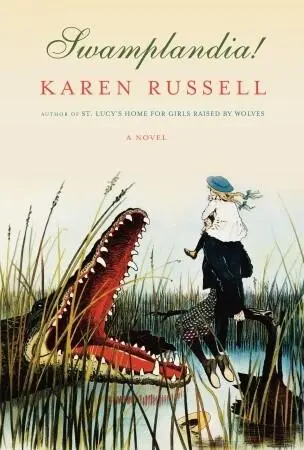
- Название:Swamplandia!
- Автор:
- Издательство:Knopf
- Жанр:
- Год:2011
- ISBN:нет данных
- Рейтинг книги:4 / 5. Голосов: 1
-
Избранное:Добавить в избранное
- Отзывы:
-
Ваша оценка:
Swamplandia!: краткое содержание, описание и аннотация
Предлагаем к чтению аннотацию, описание, краткое содержание или предисловие (зависит от того, что написал сам автор книги «Swamplandia!»). Если вы не нашли необходимую информацию о книге — напишите в комментариях, мы постараемся отыскать её.
Ava, a resourceful but terrified twelve year old, must manage seventy gators and the vast, inscrutable landscape of her own grief. Her mother, Swamplandia!’s legendary headliner, has just died; her sister is having an affair with a ghost called the Dredgeman; her brother has secretly defected to the World of Darkness in a last-ditch effort to keep their sinking family afloat; and her father, Chief Bigtree, is AWOL. To save her family, Ava must journey on her own to a perilous part of the swamp called the Underworld, a harrowing odyssey from which she emerges a true heroine.
Swamplandia! — читать онлайн бесплатно полную книгу (весь текст) целиком
Ниже представлен текст книги, разбитый по страницам. Система сохранения места последней прочитанной страницы, позволяет с удобством читать онлайн бесплатно книгу «Swamplandia!», без необходимости каждый раз заново искать на чём Вы остановились. Поставьте закладку, и сможете в любой момент перейти на страницу, на которой закончили чтение.
Интервал:
Закладка:
“Ava? That’s you, right? Don’t move. It’s okay. I’ll get candles.”
“Why not ask your boyfriend to do it?” I whispered, waiting to see if the café light would flicker on again. Louis Thanksgiving could be just outside the café windows. He could be inside this room with us, I shivered, riding out the storm. Ossie , I almost screamed, until it occurred to me that the ghost could also be inside of her.
Later, back in our bedroom, my sister unscrolled another, smaller map. She said she’d found it in the cuddy cabin on one of her dates.
“Look, Ava,” she whispered. “Louis says this is where the door to the underworld opens …”
“Na-uh.” I squinted at the map. “That’s the Eye of the Needle.”
I recognized the coordinates she was pointing to — we labeled this place on our own souvenir Swamplandia! maps and place mats. The Eye of the Needle was an Indian landmark. Grandpa Sawtooth had been fishing out there. Good red snapper hole.
“Of course it’s a real place, silly. But it’s also one of the thruways to the underworld. A gateway to the world of the ghosts.”
“The underworld? You mean, like, hell?” Just the word made my mouth go dry; I didn’t even like living this close to Loomis County. “Does the Chief know?”
The Eye of the Needle was a full day’s journey by airboat from our island — at least that, given how difficult it was to navigate the narrow mangrove tunnels between Swamplandia! and the Gulf-side shell mounds. Tourists certainly couldn’t get there, and we kids had never been. Grandpa Sawtooth took a photograph of the Eye of the Needle passageway during his rambles in the forties: a gray channel cut between two twenty-acre islands made entirely of shells. These islands looked like twin boulders to me, or like one island that lived next to its echo. Two intricate skulls rising out of the river. They are hundreds or maybe even thousands of years old — the Calusa Indians contructed the mounds out of clay and every kind of local shell: oysters and conchs and whelks. The Calusa Indians were well established in our swamp when Ponce de León arrived in 1513, and they probably hugged the shoreline of Florida for hundreds of years before the European contact; by the late 1700s their tribe had disappeared, undone by Spanish warfare and enslavement, and by microbes: smallpox and measles. The Calusa shell mounds, these seashell archipelagos, had outlasted their architects by at least five hundred years. You can find them scattered throughout the Ten Thousand Islands; visitors will drag their kayaks up a shell mound’s glittery shores and picnic there. On the Gulf side a 150-acre shell mound supports a modern township. But the Eye of the Needle was a special landmark, known only to locals, and very remote.
“The Chief doesn’t know a thing about this passage to the underworld,” said Ossie. “Nobody living does, except for me, and I only know because Louis told me on the Ouija board.”
“So how come Louis knows?”
“Uh, because he’s a ghost? It’s a doorway to the underworld , Ava. The whole dredge crew is there. It’s where Louis goes when he’s not with me — he crosses over.”
Ossie pronounced the word “underworld” with great authority, as if we were talking about Cincinnati or Peru.
I got excited then. “Have you been there, Os? To the, ah, the underworld?”
“Not yet.”
“So you don’t know what it’s like … down there?”
“Not really. Louis can’t describe it to me. Louis says it’s the kind of place you have to see to believe.”
“Okay.” I was thinking that we might find our mother in this place, and I was also thinking that my sister was officially nuts. “You’d think Grandpa Sawtooth would have mentioned something about all this, though.”
Ossie smoothed a wrinkle in the old map and met my gaze with clear, violet eyes.
“ Grandpa ? He’s a great wrestler but he’s no Spiritist. I’m sure he thought the Eye was just a pile of rocks. He didn’t have a clue what he was looking at.”
Weekend 3: The Chief is still gone.
Seths: Ninety-eight.
Sisters: Two.
Brothers: Zero.
Tourists: Zero.
Ghosts: One.
Park Hours:?
Mom:???
Gus Waddell came by late Saturday to see how we were doing.
“Most awesome, Uncle Gus,” I said from the kitchen table, not looking up. The mail crashed onto the dark sea of wood around me — I was coloring. Even I knew that I was years too old for this baby activity. Next I’d be playing dolls like some mainland girl. Using my gator noose as a jump rope. Well, somebody stop me , I frowned, snapping a blue crayon.
“Whatcha drawing there, Ava Bigtree? That sure is — huh.”
I had filled in a dozen sheets with single colors, our Bigtree tribal colors: Indian red and heron blue. The whole time I was coloring, I lived a second life in my head. I’d glance up at the kitchen clock every minute or so and think: Now is when our matinee should begin. Now is when the Chief flips on the blue lights. Gold, clap! Orange, clap! Red lights. Now here comes the song — ba-da-dum! Now Hilola Bigtree is climbing the ladder, waving at all the tiny cheering people; now she is running down the diving board; and here, ladies and gentlemen, she hits the water! …
Behind me, Uncle Gus coughed.
“I see you, ah, you like the color blue there.”
“Yup.”
Uncle Gus smelled like eggs and diesel and I wished that he would please go away. We had our food, our mail, we were all set . Uncle Gus seemed to want to pat my back, but perhaps couldn’t figure out how or where to touch a kid for sympathy purposes; his large hand hovered near my right ear, then dropped back to his side.
“You sure you’re all right? You know, I told your old man this already, but you girls are welcome to spend the night at our place, anytime. Mrs. Waddell would love to have you over.”
“Thanks. Maybe next week. We’re going good, Gus. I fed the Seths a few hours ago. Ossie is good, Judy Garland is good. It’s good here. Quiet.”
That morning I’d found a half-dead gator in our Pit. She looked like the drowned gators that wash up after storms, their blond tongues glittering with hundreds of decaying minnows. She was alive but I couldn’t tell what was wrong with her — disease was so infrequent among our alligators that scientists from the University of Florida came out once a year to take samples of their blood. I’d let her rest her leathery head against my shoulder while I touched the saffron plates of her neck. The Chief says it’s a terrible sign when a monster gives you this kind of access.
On Tuesday, it seemed that good news had come at last! Gus brought me another letter. This one came in an envelope with Loomis University’s orange-and-green seal on it.
Dear Ms. Bigtree:
Thank you for your inquiry. I have done some research on your behalf; unfortunately no such Commission or Committee or alligator-wrestling competition has ever existed. You might visit the Miccosukee Indian Reservation to watch a live alligator show.
Regards,
Amalia Curtis
Secretary to the President
University of Loomis
I tore up this letter within seconds of finishing it, put the bits of it into a plastic bag, and shook the bad news out over the Gator Pit. Later I caught some sunfish for the red Seth — she was eleven and three-quarter inches now, and very healthy-seeming, not sluggish or inappeteant or anything, a few more centimeters and maybe it would be safe to share her with Ossie and the Chief. Not tourists, though, I frowned; I really did not want strangers to see her yet, even though I knew that was the ultimate point of our training. I practiced with her for two hours. I had her to where she would walk this perfect debutante circle around my Swamplandia! ball cap. She would bite my finger with a precocious viciousness. We were going to get famous and save the park. My dream kicked painfully inside of me, and I was surprised to find how easy it was to go on working toward it as if I’d never heard from Mrs. Amalia Curtis.
Читать дальшеИнтервал:
Закладка:
Похожие книги на «Swamplandia!»
Представляем Вашему вниманию похожие книги на «Swamplandia!» списком для выбора. Мы отобрали схожую по названию и смыслу литературу в надежде предоставить читателям больше вариантов отыскать новые, интересные, ещё непрочитанные произведения.



Обсуждение, отзывы о книге «Swamplandia!» и просто собственные мнения читателей. Оставьте ваши комментарии, напишите, что Вы думаете о произведении, его смысле или главных героях. Укажите что конкретно понравилось, а что нет, и почему Вы так считаете.