Karen Russell - Swamplandia!
Здесь есть возможность читать онлайн «Karen Russell - Swamplandia!» весь текст электронной книги совершенно бесплатно (целиком полную версию без сокращений). В некоторых случаях можно слушать аудио, скачать через торрент в формате fb2 и присутствует краткое содержание. Год выпуска: 2011, Издательство: Knopf, Жанр: Современная проза, на английском языке. Описание произведения, (предисловие) а так же отзывы посетителей доступны на портале библиотеки ЛибКат.
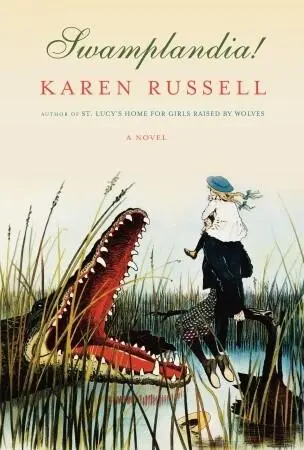
- Название:Swamplandia!
- Автор:
- Издательство:Knopf
- Жанр:
- Год:2011
- ISBN:нет данных
- Рейтинг книги:4 / 5. Голосов: 1
-
Избранное:Добавить в избранное
- Отзывы:
-
Ваша оценка:
Swamplandia!: краткое содержание, описание и аннотация
Предлагаем к чтению аннотацию, описание, краткое содержание или предисловие (зависит от того, что написал сам автор книги «Swamplandia!»). Если вы не нашли необходимую информацию о книге — напишите в комментариях, мы постараемся отыскать её.
Ava, a resourceful but terrified twelve year old, must manage seventy gators and the vast, inscrutable landscape of her own grief. Her mother, Swamplandia!’s legendary headliner, has just died; her sister is having an affair with a ghost called the Dredgeman; her brother has secretly defected to the World of Darkness in a last-ditch effort to keep their sinking family afloat; and her father, Chief Bigtree, is AWOL. To save her family, Ava must journey on her own to a perilous part of the swamp called the Underworld, a harrowing odyssey from which she emerges a true heroine.
Swamplandia! — читать онлайн бесплатно полную книгу (весь текст) целиком
Ниже представлен текст книги, разбитый по страницам. Система сохранения места последней прочитанной страницы, позволяет с удобством читать онлайн бесплатно книгу «Swamplandia!», без необходимости каждый раз заново искать на чём Вы остановились. Поставьте закладку, и сможете в любой момент перейти на страницу, на которой закончили чтение.
Интервал:
Закладка:
“Well, goddamnit, Louis, you don’t need to brag about it.” Gideon Thomas, the engine man, laughed. “Born dead — shit, son, everybody is!”
Of all the men on the dredge, Gid was probably Louis’s best friend, although it wasn’t exactly a symmetrical relationship, since Gid teased Louis without mercy and “borrowed” things from the kid that he couldn’t really return, like food.
“I’m not bragging,” Louis said, and he wasn’t bullshitting the crew, either. He was just repeating a fact that he’d heard from his adopted father—“born dead” was an epithet that he had used to needle Louis whenever he moved too quickly for the old man’s fists. And although the old man had boiled the boy’s birthday story down to two cruel words, they both happened to be true — Louis Thanksgiving had very nearly been a nobody.
At birth, his skull had looked like a little violin, cinched and silent. The doctor who had uncorked the baby from his dead mother in the chilly belly of the New York Foundling Hospital had begun shaking it to a despondent meter, thinking, Ah, what a truly rude awakening! Because this tiny baby — holding its breath, refusing to wiggle — was failing at the planet’s etiquette. He did not blink. He was resolute and blue in the doc’s blood-soaked arms.
“A stillborn,” the doc told a nurse. “And the woman’s dead, uterine rupture, terrible …” So this kid had missed it totally, then, his windy little interval between birth and death. His life. And the unwed mother, lying naked on a table in the Foundling Hospital, was now no one’s mother or daughter.
The doctor lit a Turkish cigarette and let out a little cry, a sadness that registered in decibels somewhere between a gambler’s sigh and the poor woman’s grief-mad wailing at the end of her labor — and then another cry joined the doctor’s. The stillborn’s blue face opened like a flower and he started crying even harder, unequivocally alive now, unabashedly breathing, making good progress toward becoming Louis. The baby’s face kept reddening by the second, and the doctor plucked the cigarette from his lips like a tar carnation. He would have liked to keep on smoking, and drinking, too, but babies — you could not just stand there and toast their voyage back to nothingness! Although. If the room had been emptied of witnesses, no nurses, no mother, just this baby’s squalling eyes, and your own …? Could you maybe then …? No , the better doctor inside the doctor insisted. We can’t do that . So the doc put on his self-prescribed green eyeglasses and massaged air into the baby’s chest with the flats of his hands; and when blood and air started to work in tandem and the midnight pigments in Louis’s bunched-sock face brightened to a yellowish pink, the doc stared down at the baby and said, “Well, pal, I think you made the right choice.” The mother’s cracked heels were by this time cooling to putty on the table.
Exhausted, the doctor left the birth certificate blank. L-O-U-I-S read the alphabeads that two nuns strung on a little black bracelet for the baby, because the doctor remembered or imagined he remembered that the dead mother had at one point whispered this American name to him. Louis’s mother was an immigrant from a country that Louis could not have pronounced or found on a map — and if Louis ever did hear its name when he was growing up, well, it could have been Oz or the moon to him, an imaginary place.
One of the Children’s Aid nuns at the New York Foundling Society came in to retrieve the newborn orphan. Louis lost his true past in a few squeaks of her nun shoes on the linoleum. Carrying him away, leaving that widening blank of a woman behind him, this wimpled stranger wound the clock of Louis’s life. The nun (who sometimes dreamed she was a man in advertising, writing copy for Hollywood movies) tucked a paper with a short description of his delivery into his blanket, thinking that this might help him to be adopted by a Christian family at the train station: MISLABELED STILLBORN MIRACLE BABY ALIVE PRAISE GOD FOR LOUIS, THANKSGIVING!
Somewhere down the line the nun’s purple comma got smudged and then Louis had a surname.
When he was three days old, Louis Thanksgiving was added to a group of eleven orphans, accompanied by one nun, one priest, and one mustachioed western agent who really did not care for children at all. He became one of those unfortunates who grew up in the Midwest, part of the human sediment deposited by the orphan train that ran from New York to Clarinda, Iowa; and while plenty of boys and girls found their way to loving adoptive families, such was not the case for Louis. The New York Foundling Society had placed a melodramatic advertisement in the newspapers of each of the towns along the railroad route, and dozens of farm families had gathered under a striped awning at the Clarinda station to size up the scabby knees from New York City. Louis was picked up at the station by Mr. Frederick K. Auschenbliss, a German dairy farmer who treated him worse than the livestock — at least the dairy cows got to stand still and swat flies; Louis was up to milk the cows at 2:30 a.m., spreading manure on the flat fields at sunup. Mr. Frederick K. Auschenbliss was not an affectionate father. Picture instead a slave driver who grew into the hard hiss of that name — a hog-necked man with a high Sunday collar, his eyes a colorless sizzle like grease in a pan, half his face erased by the dark barn. Louis was zero when he arrived at the Auschenblisses’ farm, sixteen when he escaped it — and even Death, judging by the gaps in Osceola’s story, had not yet afforded Louis T. enough time and distance to permit him to tell the story of those lost years.
Louis T., now grown into a bruised and illiterate young man, the brother to no one in that house of twelve, escaped the farm as soon as flight seemed possible. He rode the rails southward on a voyage that had the fitful logic of a sleep interrupted: suns set and suns rose. Forests dispersed into beaches and regrouped again in mountain passes. Lightning sent down its white spider legs outside the dining-car windows and crawled up the pine trunks, trailing fires. He hopped trains that crisscrossed the Midwest, touching golden millet fields and the black corners of the Atlantic before he finally pushed beyond the Florida Panhandle.
Florida, in those days, was a very odd place: a peninsula where the sky itself rode overland like a blue locomotive, clouds chuffing across marshes; where orange trees and orderly rows of vegetables gave way to deep woods and then, further south, broke into an endless acreage of ten-foot grass. This, finally, was the vision that reached Louis T. through the train window: a prairie that looked as vast as the African savanna. A strange weed or wild corn shifted restlessly in the afternoon winds —saw grass , said a fellow passenger beneath the slouch of his hat. That was the name for the long stalks that swallowed the WPA men up to the waists of their coveralls. Teams of lumbermen and government surveyors were working up and down the train rides, an eerie counterpoint to the dozens of herons and deer that Louis saw standing in the marshes. Then the dizzying height of the trees in the pinewoods, the thin millions of them extending as far as the eye could see. They were called slash pines for the cat-face scars left by the gum tappers — already thousands of acres had been tapped for turpentine. The slash pines reminded Louis of a stark daguerreotype he had once seen as a child of Lee’s emaciated Confederate forces.
These woods were deep but they were neither peaceful nor quiet — they were full of men. Axes swung and fell, a blue glinting on the edges of the woods, and Louis followed the blade handles to the stout arms and the square, heat-flattened faces of the Civilian Conservation Corps lumbermen. It was the Depression, and thirteen million job seekers were surging southward, westward, eastward and massing like locust clouds in the cities. But few of these money hunters had made it to the deep glade. From Louis’s window seat in the train, he saw just a smattering of humans. When the train had some mechanical problem outside the Crooked Lake National Forest, they cut the engine and the metal moaned to a full stop in the middle of a wrinkled wood. Out here you could hear the beginning of the wind, the hiss of the air plants and the crimson bromeliads. Oak toads chorused incessantly. If he could hear his own death in all that lively hubbub, he ignored it. Home, home, home , sang the rails, and the train lurched back to life.
Читать дальшеИнтервал:
Закладка:
Похожие книги на «Swamplandia!»
Представляем Вашему вниманию похожие книги на «Swamplandia!» списком для выбора. Мы отобрали схожую по названию и смыслу литературу в надежде предоставить читателям больше вариантов отыскать новые, интересные, ещё непрочитанные произведения.





Обсуждение, отзывы о книге «Swamplandia!» и просто собственные мнения читателей. Оставьте ваши комментарии, напишите, что Вы думаете о произведении, его смысле или главных героях. Укажите что конкретно понравилось, а что нет, и почему Вы так считаете.