Karen Russell - Swamplandia!
Здесь есть возможность читать онлайн «Karen Russell - Swamplandia!» весь текст электронной книги совершенно бесплатно (целиком полную версию без сокращений). В некоторых случаях можно слушать аудио, скачать через торрент в формате fb2 и присутствует краткое содержание. Год выпуска: 2011, Издательство: Knopf, Жанр: Современная проза, на английском языке. Описание произведения, (предисловие) а так же отзывы посетителей доступны на портале библиотеки ЛибКат.
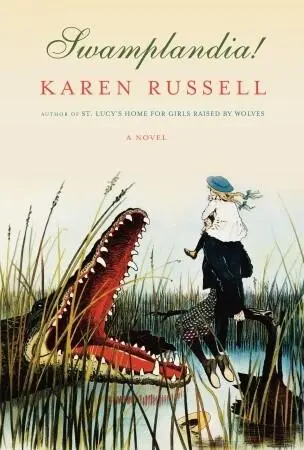
- Название:Swamplandia!
- Автор:
- Издательство:Knopf
- Жанр:
- Год:2011
- ISBN:нет данных
- Рейтинг книги:4 / 5. Голосов: 1
-
Избранное:Добавить в избранное
- Отзывы:
-
Ваша оценка:
Swamplandia!: краткое содержание, описание и аннотация
Предлагаем к чтению аннотацию, описание, краткое содержание или предисловие (зависит от того, что написал сам автор книги «Swamplandia!»). Если вы не нашли необходимую информацию о книге — напишите в комментариях, мы постараемся отыскать её.
Ava, a resourceful but terrified twelve year old, must manage seventy gators and the vast, inscrutable landscape of her own grief. Her mother, Swamplandia!’s legendary headliner, has just died; her sister is having an affair with a ghost called the Dredgeman; her brother has secretly defected to the World of Darkness in a last-ditch effort to keep their sinking family afloat; and her father, Chief Bigtree, is AWOL. To save her family, Ava must journey on her own to a perilous part of the swamp called the Underworld, a harrowing odyssey from which she emerges a true heroine.
Swamplandia! — читать онлайн бесплатно полную книгу (весь текст) целиком
Ниже представлен текст книги, разбитый по страницам. Система сохранения места последней прочитанной страницы, позволяет с удобством читать онлайн бесплатно книгу «Swamplandia!», без необходимости каждый раз заново искать на чём Вы остановились. Поставьте закладку, и сможете в любой момент перейти на страницу, на которой закончили чтение.
Интервал:
Закладка:
(Later, on the rooftop, Kiwi would try to gauge the weirdness of his encounter with the payroll manager by relaying it to Vijay: “I wish you had seen that jacket they make him wear … bro. He went to college! I saw his degree. Do you think he is embarrassed to be wearing that?”
“You think you know everything about everyone? Please. You don’t know shit about shit, Margaret. Maybe the payroll manager loves to dress up like in that jacket. Maybe that’s the reason he even went to college — maybe he, like, can’t wait to put it on in the morning. Maybe he sets a fucking alarm , bro …”)
“There’s been some mistake here.” Kiwi smoothed the check on Scott’s desk; according to the computer-generated invoice that accompanied it, Kiwi had worked three sixty-hour weeks inside the Leviathan and yet he somehow owed the Carpathian Corporation, the World’s parent company, $182.57.
“Well.” He wheeled his pencil around the well of one freckled ear. “Well! That’s what I’m here for, Mr. Bigtree. Let’s do the tally together.”
Lunches, those Jumbo Magma sodas that only left you thirstier and the eye-watering Hellspawn Hoagies? They weren’t free and neither was his dormitory rent.
Water, AC, electricity, et cetera, mumbled the payroll guy without looking up at Kiwi’s face. Instead he stared sternly down at his computer keyboard, as if he were trying to draft a letter with no hands.
Seventy dollars had been deducted for his flame-emblazoned World of Darkness uniform, Scott informed him.
“Wait, they made me pay for this shirt?” Kiwi stared down at his chest, which glowed like a barbecue coal. “Is that hopefully against some law?”
This uniform was starchy, ill-fitting. It had a huge puffy flame exploding out of it. “Like a blister,” Kiwi told Scott. Kiwi was no expert, but it seemed like the World of Darkness employees should be the ones receiving extra money to wear these suits. Yvans liked to jog around the ladies in his outfit and blow into an invisible whistle. “Margaret!” he’d shout. “Look! I am the referee for a girls’ soccer game in hell!”
Forty dollars had been deducted as well, a “processing” fee for his ID badge and locker assignment.
The lock on his locker cost him $5.02.
Kiwi was paying city and state taxes now.
He was also, unwittingly and against his wishes, saving for retirement.
“Oh,” Kiwi said, and “Thank you.” Terrific. He smoothed the cotton flames on his seventy-dollar shirt with the flats of his hands and left the office. I’m turning out to be a pretty shitty Redeemer here , he thought. He hadn’t yet made a penny to send to Swamplandia!
CHAPTER NINE. The Dredgeman’s Revelation
When the Chief called us on the kitchen telephone to see how we were doing, I said, “Fine, Dad.” And when he asked me about the Seths, I said the same. Everything was fine, everyone was gone. The park was still “temporarily closed” with green tarps drawn over all the airboats and picnic tables. The park was all ours. Without a show to perform, the whole island had become our backstage. The Seths grinned up at us, our only audience. One afternoon Osceola and I fed cookies and whipped cream to the Seths to see what would happen. Nothing happened. I wrote M-O-M? on the Ouija wood, wishing for dark vegetables, punishments.
A few times I walked out to the original gator hole. The baby Seth rode in my coveralls with her fingerling jaws taped up, a little coal in my pocket. My face in the water looked ugly, I thought, bulbous and freckled like some red-spotted frog. Even the gator hole was derelict that summer — algae covered its surface. No mama gator and no hatchlings. Unmenaced, all the fish inside the hole had grown huge and lippy. The bass turned in a thick circle, a clock of gloating life. You guys think you’re safe? The buzzards are going to come and eat you next, you stupid fish . This time when I ate the saw-grass buds I got a bad stomachache.
Osceola was barely talking to me. I’d trot after her toward the Last Ditch until she turned and shouted at me to leave her alone. One time she sprayed insect repellent at me.
“Ava, please . Quit spying on me! He won’t come if you’re here.”
“I can’t visit the ditch? It’s a free country. Hey, slow down!”
But I’d stop at the end of the boardwalk, frozen in place. “Just tell me, Ossie — who are you going to see?”
One night I finally made her crazy enough to turn and face me. It was twilight, and we were halfway down the shadowy path behind the Gator Pit, my flashlight beam chasing hers along the sticks and rocks.
“I’m going to see Louis Thanksgiving, Ava. His ghost. My boyfriend. That’s who. One of the crew of dredgemen who never made it to the Gulf.”
“Yeah, right.” The lamps glowed. “Your boyfriend. ” Saw grass bent westward on either side of the boardwalk. Neither of us moved.
“So what happened, exactly?” I finally asked. “Will you tell it to me?”
“What? Tell you what?”
“How it … how the Dredgeman became a ghost?”
“Okay,” she said after a long pause. “But it’s a secret. And it’s not a happy story, Ava. Obviously. You sure you’re ready? Sit,” she said, and the lights seemed to tremble with her voice.
I thought she sounded a little relieved, and I wonder now if the Dredgeman’s Revelation wasn’t also a kind of burden, a weight that my sister needed my help to carry. His death story seemed very heavy to me, in whatever unit death stories get measured.
The dredgeman had a name, Louis Thanksgiving Auschenbliss; but on the dredge barge he preferred to think of himself as a profession. For the past six months, he’d spent each day and half the night pushing deep into the alien interior of the Florida swamp, elbow-to-elbow with twelve other crewmen, the “muck rat” employees of the Model Land Company. They were the human engine of a floating dredge, a forty-foot barge accompanied by two auxiliary boats — the cook shack and, for sleeping, the houseboat. The Model Land Company was digging a canal through the central mangle of the swamp and the dredge clanged toward the Gulf amid blasts of smoke and whining cables, tearing up roots and bedrock and excavating hundreds of thousands of gallons of bubbling soil. In sunlight and in moonlight, everybody on the barge had to work under billowing capes of mosquito netting — and the weave of that finely stitched protection was what the word “dredgeman” felt like to Louis. Like soft armor, a flexible screen. As a dredgeman, Louis was the same as anyone on deck. And on the floating machine, in this strange and humid swamp, every yellow morning was like a new skin that you could slip into.
At seventeen, Louis was the youngest member of the crew. It was the height of the Depression, and sometimes the men turned to the past for distraction — talking about the girlfriends they’d left mooning after them in red diner booths in Decatur, or their high school teachers, somebody’s family store in Rascal Mountain, Georgia, or their army stints, the dogs and the children that they’d left on terra firma, the debts they’d gleefully abandoned. Inside the suck of these other guys’ nostalgia, Louis became almost unbearably nervous.
“What about you, Lou?” somebody eventually asked. “How did you get washed down here?”
“Oh, not much to tell …” he mumbled. Very little of his childhood before the dredge felt real anymore. In fact, the vast and empty floodplain that spread for miles in every direction around the dredge’s gunwales seemed to mock the notion that a childhood had ever happened. Two skies floated past them — one above and one below on the water, whole clouds perfectly preserved. “One thing about me, though,” Louis said, coughing, trying like the other guys to make his past into good theater. “One sort of interesting thing, I guess, is that I was born dead.”
Читать дальшеИнтервал:
Закладка:
Похожие книги на «Swamplandia!»
Представляем Вашему вниманию похожие книги на «Swamplandia!» списком для выбора. Мы отобрали схожую по названию и смыслу литературу в надежде предоставить читателям больше вариантов отыскать новые, интересные, ещё непрочитанные произведения.






Обсуждение, отзывы о книге «Swamplandia!» и просто собственные мнения читателей. Оставьте ваши комментарии, напишите, что Вы думаете о произведении, его смысле или главных героях. Укажите что конкретно понравилось, а что нет, и почему Вы так считаете.