H. Adler - Panorama
Здесь есть возможность читать онлайн «H. Adler - Panorama» весь текст электронной книги совершенно бесплатно (целиком полную версию без сокращений). В некоторых случаях можно слушать аудио, скачать через торрент в формате fb2 и присутствует краткое содержание. Год выпуска: 2011, Издательство: Random House, Жанр: Современная проза, на английском языке. Описание произведения, (предисловие) а так же отзывы посетителей доступны на портале библиотеки ЛибКат.
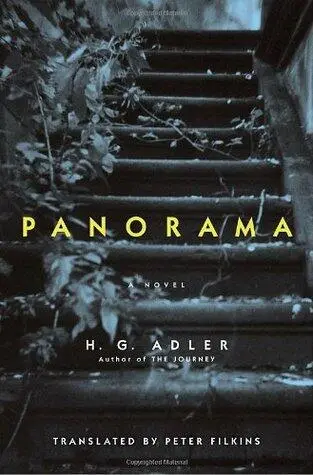
- Название:Panorama
- Автор:
- Издательство:Random House
- Жанр:
- Год:2011
- ISBN:нет данных
- Рейтинг книги:4 / 5. Голосов: 1
-
Избранное:Добавить в избранное
- Отзывы:
-
Ваша оценка:
Panorama: краткое содержание, описание и аннотация
Предлагаем к чтению аннотацию, описание, краткое содержание или предисловие (зависит от того, что написал сам автор книги «Panorama»). Если вы не нашли необходимую информацию о книге — напишите в комментариях, мы постараемся отыскать её.
, and a direct literary descendant of Kafka.
When
was discovered in a Harvard bookshop and translated by Peter Filkins, it began a major reassessment of the Prague-born H. G. Adler by literary critics and historians alike. Known for his monumental
, a day-by-day account of his experiences in the Nazi slave-labor community before he was sent to Auschwitz, Adler also wrote six novels. The very depiction of the Holocaust in fiction caused furious debate and delays in their publication. Now
, his first novel, written in 1948, is finally available to convey the kinds of truths that only fiction can.
A brilliant epic,
is a portrait of a place and people soon to be destroyed, as seen through the eyes of young Josef Kramer. Told in ten distinct scenes, it begins in pastoral Word War I — era Bohemia, where the boy passively witnesses the “wonders of the world” in a thrilling panorama display; follows him to a German boarding school full of creeping xenophobia and prejudice; and finds him in young adulthood sent to a labor camp and then to one of the infamous extermination camps, before he chooses exile abroad after the war. Josef’s philosophical journey mirrors the author’s own: from a stoic acceptance of events to a realization that “the viewer is also the participant” and that action must be taken in life, if only to make sure the dead are not forgotten.
Achieving a stream-of-consciousness power reminiscent of James Joyce and Gertrude Stein, H. G. Adler is a modern artist with unique historical importance.
is lasting evidence of both the torment of his life and the triumph of his gifts.
Panorama — читать онлайн бесплатно полную книгу (весь текст) целиком
Ниже представлен текст книги, разбитый по страницам. Система сохранения места последней прочитанной страницы, позволяет с удобством читать онлайн бесплатно книгу «Panorama», без необходимости каждый раз заново искать на чём Вы остановились. Поставьте закладку, и сможете в любой момент перейти на страницу, на которой закончили чтение.
Интервал:
Закладка:
The boys in the room have been resting for a bit, and when they see all the groceries their eyes brim with joy, after which the stove is quickly lit, Josef begins to make a hearty soup, and when he discovers that he didn’t get any margarine Simon gives him a little chunk of fat, though tomorrow they’ll have to make sure not to forget margarine when they go to Kopřiva, while in the meantime sweet corn pudding is prepared. The wood provides a steady fire, the stove is excellent, and so the food is soon done, there being a lot of it, though no one worries that any will be left over, for everything is divided up and consumed. How quickly and easily they have arranged their own accommodations here, some saying how fantastic it all is, and that they want to keep doing the same. None of Josef’s colleagues think about sneaking out the way they did yesterday, and although they are all very tired, each also feels very content, his bond with the others strengthening, his depression waning. Josef thinks his comrades will get used to it all, nor will Sajdl eat them up, they just need to be strong and keep their heads and not dwell upon their cares too much. Josef doesn’t need to tell them to get some rest, for they are happy to do so on their own.
Simon still wants to talk to Josef and says, “My hands are clearly going to be ruined here. I play the violin. My hands will get too stiff from working. Already my fingers feel like clumps. I couldn’t play a scale even if I tried.” Josef wants to comfort him, for certainly you can’t play the violin after such work, but in two or three years Germany will have lost the war, you have to be patient until then, while in the meantime it makes no sense to keep dwelling on the future. Simon agrees, though he cannot believe that the war will last only another two years, Germany is much too strong, and if it goes well it could last four years, and by then with or without forced labor the Jews will be finished, they won’t be allowed to live in such half-free manner as they do here in Wirschenowitz for long, because it’s only a transitional period. Simon has a cousin who has it on good intelligence that bad things are being planned for the Jews, and that they will be shut up in large camps and supposedly all sent to Poland, and whoever doesn’t die in the process will be threatened with pogroms and hunger, the families ripped apart and destroyed, sick and old and weak people certainly having no chance of survival. Simon’s greatest fear is that his father was taken as a hostage in Pilsen at the start of the war and was never let go, and that he is sitting in a German camp called Buchenwald, his mother continually afraid, for now that Simon is no longer with her she is alone with her aging mother, the father having run a busy practice as a skin doctor, the best specialist far and wide, he being a wonderful man, somewhat quiet but full of good humor. He made the most wonderful toys for Simon, none of the ones for sale half so beautiful, he once having built a medieval castle out of wood, complete with towers and battlements, and painted splendidly, while he had also taken such joy in Simon’s progress with the violin, such that he came to pressure the boy a bit, saying that he must become a violinist, because he had what it takes, while the father loved to comment on Simon’s playing, even though he wasn’t a trained musician himself, he not understanding the expressive aspects of the violin, but rather the technical problems, such that Simon learned as much from him as from all his teachers. It’s almost a year since he was arrested, yes, in fourteen days it will be a year, and he’s only rarely allowed to write and very little, though they are valiant letters, he knowing marvelously how to conceal what he means to say, though the mother and son know exactly what he means to say, he telling the mother to be brave, for Simon to study hard and play his violin in order to improve, though it’s been months since he’s been able to, since he had to work in a factory during the day, and at night he had to help his mother, he being able to practice only on the weekends.
“I’m afraid that I’m finished with the violin for good. I don’t even have it with me here. It would be ridiculous. I wouldn’t risk taking my good violin along, and the bad one … No, it’s just better that I don’t have one at all.” Josef reminds Simon that he’s still very young, and he has a long time to decide whether or not he will become a violinist, so he shouldn’t burden himself now, for these days it’s easy to get lost in plans for the future, but he should still live for his music, and think about beautiful, uplifting works inside. It’s especially in times like these that you question whether art is worth anything and, should you not want to make it, that doesn’t mean that life comes to a standstill, for life is what the living value most, it can be willingly sacrificed out of dignity, but no price can ever be placed upon it, and even amid forced labor you don’t sacrifice your dignity, for it’s what allows you to endure. This helps Simon to think about how his father would handle matters, he no doubt suffering much worse conditions than anyone in Wirschenowitz. Josef reminds him of the hard work ahead of them tomorrow, that he needs to get some sleep, and that they will remain friends and will spend many hours togther on Sundays, after which they say good night.
The week marches on, the digging up of the area of turf nears an end, after which the heavier work begins, though it’s not too strenuous, especially when the weather is good. Josef gets better and better at his work, it showing in the fact that Rybák is not constantly angry, Josef is not yelled at the way many of his colleagues are, while Sláma also remains friendly, and he is beginning to know everyone in his group by name. Josef has had a salve for rheumatism sent to him, one that’s tried-and-true, and he gives it to Sláma for his wife, the former thanking him very much, saying that he knew Josef was a doctor, and if the salve helps Josef will get a hefty slab of bacon. Soon a bed is laid for the light train, as they dig up the ground with their picks and wheel the wheelbarrows, the extra clumps of earth are broken up with picks in order to shovel them into the train barrows, Sláma demonstrating how to handle the iron barrows, they needing to be filled properly and guided along planks, otherwise if they slide off the wheel presses straight into the soft earth and is hard to pull out, though no need to worry, it will all work with a bit of care and attention. Guiding the wheelbarrow up a narrow, wobbly plank and adroitly tipping it over above is harder, Josef often losing control of the barrow and spilling his load, it then taking a few minutes to fill the barrow again, though Josef is hardly annoyed but instead finds it funny, for he can’t take the building of the railroad seriously, the track a ridiculous project that has no purpose whatsoever, the progress of the building even more ridiculous yet, for there is hardly any coordination of the work at hand, which could be utilized for quite different purposes if the Conqueror weren’t so maddeningly fixated on shoving around the people he oppressed.
Josef notices a boy who is clever and dreamy and exceptionally handsome, who works quickly and easily, even though he is delicate and fragile, he remaining noticeably clean, Josef not having seen anyone among Sláma’s crew who got neither his clothes nor his hands dirty, even his boots are not as dusty as the others, Karl Peters his name, his daintiness and his graceful movements causing him to be laughed at in the beginning, though now hardly anyone even pays attention. Once during the lunch break Josef seeks out Karl and begins to have a conversation with him, which is not easy to do, for Karl is quite shy and keeps somewhat to himself, although he’s indeed friendly to everyone and very agreeable to work with. Karl explains that he is treating his stay in the work camp like an extended school vacation of uncertain length. “That’s how I’ve come to think of it. I don’t let myself be affected by what goes on around me.”—“But you are nothing more than a forced laborer.”—“Of course, but I don’t let myself be conscious of it. I don’t want to go crazy. Everyone is crazy these days. I don’t like to get caught up in psychological problems. I want to stay normal.”—“But you can’t separate yourself from your surroundings.”—“Unfortunately, not completely, though to some extent. Many things I simply choose not to see, they don’t exist for me.”—“Do you think that you’ll be able to survive that way?”—“I don’t know whether I’ll survive. None of us knows that. But I won’t let up so long as I’m alive.” Karl works with his eyes half shut, he being quite sure of himself, even when he’s moonily lost in a dream. Josef has never come across him on the path from work and learns from him that he doesn’t follow the path the whole way, for it only reminds him more than necessary of the labor he’s forced to do, which he shies away from wherever it occurs, instead having discovered a wonderful path that leads toward Wirschenowitz through dense woods, all you have to do is cross a bridge in Najdek and then head right, it taking a couple of minutes longer, though you hardly ever encounter another person and don’t have to stumble along over the railroad ties. It pleases Josef as well and he also begins to use this path, but not every day.
Читать дальшеИнтервал:
Закладка:
Похожие книги на «Panorama»
Представляем Вашему вниманию похожие книги на «Panorama» списком для выбора. Мы отобрали схожую по названию и смыслу литературу в надежде предоставить читателям больше вариантов отыскать новые, интересные, ещё непрочитанные произведения.







Обсуждение, отзывы о книге «Panorama» и просто собственные мнения читателей. Оставьте ваши комментарии, напишите, что Вы думаете о произведении, его смысле или главных героях. Укажите что конкретно понравилось, а что нет, и почему Вы так считаете.