H. Adler - Panorama
Здесь есть возможность читать онлайн «H. Adler - Panorama» весь текст электронной книги совершенно бесплатно (целиком полную версию без сокращений). В некоторых случаях можно слушать аудио, скачать через торрент в формате fb2 и присутствует краткое содержание. Год выпуска: 2011, Издательство: Random House, Жанр: Современная проза, на английском языке. Описание произведения, (предисловие) а так же отзывы посетителей доступны на портале библиотеки ЛибКат.
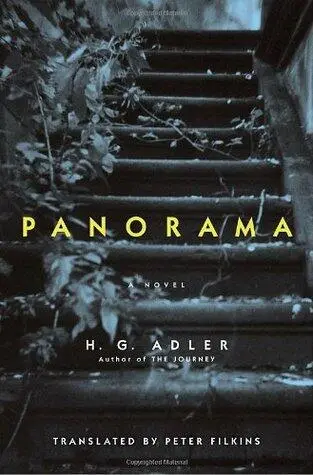
- Название:Panorama
- Автор:
- Издательство:Random House
- Жанр:
- Год:2011
- ISBN:нет данных
- Рейтинг книги:4 / 5. Голосов: 1
-
Избранное:Добавить в избранное
- Отзывы:
-
Ваша оценка:
Panorama: краткое содержание, описание и аннотация
Предлагаем к чтению аннотацию, описание, краткое содержание или предисловие (зависит от того, что написал сам автор книги «Panorama»). Если вы не нашли необходимую информацию о книге — напишите в комментариях, мы постараемся отыскать её.
, and a direct literary descendant of Kafka.
When
was discovered in a Harvard bookshop and translated by Peter Filkins, it began a major reassessment of the Prague-born H. G. Adler by literary critics and historians alike. Known for his monumental
, a day-by-day account of his experiences in the Nazi slave-labor community before he was sent to Auschwitz, Adler also wrote six novels. The very depiction of the Holocaust in fiction caused furious debate and delays in their publication. Now
, his first novel, written in 1948, is finally available to convey the kinds of truths that only fiction can.
A brilliant epic,
is a portrait of a place and people soon to be destroyed, as seen through the eyes of young Josef Kramer. Told in ten distinct scenes, it begins in pastoral Word War I — era Bohemia, where the boy passively witnesses the “wonders of the world” in a thrilling panorama display; follows him to a German boarding school full of creeping xenophobia and prejudice; and finds him in young adulthood sent to a labor camp and then to one of the infamous extermination camps, before he chooses exile abroad after the war. Josef’s philosophical journey mirrors the author’s own: from a stoic acceptance of events to a realization that “the viewer is also the participant” and that action must be taken in life, if only to make sure the dead are not forgotten.
Achieving a stream-of-consciousness power reminiscent of James Joyce and Gertrude Stein, H. G. Adler is a modern artist with unique historical importance.
is lasting evidence of both the torment of his life and the triumph of his gifts.
Panorama — читать онлайн бесплатно полную книгу (весь текст) целиком
Ниже представлен текст книги, разбитый по страницам. Система сохранения места последней прочитанной страницы, позволяет с удобством читать онлайн бесплатно книгу «Panorama», без необходимости каждый раз заново искать на чём Вы остановились. Поставьте закладку, и сможете в любой момент перейти на страницу, на которой закончили чтение.
Интервал:
Закладка:
Haschke is not satisfied with this, continuing to complain about his lot in life and about his family, though this time Johannes interrupts him, saying, “Once a person knows how to be alone, then he knows how to be at home anywhere. You accomplish nothing by being so self-indulgent.” Then Haschke is quiet a moment, but since no one else says anything to break the silence he feels uneasy and must speak again, continuing his same grumbling as he tells about a visit to the theater, where he saw a group from India that danced to its own musical instruments, a kind of gamelan with a lovely gong that would have delighted Johannes, as well as everything else, since it was all so intuitive and not so formal like the players that the Europeans dance to, but instead concentrated, like the Bhagavad Gita , which Johannes loves so, the dancing in fact religious, a kind of yoga, everything having been explained in the program, which Haschke will bring with him next time so that Spiridion can have it for his collection. Haschke had also thought that he always wanted to dance, so after the theater he tried it at home in front of the mirror, using the Indian dancing as a model, though in his own way, for he believes, as Johannes says, that one should always follow one’s own path, and because he wanted to properly study dance he wants to have a Greek costume made out of an old throw that his aunt has promised him and which now decorates her piano. Haschke is indeed waiting for the day when he can dance for Johannes and the other members of the group, the spotlight turning on him, the regular lights turned off, he already asking that Johannes play the gong as always, for Haschke will dance to each and every tone.
During this story the group has begun to relax and return to the normal run of things, at which Yolanda speaks up and says, “You’re right, Haschke. That’s a good idea about the dancing.” But Johannes says, “The only proper dance is silence and stillness. Why do you always want movement and agitation? Learn for once to remain motionless.” The painter adds, “Dance cannot achieve the spirituality of other arts, because it is, as it were, a bodily art. Every body must relieve itself and is full of nasty substances. Thus it’s a mass in which nothing august can exist. That’s why I’m no fan of dance. If I understand Meister Eckhart correctly, namely the passage that Johannes read to us, then I understand that the wonder that one should remain caught within lies in the works that we perform, such as, as it were, my paintings. Dance is also seductive, because it wishes to transcend this need. It is a science that too easily manifests itself.” Spiridion agrees, saying, “You’re right, Master Ringel. I think dance is the expression of unfulfilled desire.” Schorschl then interrupts to say, “When you really love a girl, I mean, when you are really dedicated to someone, then it doesn’t matter if you dance with her. It’s simply a comfortable diversion, and you can still remain on your path. My mother always says that you can dance if you are a respectable person. She herself danced with Papa, and nothing happened. Isn’t that so, Mama?” Yolanda is somewhat embarrassed by Schorschl’s really childish talk, he being at least two years older than Thomas and Josef, but she says good-naturedly, “Whatever makes a person respectable cannot be bad, just as long as you don’t forsake your honor and remain respectable.”
During this Herr von Flaschenberg has pulled out his poem and waited for a good while in order to have an audience to read it to without having to cut off the conversation about dance, and so he speaks up during the pause that occurs after Yolanda’s explanation about respectability, saying that every work of art can be grasped much like dance, especially poetry, so he would like to read his about the electrical, it perhaps being a bit late, since for a good poem one can’t be too tired, otherwise it’s too hard to follow. He then begins to declaim elaborate dactyls with deep pathos so loud that Johannes gives several signs for Spiridion to rein himself in, though after a couple of verses his voice begins to swell again, until Johannes finally speaks up and says, “We’ll disturb the neighbors!” Then the poet tries to quiet down, but there really is no stopping him. The poem begins with the creation of the world, the Lord separating light and dark and then expelling the first man and woman from the Garden of Eden, such that upon the earth all things great and small are emblems, only man being so crude as to think of them in materialistic terms, although he can find no base matter, as it is always ever more apportionable, until it disappears, leaving pure energy in its stead, which is a divine or cosmic stream, the sharpest of eyes seeing without the aid of physics that there is no matter, but only the appearance of matter, for everything is an image of the spirit, every machine being alive as well, even when it doesn’t have a streetcar to run, the great mystery being electricity, now appearing powerful as a flash of lightning, and at other times mellow as polished amber as it attracts metal shavings or passes through a tortoiseshell comb that a girl uses to comb her hair until fine sparks are given off which one can see in the dark. Strong and weak currents point to the macro- and microcosmos, together which make a single All, in the middle of which stands man, who looks at both the larger and the smaller worlds, arming his eyes with ground lenses in order to penetrate the mysteries of both worlds, harnessing electricity in order to protect against its dangers, Prokop Diviš having protected us from lightning before Ben Franklin, Thomas Edison surpassing both when he enabled a carbon filament to glow so that people from the mightiest palaces to the poorest shacks could use lights, which then spread across all countries like a fraternal network, power stations churning it out, a society formed through electricity and, so that all people can find one another within it, Werner von Siemens and František Křižík developed the electric streetcar, a subtle current generating enough power for a heavy wagon to move as it hurries through the city clanking and whooshing along. There is no more august occupation than that of streetcar driver as he stands before his lever box with his hand on the lever by which he increases or lessens the current through small adjustments in order that the wagon travels slow or fast, though if the driver thinks of his occupation in a funny way, he is a conqueror of chaos who out of the city’s cauldron conveys the workers, teachers, and mothers to their destinations, their eternal homes, the conductor being the driver’s trusted sidekick who sells all the passengers their tickets and calls out the stops, in order that everyone knows how much of the journey has passed, while if one thinks of the driver as the father and the conductor as the mother of the streetcar, then the passengers are the children, who are taken care of reliably in any kind of weather, the wagon a safe refuge, the driver and conductor in charge, the rails indicating a secure pathway, the issuing of tickets an emblem of the daily sharing of bread. Still, man’s creation is childish and unaware, and it remains unconscious and innocent of what the poet sees, and who fathoms the emblem’s meaning, and so the passengers travel safely as at the beginning of Creation and before the Fall, driver and conductor representing the ancient original couple expelled by the Lord from the Garden of Eden, and which will remain on earth until the end of days, when the Lord once again unites light and dark amid a blessed cosmos.
The poem is not met with overwhelming applause, some seeming tired, it having lasted too long for everyone, some suppressing a tired yawn, though most indeed say that it pleased them, as Yolanda asks with great interest, “Spiridion, will the poem be in your next book?” To which he replies, “Of course. I don’t write poems that aren’t publishable.” Yolanda adds, “That’s good, Spiridion. Your poem is quite lovely. But one needs to read it a few times in order to understand it all.” Haschke disagrees, saying, “Oh, it’s clear as day! It’s heavenly! If only I could do the same! You have created poetry like a fire-breathing Prometheus!” Herr von Flaschenberg corrects him, “Fire-stealing Prometheus.” He in fact wants to explain further to Haschke, but Ringel wants to weigh in with his thoughts, and says, “The poem certainly has an elaborate structure. Perhaps it’s a bit overdone, if you allow me. But in truth it’s very modern.” Spiridion explains, “I thought about the content a great deal. I wanted to express the flow of the electricity and to make the roar of the streetcar palpable. I thought of Verlaine’s violin poem, in which everything is built around the sound of ‘O.’ But Verlaine, and also Wildgans in his cello poem, made it easy on themselves, for they wanted only to elicit the sound of music. They succeeded, but it’s too naturalistic and not really symbolic. One needs to show with such a theme that everything is spiritual.” Thomas then raises a few objections, saying that for him the repeated images are somewhat strained, and that in his opinion the poem doesn’t manage to capture actual reality, at which point the poet interrupts to say, “Thomas, my young friend, you just try to write such a poem yourself! You couldn’t do so if you had a year, and I wrote it in a single evening! That’s not easy. But for critics it is. Look around at poetry today and tell me where you know of a poem like it. Walt Whitman would have applauded me, but he is most likely the only poet who would be able to grasp my boldness.” Spiridion turns from Thomas in a huff and says to Josef, “If you’re his friend, tell him how hard it is. I hope you understand me better than he does.” Then Herr von Flaschenberg turns to Johannes, saying, “So what do you think? Don’t you want to say how much it pleased you?” Johannes replies, “I think poems should express inner simplicity. Quiet as a snowflake and deep as a raindrop.” At this, Spiridion wants to hear no more.
Читать дальшеИнтервал:
Закладка:
Похожие книги на «Panorama»
Представляем Вашему вниманию похожие книги на «Panorama» списком для выбора. Мы отобрали схожую по названию и смыслу литературу в надежде предоставить читателям больше вариантов отыскать новые, интересные, ещё непрочитанные произведения.







Обсуждение, отзывы о книге «Panorama» и просто собственные мнения читателей. Оставьте ваши комментарии, напишите, что Вы думаете о произведении, его смысле или главных героях. Укажите что конкретно понравилось, а что нет, и почему Вы так считаете.