H. Adler - Panorama
Здесь есть возможность читать онлайн «H. Adler - Panorama» весь текст электронной книги совершенно бесплатно (целиком полную версию без сокращений). В некоторых случаях можно слушать аудио, скачать через торрент в формате fb2 и присутствует краткое содержание. Год выпуска: 2011, Издательство: Random House, Жанр: Современная проза, на английском языке. Описание произведения, (предисловие) а так же отзывы посетителей доступны на портале библиотеки ЛибКат.
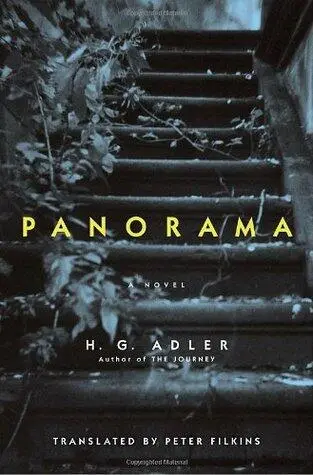
- Название:Panorama
- Автор:
- Издательство:Random House
- Жанр:
- Год:2011
- ISBN:нет данных
- Рейтинг книги:4 / 5. Голосов: 1
-
Избранное:Добавить в избранное
- Отзывы:
-
Ваша оценка:
Panorama: краткое содержание, описание и аннотация
Предлагаем к чтению аннотацию, описание, краткое содержание или предисловие (зависит от того, что написал сам автор книги «Panorama»). Если вы не нашли необходимую информацию о книге — напишите в комментариях, мы постараемся отыскать её.
, and a direct literary descendant of Kafka.
When
was discovered in a Harvard bookshop and translated by Peter Filkins, it began a major reassessment of the Prague-born H. G. Adler by literary critics and historians alike. Known for his monumental
, a day-by-day account of his experiences in the Nazi slave-labor community before he was sent to Auschwitz, Adler also wrote six novels. The very depiction of the Holocaust in fiction caused furious debate and delays in their publication. Now
, his first novel, written in 1948, is finally available to convey the kinds of truths that only fiction can.
A brilliant epic,
is a portrait of a place and people soon to be destroyed, as seen through the eyes of young Josef Kramer. Told in ten distinct scenes, it begins in pastoral Word War I — era Bohemia, where the boy passively witnesses the “wonders of the world” in a thrilling panorama display; follows him to a German boarding school full of creeping xenophobia and prejudice; and finds him in young adulthood sent to a labor camp and then to one of the infamous extermination camps, before he chooses exile abroad after the war. Josef’s philosophical journey mirrors the author’s own: from a stoic acceptance of events to a realization that “the viewer is also the participant” and that action must be taken in life, if only to make sure the dead are not forgotten.
Achieving a stream-of-consciousness power reminiscent of James Joyce and Gertrude Stein, H. G. Adler is a modern artist with unique historical importance.
is lasting evidence of both the torment of his life and the triumph of his gifts.
Panorama — читать онлайн бесплатно полную книгу (весь текст) целиком
Ниже представлен текст книги, разбитый по страницам. Система сохранения места последней прочитанной страницы, позволяет с удобством читать онлайн бесплатно книгу «Panorama», без необходимости каждый раз заново искать на чём Вы остановились. Поставьте закладку, и сможете в любой момент перейти на страницу, на которой закончили чтение.
Интервал:
Закладка:
As promised, the worker wakes the pack on time, each of the boys gathering together his several things and all of them shuffling sleepily through the morning mist across the empty platform to the train, the air fresh and damp, most of them soon perking up, the Wanderers having the entire car of an almost empty train to themselves, as it heads off through the dusky countryside, many of them stretching out again and dozing some more, the older ones sitting up or standing at the window to marvel at the dawning day, except for the always-sleepy Fabi, the area both stark and lush at the same time, long lakes branching out into reedy, undulating swamps, dreamy forests standing motionless in between, and everything quiet beneath the light of the rising sun. A half hour before the next change of trains the sleepers are awakened, because Alfred wants them all to eat something, since they have a long day ahead of them, though there is nothing hot to drink, all the Wanderers refusing to carry a thermos, most having some cold tea in their canteen which is still lukewarm, which to no one but a real Wanderer tastes any good. Then it’s time to get off and endure another layover of about an hour, Alfred and Willi making sure that anyone who makes use of the water fountain makes sure to pay attention to the signs that say ONLY FOR DRINKING! and NOT FOR WASHING! after which many faces and hands are cleansed of soot, all of them completely black from the journey, FHF comically announcing, “The heroes from Landstein at the Castalian Spring, but not on Parnassus!” Meanwhile Hans tells FHF that he’d do better to make sure not to splash any around, for it’s not water for washing but precious drinking water. At last all the boys are refreshed and bright-eyed, it being good that they’re done, for a rail official arrives and asks whether any of them can read, to which Alfred responds in an exceptionally polite and peaceful manner, “Yes, we can all read.” At this the official laughs heartily, flashing Alfred a dark look, after which the official turns on his heels and disappears, the rest prowling around for a bit before getting onto the narrow-gauge train.
Everyone by now is in a good mood and joking around, as excitedly the Wanderers admire the surrounding countryside, those who already know Landstein telling the others, “Just wait till you see the camp for the first time, as well as the mountain and Sichelbach Lake!” In the train are a couple of people from Adamsfreiheit, Alfred asking them where the baker is located, who the best grocer is, and so on. The train rolls on like a snail for almost two hours, the manager of the station and his helpers surprised to see such a pack of young men get off, all of them happy that the journey is over. Alfred and Willi inquire immediately if the crates have arrived, and hear that, yes, they arrived just fine, a driver from Adamsfreiheit saying that he had to pick up something in Markl the next morning and that he could swing by with the empty wagon and pick up the crates if someone sent two strong boys to the station early, and that it would be an honor to do it without charging the Wanderers. This all arranged, the pack heads off laughing and singing, the little ones a bit tired, their knapsacks having to be carried by others, the older ones somewhat uncomfortable now with a knapsack hanging from each shoulder. Soon they reach Leinbaum, where a farmer asks if the boys want some milk, the Wanderers not hesitating for a moment as they stretch out on the edge of the road across from the farmer’s yard to rest, drink some milk, and eat something as the farmer introduces himself as Herr Hunger. Hans is glad they can order milk from Herr Hunger each day, but Alfred says it’s too far to walk to Leinbaum each morning, it being easier to get milk in Sichelbach or Markl.
Willi recommends that they get moving, there being still lots to do that day, the younger boys also now excited as they soon reach the cool forest, having decided to pay a quick visit to Ranger Brosch, the ranger’s house lying in a clearing amid a large meadow, some plowed fields, and a duck pond, where they again take a short break as Alfred and Willi and Hans go up to the house, though Hans comes right back out to yell, “Boys, quick! Frau Brosch has made lunch for us!” No sooner are they all inside with their bags and packs than FHF wants to know how big the district really is that Ranger Brosch oversees, though Alfred doesn’t give FHF much time with him, for he thinks it’s more important to speak with the ranger himself. Frau Brosch apologizes that she doesn’t have enough place settings for twenty-four people, for though there is enough room, there aren’t enough plates, Alfred reassuring her that the Wanderers have their own camp plates and are used to using them, though Frau Brosch says all the same, “Still, it’s bad hospitality!” Then they all say that she shouldn’t worry about it, and as the ranger comments that when it comes to food the stomach matters a lot more than the plate, his wife still insists that at least the older boys should eat off her plates, at which the rest say as one, “Everyone is equal among us Wanderers!” Willi adds, “Please don’t treat us any differently.” She understands, yet she continues to insist that Alfred, as the oldest, should eat from her dinnerware, otherwise she will be insulted, to which he finally gives in. A huge bowl with thick potato soup is then brought in, it tasting wonderful as it is quickly served up to all, everyone thinking this is the entire meal, for it’s so rich and satisfying, but then the main course arrives, dumplings with sauerkraut and bits of bacon and gravy soon filling their bellies, as they lick up every last bite, which satisfies the ranger’s wife.
By now it’s high time they were on their way, though Herr Brosch wants the troop to stay and sleep in the hayloft for a couple of days or at least a night, during which time they can set up the tents, but Alfred turns down the offer with such gratitude that the Brosches are much impressed and don’t press the matter any further. Instead, the ranger only offers to accompany them to their campsite in order to show them a shortcut, which he points out on a map. The offer is accepted with pleasure, Josef already convinced that the ranger is no philistine. They then march off, the ranger wanting to carry the littlest one’s pack, though this boy, known as Pony, is not at all weak and ever so proud, as he tells Herr Brosch that every Wanderer has to be able to make his own way and not take any help from others, at which the ranger laughs, as they all happily hike to the campsite, where they throw off their packs, and Herr Brosch shows Bambus the nearest flowing spring and makes him promise that the Wanderers will take good care of it, making sure to protect everything they encounter in such a natural setting, to which Bambus answers in a dignified manner, “If everyone took care of things the way the Wanderers do, then the world would be a much better place, nor would there be any reason to besmirch a forest with ugly notices warning what not to do.” Herr Brosch then smiles and wishes them all a nice time and a pleasant stay, shakes Alfred’s hand, and says a warm goodbye.
Now the Wanderers are at last alone, most of them stripping off their clothes down to their shorts, some checking out the surrounding area, others wanting to clean up and head down to the creek to figure out where to set up a dam so that they have a place to wash where the water will reach up to their knees, and where the pots can be cleaned, and though everything will take time, a real Wanderer never complains about anything, some of them resting as FHF comes down to announce, “The travelers have reached their land. The holy line of the knights of Landstein lives once again. A new page in the history of the heroes is opened.” Josef says to Alfred, “We’ve never had a better site, have we?” Alfred agrees and replies that it’s good that a line of trees separates the site from the meadow below, for that way they won’t be bothered by gnats, while Willi, glancing at his watch, says, “We need to call the others, for it’s high time to start pitching the tents, otherwise the little ones will be too tired.”
Читать дальшеИнтервал:
Закладка:
Похожие книги на «Panorama»
Представляем Вашему вниманию похожие книги на «Panorama» списком для выбора. Мы отобрали схожую по названию и смыслу литературу в надежде предоставить читателям больше вариантов отыскать новые, интересные, ещё непрочитанные произведения.












Обсуждение, отзывы о книге «Panorama» и просто собственные мнения читателей. Оставьте ваши комментарии, напишите, что Вы думаете о произведении, его смысле или главных героях. Укажите что конкретно понравилось, а что нет, и почему Вы так считаете.