Joseph McElroy - Women and Men
Здесь есть возможность читать онлайн «Joseph McElroy - Women and Men» весь текст электронной книги совершенно бесплатно (целиком полную версию без сокращений). В некоторых случаях можно слушать аудио, скачать через торрент в формате fb2 и присутствует краткое содержание. Год выпуска: 1987, Издательство: Knopf, Жанр: Современная проза, на английском языке. Описание произведения, (предисловие) а так же отзывы посетителей доступны на портале библиотеки ЛибКат.

- Название:Women and Men
- Автор:
- Издательство:Knopf
- Жанр:
- Год:1987
- ISBN:нет данных
- Рейтинг книги:4.33 / 5. Голосов: 3
-
Избранное:Добавить в избранное
- Отзывы:
-
Ваша оценка:
Women and Men: краткое содержание, описание и аннотация
Предлагаем к чтению аннотацию, описание, краткое содержание или предисловие (зависит от того, что написал сам автор книги «Women and Men»). Если вы не нашли необходимую информацию о книге — напишите в комментариях, мы постараемся отыскать её.
McElroy rests a global vision on two people, apartment-house neighbors who never quite meet. Except, that is, in the population of others whose histories cross theirsbelievers and skeptics; lovers, friends, and hermits; children, parents, grandparents, avatars, and, apparently, angels. For Women and Men shows how the families through which we pass let one person's experience belong to that of many, so that we throw light on each other as if these kinships were refracted lives so real as to be reincarnate.
A mirror of manners, the book is also a meditation on the languagesrich, ludicrous, exact, and also Americanin which we try to grasp the world we're in. Along the kindred axes of separation and intimacy Women and Men extends the great line of twentieth-century innovative fiction.
Women and Men — читать онлайн бесплатно полную книгу (весь текст) целиком
Ниже представлен текст книги, разбитый по страницам. Система сохранения места последней прочитанной страницы, позволяет с удобством читать онлайн бесплатно книгу «Women and Men», без необходимости каждый раз заново искать на чём Вы остановились. Поставьте закладку, и сможете в любой момент перейти на страницу, на которой закончили чтение.
Интервал:
Закладка:
He stopped, and then he went on. On the far sidewalk she looked around her — everywhere except behind her. And then she went into his cafe. He called to her, but she went on inside. The way she had looked around uncertainly, she hadn’t planned to go to the cafe. What had she planned for the evening?
He would surprise her, but when he crossed the avenue and came to the takeout window and saw that the Puerto Rican woman hadn’t come on yet, Linda was at the door and stepped out onto the sidewalk and shook her head at him, smiling.
"They don’t have a pay phone," she said.
‘They don’t?" he said.
‘There wouldn’t have been anyone home."
"I hope not," he said. "I should get a machine."
They looked each other in the eye. He invited her in for coffee. "How did you wind up behind me?" she said. "Your face looks funny."
He didn’t like that. "I went down to my old pay phone to phone you."
"Why’d you do that?" she asked. "I was trying to catch up with you."
"Did you phone the police?" John asked.
Of course not; the Departed Tenant wasn’t dangerous. He had been phoning earlier, when John was there, to tell her he had reclaimed his hammer, he needed it, he was on his way at last.
"With his master key," said John. But he didn’t know.
She was having the lock changed tomorrow. John told her to see if she could have the key registered. She had thought of that.
"Fair exchange — a quilt for a hammer."
"Not a great quilt, but after all the hammer was his to begin with," she said, and she kissed him very lightly. He felt his heart race.
"The quilt went with the bed," he said.
"It stayed," said Linda.
"He must like you a lot to leave you the quilt."
"I think he liked her a lot. The girl from upstate. The quilt went with the bed."
"But not the hammer," said John. "Hammers are expensive if you’re an itinerant carpenter going to New Mexico."
"I think he loved her," said Linda.
"Will he show people your picture on his way west?"
"What would he say, I wonder?" said Linda.
John produced the picture from his inside jacket pocket. She looked from the picture to him and back again. She was pleased. "I knew it," she said, surprised. She put her hand on his shoulder, and they both looked at the photograph. "This makes better sense," she said. "When I left for work yesterday, there were two pictures. Now they’re all accounted for."
"If that guy had taken one — I mean as a souvenir — there would still have been one left for me," said John. "By the way, the hammer certainly wasn’t on the bed table, so the Departed Tenant must have been and gone."
"What were you doing in my apartment in the middle of the day?"
"I’m a degenerate," John said. "But you gave me the keys."
"I’m particular who I give them to," she said. "Didn’t you know that? No wonder you’re not married."
"Not even half married?" he asked.
She touched his hand. "No, not even half married. Unless it’s someone I don’t know about."
They decided not to have coffee after all. On the way back to Linda’s they discussed the Departed Tenant. Had he really, as he’d said, hoped to keep the apartment and sublet it to someone but couldn’t get permission? Whatever had been going on, they agreed that he had meant well. They agreed that he had moved out of the apartment because he had to.
Larry
The word one heard was "homework," heard sitting at one’s somewhat small but new and not-cheap old-fashioned roll-top desk, the only word one heard aware that one’s mother was leaving was "homework," not "housework." Her last sentence (oration in espahol, a language for New York and for today, one’s father has assured one, for today’s complex horizons while the bilingual subway skips the horizon and goes under it) was heard only in that last word "homework." Like she’s been speaking in some next room.
Well, she had been. And with one’s erstwhile father. But like soundproofed with the door closed, and she seemed to throw it open for that last word homework which now therefore (though no echo) felt chock-a-block with housework, the code-word key-word clearing the voice-print of one’s mother’s ongoing discussion if that was the right word with one’s father who was in the habit of settling pre-contract differences with her out of court until it was too late for any kind of contract. Except, well, you know, a contract. Marriage contract. For a kind of new marriage.
Upon which both together seemed to laugh and she said low in this direction not the phone’s, "Oh Marv you know what I’d really" — succeeded by a murmur, and if not any more a liquor snicker or a courting snort at least a fickle chuckje and a pretty heavy sigh—"You look radiant!" — that came together into Jne untranstonguable impact in the next room the sincerity of which one did not wish to witness, having failed oneself to receive the incoming phone call (failed to make it one’s own, failed to will that it be from Amy), while forced to witness one’s parents in the next room in any case or along any curve clothed or unclothed, because one had acknowledged one’s existence by answering the "homework"-ending sentence "Yeah" (the cornerstone of one’s active vocabulary yet not one’s private).
Well then, ‘‘ Yeah," one answered, letting it slide off into the other things to be said to one’s mother or for that matter to one’s father if one had found the thoughts to go with those things. Not "Yeah, Ma" or "Yeah, Mom," which she, naked or dressed, nude or unnuded or denuded, objected to, but not "Yeah, Susan" (which she wants) either, because one does not feel right saying "Susan," which one’s Dad quite understands, and which one undertook to explain to him one Sunday morning amid much nodding of heads, first his, then one’s, then his and his again and yet again, then out of pity one’s own — out of pity or in time to Dad’s rhythm, one’s own head together or not quite, yet not with his then or now because often these days of raised consciousness he is too busy nodding, naked with one’s mother nodding, nodding, naked together spooning yogurt together, spooning, dripping a blob of white-filmed apricot like it had a cottony mold on it off the end of his yogurt spoon, nodding so as to transcend one’s own "Yeah" in answer to one’s mother’s mysterious oration depicting the life of her leader like that explained fathers and husbands, climaxed by the word homework, not assignment.
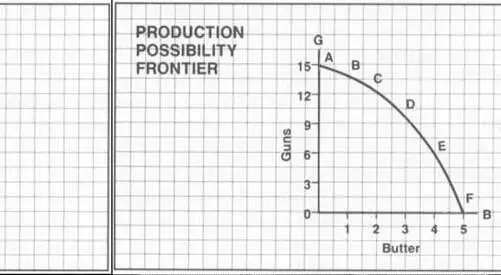
But one says assignment —one is in the big league if not big time, no longer in high school where assignment was also said, but college, for one is on the production-possibility frontier fully employed trading off guns and butter or highways and housing along all the points between no butter and all guns (dry) and no guns and all butter (sticky), the frontier (also called product-transformation curve) along whose arc are targeted all the points of well-oiled trade-off whereby one may surrender so many guns to get so much added butter or produce ten less butters to get two more guns, and on this menu of choices, this curve of output pairs — two million tons of food to fourteen million tractors, four million to twelve, six to ten — on this range of combinations, a week or more may be spent in the big time, the big league, firing one’s rounds of animal fat (leading one’s moving target) while spreading one’s arms as wide as there’s bread to spread them on, staying busy on the production-possibility frontier, not falling away inside it where point U marks the warning flash for Unemployed Resources, big lag, let’s say.
Интервал:
Закладка:
Похожие книги на «Women and Men»
Представляем Вашему вниманию похожие книги на «Women and Men» списком для выбора. Мы отобрали схожую по названию и смыслу литературу в надежде предоставить читателям больше вариантов отыскать новые, интересные, ещё непрочитанные произведения.









Обсуждение, отзывы о книге «Women and Men» и просто собственные мнения читателей. Оставьте ваши комментарии, напишите, что Вы думаете о произведении, его смысле или главных героях. Укажите что конкретно понравилось, а что нет, и почему Вы так считаете.